Team Buffalo
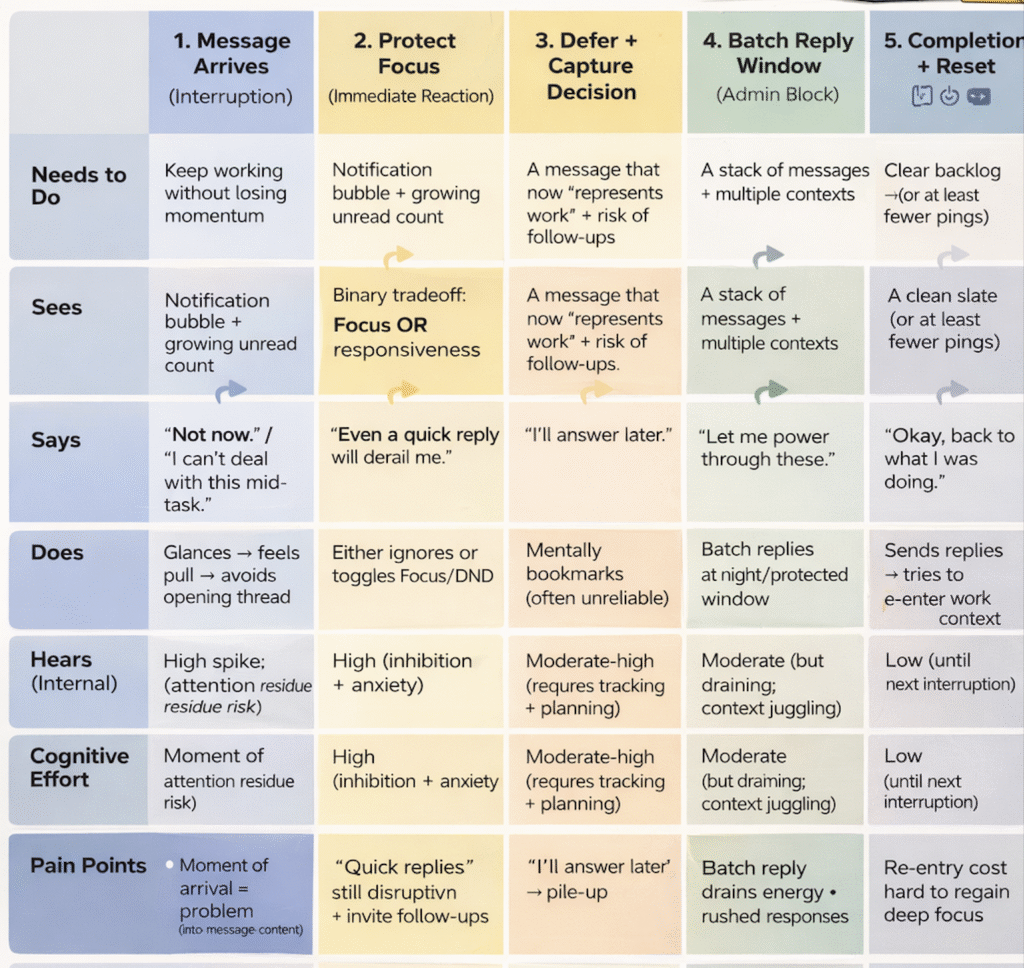
Vector has a hard time doing tasks in the middle of work, or context switching to another task. He avoids responding because replying breaks focus, and he needs to allocate separate time to batch respond, bad at multi-tasking, even low-effort replies are disruptive. Key behavior observed: avoidance due to how hard it is to context switch, occurs at the moment the message arrives not because of the message itself. Tradeoff feels binary when message arrives: focus or responsiveness, not both
Behavioral Persona
| Drawing | Name | Vector (Mr. Can’t Context Switch) |
| Activated Role | Mechanical Engineering Student (Busy, Goal-Driven, involved with a lot of time consuming clubs) | |
| Goal | Uphold all responsibilities for his studies/major, deliver on his extracurricular responsibilities, have time for interesting hobbies, and make time for his close relationships. | |
| Motivation | Wants to be seen as reliable and “on top of it,” both academically and socially. Protects deep work quality, as he cares about output, not just checking boxes. Tries his best to avoid letting people down; responsiveness feels like part of being a good teammate/friend. Has an intense fear of small delays becoming big consequences such as missed deadlines, missed plans, and missed opportunities. Values autonomy heavily where he wants to choose when he engages, not be pulled by notifications. | |
| Conflict | Vector has a hard time doing tasks in the middle of work, or context switching to another task. He avoids responding because replying breaks focus, and he needs to allocate separate time to batch respond, bad at multi-tasking, even low-effort replies are disruptive. Key behavior observed: avoidance due to how hard it is to context switch, occurs at the moment the message arrives not because of the message itself. Tradeoff feels binary when message arrives: focus or responsiveness, not both | |
| Attempts to Solve | “I’ll answer later” -> messages pile up and later feels worse
Batch replying at night -> helps briefly, but drains energy and replies get rushed. Do Not Disturb / Focus mode -> improves productivity, but increases anxiety about missing something important. Quick acknowledgements -> reduces guilt, but invites follow-ups and still breaks flow. Mentally bookmarking -> unreliable and he forgets or procrastinates because nothing external captures it. Overcompensating later (long apology + long reply) -> adds effort and reinforces the sense that replying is costly. |
|
| Setting/ Environment | Often finds himself in environments of deep work such as the library, lab, dorm desk, late-night problem set grind, CAD/design workshops. Other times, he’s in club environments such as meetings, build sessions, slack-heavy coordination periods. Transition zones are walking between buildings, waiting for class, and commuting. High-friction contexts include debugging, writing reports, solving multi-step math/physics, and working on designs. | |
| Tools | iPhone notifications from iMessage, WhatsApp, email, and Slack/Discord. Tools to avoid responding immediately are focus modes, Do Not Disturb, Calendar blocks. To help respond at the end of the day, he uses totes/to-do app (inconsistently used for message capture) | |
| Skills |
|
|
| More | The avoidance happens at the moment the message arrives, not because the message is hard. The biggest pain is activation energy where starting the reply is the hardest part. He applies a two step response process. Step 1: ultra-low-effort acknowledgement and setting expectations (“I saw this and I will reply at 6”). Step 2: batched full replies during a protected admin block |
Journey Map