
Intervention Study Ideas
Idea 1: Nudge Calling
Description
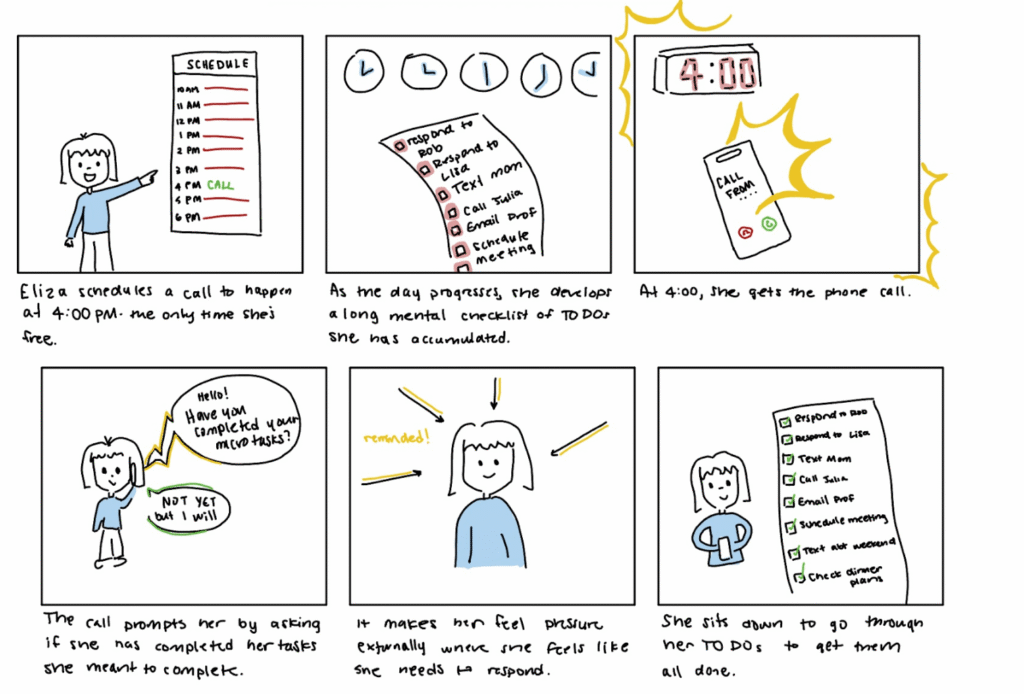
Participants will send us a time that they choose each day when they would be free to receive a call. At that time, we will send them a call, prompting them by asking if they have completed all of their microresponsibilities and reminding them to complete all of the delayed ones. This call, once a day, is a source of external accountability and a structured moment to initiate the behaviors of responding and catching up on delayed tasks each day.
This intervention attempts to serve the difficulty in initiating the barriers to do tasks and serves as a nudge reminder to complete them.
Storyboard
Pros
- Strong external social accountability that feels like a social commitment/check-up each day, making it harder to delay tasks
- Prevents forgetting responses by acting as a verbal reminder each day, and prevents avoidance
- Creates a structured response time within a busy schedule to dedicate to responses
Cons
- The call may feel like external pressure that can feel burdensome or unwanted
- The singular call may not be efficient if the call is ignored
- “Best call times” change each day, so if the chosen time doesn’t align with the actual availability and capacity of the participant, the intervention may not be effective
Idea 2: List Tracker
Description
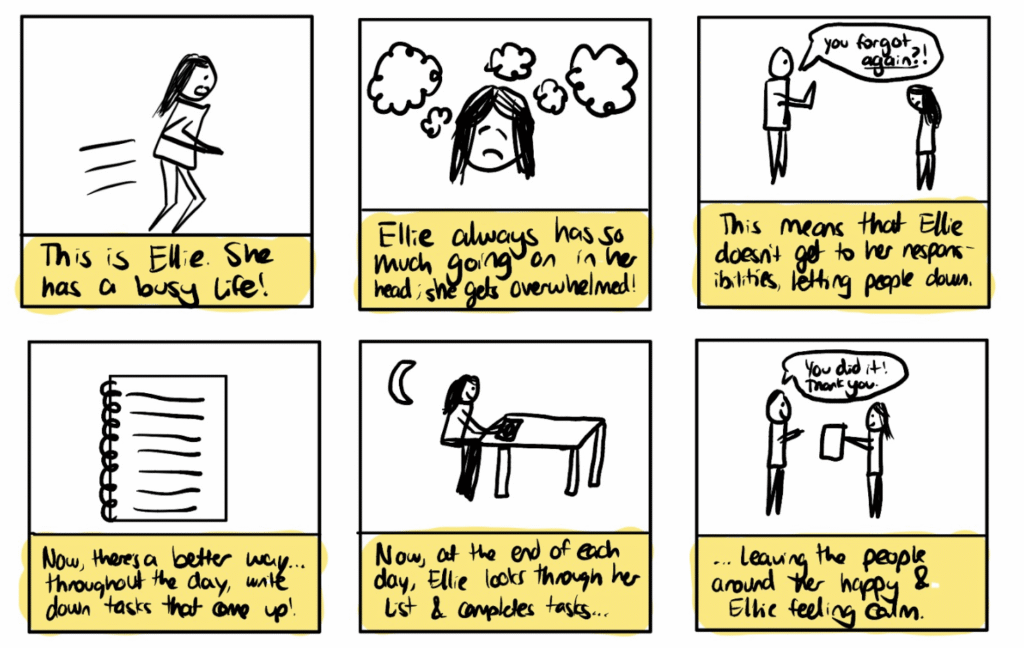
Participants will maintain a daily list of micro-tasks somewhere that’s easily accessible, such as a notebook or the iPhone Notes app. Throughout the day, they’ll add any tasks that come up to this list. Oftentimes, the participant won’t be able or willing to complete these tasks immediately, so they use this list as a reminder. At the end of the day, they look through this list and take 10-15 minutes to get through the tasks.
This intervention attempts to reduce the overwhelming feeling that people get when facing microresponsibilities, which often causes them to push them off. By asking them to simply write them down, this intervention aims to clear up the mental clutter that these tasks cause.
Storyboard
Pros
- By writing tasks down and getting it out of participants’ minds, this directly tackles and reduces mental clutter.
- This is a very simple method which doesn’t require difficult adoption to a new technology.
- This method is flexible and can be adapted to different types of lifestyles, microresponsibilities, etc.
Cons
- Sometimes when a task is assigned, it’s not socially acceptable to immediately write it down (in a conversation, in class, etc.). Hence, by the time the participant gets the chance to take note, they may have forgotten the task already.
- By the end of the day when the participant is supposed to get through the list, they may be exhausted.
- Participants may forget or may not want to note down every task they come across.
Idea 3: AI Response Generator
Description
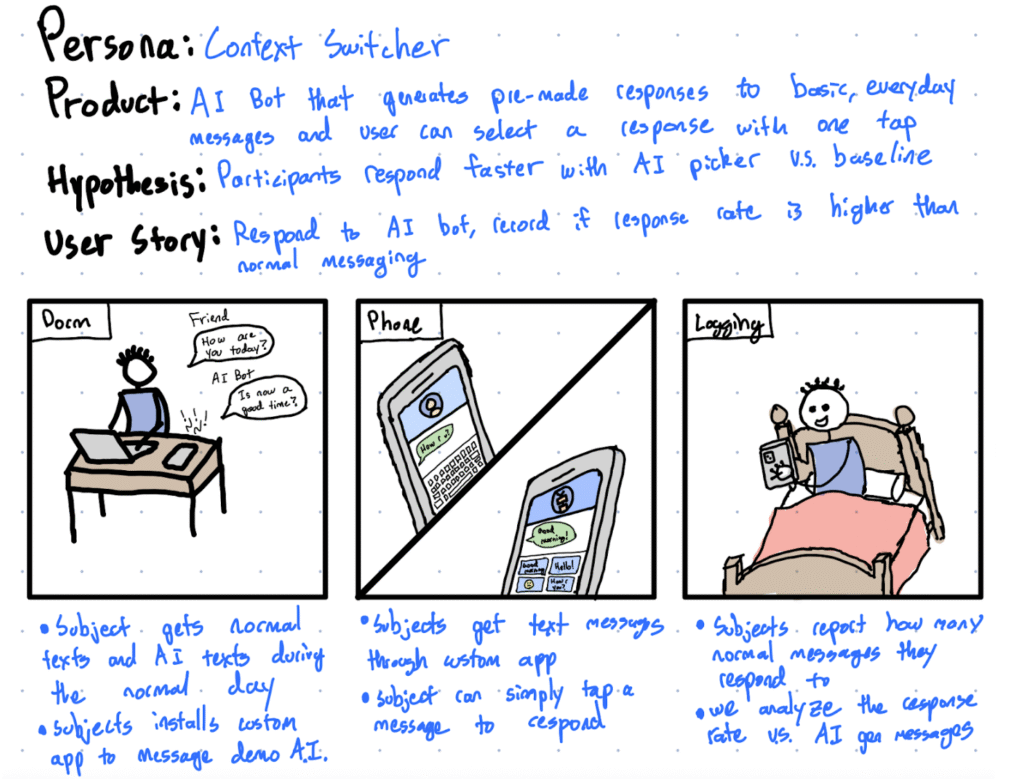
Participants will use two messaging modes across the study period. Firstly, they will use their normal texting workflow as a baseline along with a custom messaging app that generates four AI written replies for each incoming message, where the participant can respond by tapping one option (no typing required unless they want to edit). The core comparison is how often and how quickly participants respond in baseline vs the AI-picker condition. This is especially crucial during moments when responding normally would require a costly context switch.
Storyboard
Pros
- Measurable outcomes are easy to quantify, which are response rate, time to response, and backlog size across baseline vs AI-picker
- Also preserves focus, reduces attention residue because the user avoids opening the full thread and generating follow-ups
- Suggested replies to us can be short, polite, and closing-the-loop by default generated by the AI
Cons
- Users may hesitate to send an AI reply if it feels it might commit them to something unintended
- For sensitive conversations, one-tap options may feel impersonal or inappropriate
- Users might stop practicing quick response habits and become dependent on the tool
Intervention Study
Research Question: Does a daily accountability call at a self-selected time increase the completion rate of delayed micro-responsibilities (texts, emails, small tasks) among college students, and what aspects of the nudge (timing, social pressure, reminder itself) drive or hinder task completion?
Study Design: 5-Day Intervention (Monday–Friday, Week 7)
Participants: 5 total (3 returning from baseline, 2 new participants)
Daily Protocol
Morning (via text, ~30 seconds for participant): Each participant texts your team their preferred call time for that day. This lets them adjust daily rather than locking in one time that might not work. They would just reply to a text like: “Hey! What time works for your check-in call today?”
At their chosen time (~3–5 min call): A team member calls and walks through a short script:
- “How’s your day going?” (brief warmup, ~30 sec)
- “Do you have any texts, messages, or small tasks you’ve been putting off today?”
- “What’s stopping you from doing them right now?”
- “Can you do one of them right now or in the next 30 minutes?”
- “Great, I’ll check in tomorrow. Good luck!”
Log the call immediately after (team member fills out a quick internal tracking sheet)
End of day (via text, ~1 min for participant): One text asking: “Quick check-in — did you get to any of those tasks after our call? Reply Y/N and a sentence about what helped or got in the way.”
That’s it for daily participant effort. Morning text + take a 2-min call + one evening text.
Data Collection Plan
1) Logistical Data (tracked by your team per call)
- Call time requested vs. actual call time
- Whether they picked up (yes/no/callback)
- Number of pending tasks they mentioned
- Whether they committed to doing one on the call
2) Content Data (from evening text + post-study interview)
- Self-reported task completion (Y/N)
- What helped or blocked them (their words)
- Feedback to the call (captured in post-study interview)
3) Post-Study Data (end of Day 5 or Day 6)
- Post-study interview (15–20 min, required) OR a post-study survey(Google Form) if scheduling is difficult
- Focus areas: Did the calls change their behavior? Which calls were most/least effective and why? Did accountability feel motivating or pressuring? Would they want this to continue?
For returning participants, we will directly compare: “During the baseline study, how many tasks did you typically delay vs. now?”
Study Materials and Protocol
- Participant Introduction Document
On Sunday evening prior to the start of the study, each participant will receive a one-page introduction document outlining the purpose of the study, the daily protocol, and logistical expectations. This document will explain that the study aims to evaluate whether a short daily check-in call can help participants stay on top of small, frequently delayed tasks. It will walk participants through the daily structure (a morning text to select their preferred call time, a brief check-in call, and an evening follow-up text), confirm the five-day duration from Monday through Friday.
- Pre-Study Interview Guide (New Participants Only)
The two new participants will complete a brief pre-study interview (~5 minutes) over the weekend before the study begins. This interview is designed to establish a baseline understanding of their current habits and attitudes around micro-task completion. Questions will cover the types of small tasks they tend to delay (such as texts, emails, or errands), what typically motivates them to eventually complete those tasks, how they feel when tasks accumulate, and whether they have prior experience with external reminders or accountability from others.
- Daily Call Script
Each check-in call will follow a short, semi-structured script to ensure consistency across participants while maintaining a warm, conversational tone. The caller will open with a brief personal check-in, then ask whether the participant has any texts, messages, or small tasks they have been putting off. The script will prompt the caller to ask what barriers are preventing completion, whether the participant can commit to completing one task within the next 30 minutes, and will close with a brief note of encouragement.
- Team Tracking Sheet
The research team will maintain a shared Google Sheet to log data from each daily interaction. Columns will include Participant ID, Day, Requested Call Time, Actual Call Time, Whether the Participant Picked Up (Y/N), Number of Tasks Mentioned, Whether the Participant Committed to Action (Y/N), Evening Check-In Response, and any additional notes. This sheet will serve as the primary source of logistical and behavioral data throughout the study, and will be filled out by the team member conducting the call immediately after each interaction to ensure accuracy.
- Post-Study Interview Guide
Upon completion of the five-day intervention, each participant will take part in a post-study interview lasting approximately 15 to 20 minutes. This interview will explore how participants experienced the daily calls overall, whether specific days felt more or less helpful and why, and whether they believe they completed more tasks than they typically would have without the intervention. Participants will be asked to reflect on which aspect of the call had the greatest impact on their behavior, whether that was the reminder itself, the sense of accountability to another person, or having a designated time to address their tasks. They will also be invited to suggest changes or improvements to the intervention. Returning participants from the baseline study will additionally be asked to compare their behavior and experience during this study to the baseline period.
- Closing Text Message
Following the post-study interview, each participant will receive a closing message thanking them for their time and contribution to the study.



