Overview
Our mission this quarter is to help people wear sunscreen more often. As a result, we set out to explore existing solutions in both the sunscreen / skincare space as well as general habit creating solutions.
Sunscreen-specific apps
1. UVLens App
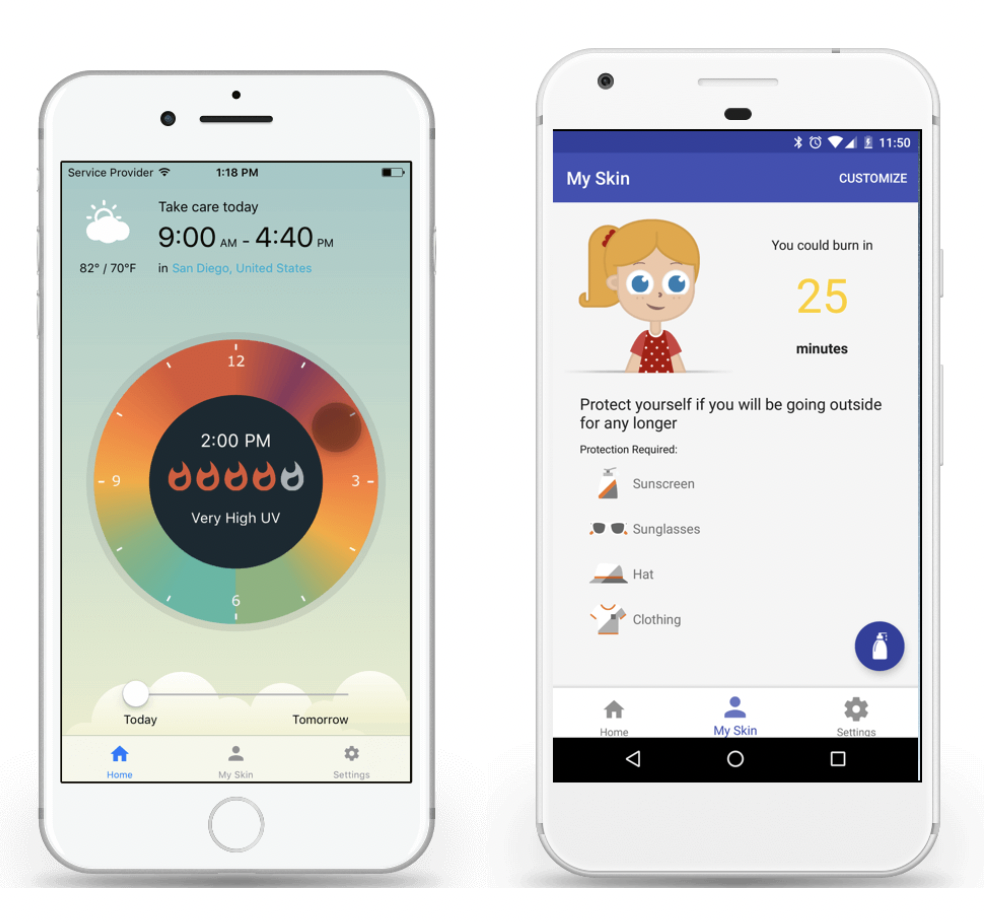
UVLens is a free skincare app that lets you find out in which location sun intensity is the strongest. It determines your UV index per house wherever you are by using readings of the amount of sunlight collected from hundreds of weather stations (taking into account the atmosphere). With daily updates, you may use it to identify the ideal sunscreen for your skin type (done through a skin type survey). This software will offer more precise and individualized guidance on how much sun you can handle. Additionally, it notifies you when you need to reapply. This app is targeted towards anyone who wants to go outside.
Strengths: Caters to all skin types, specific data, time sliver of one day, mobile so people can check per hour, recommends personalized activities and information based on user’s sunscreen SPF and user-inputted activity. Also reminds users when they need to reapply.
Weaknesses: user interest driven, interface did not give a modern design and felt as if the app’s layout was not thought out. 12 hour clock is an unintuitive and confusing representation of a 24 hour day
Opportunities to Improve On:
- More targeted towards users who are already concerned about the UV radiation that they’re getting and want to become even better informed. Does not capture as much the group of people who aren’t as concerned about UV radiation and/or are not as informed about the effects / don’t use sunscreen
- We can perhaps focus on educating the users can motivate them to keep on using the app
- UV index may sound like jargon to the layperson
- Skin type surveys may be challenging + add friction–how do users know what skin types they have?
- Accessibility–do users have access to the best sunscreen for their skin?
2. Mii Skin
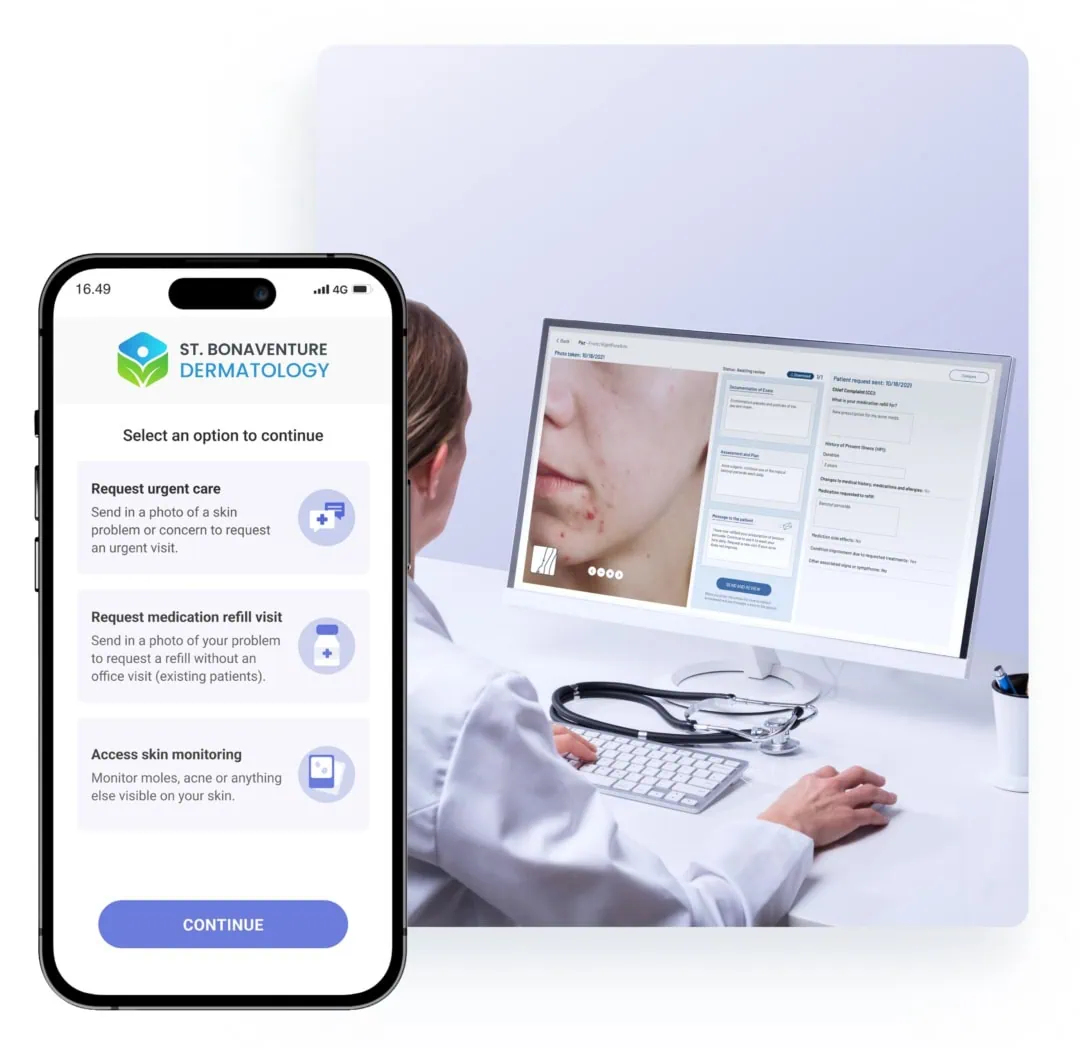
Miiskin offers a secure and HIPAA-compliant skin health platform for research organizations, health systems, and independent dermatology practices; it consists of a patient app and clinical web portal. To assess the effects of UV rays and other aging-causing factors, it evaluates the appearance of your skin. The app scans your skin images and uses AI to find the areas that are changing over time. It allows you to monitor your skin’s appearance and see what you’re doing right and wrong. Additionally, you can measure your level of sun exposure and choose the ideal time to apply sunscreen using the UV meter that is integrated into the app. This app is targeted towards healthcare providers and their patients, with less of a focus on users trying to start new skincare habits independently.
Strengths: HIPAA-compliant, research and medical professional driven, an app and a web platform makes it accessible to many different users, provides specific and personalized information on how your skin is changing, provides UV data and a specific time on when you should apply
Weaknesses: invasion on personal privacy (photos of self), requires a provider, you are giving up your data to a platform and research
Opportunities to Improve On:
- This platform is also not necessarily meant to help users form new skincare habits, as it is focused more on monitoring skin health.
- This app, similar to the first one, requires the user to already be concerned about the effect UV rays have on their skin, as this app must be used over a certain amount of time
- Education about skin effects can be just as important for users to understand why UV rays have certain effects
- Scanning skin has certain limitations, really dependent on algorithm that is being used
3. Trove Skin

Trove Skin is a free app that measures the health of your skin and monitors how it reacts to stress, the sun, and other variables as you may be changing your skincare routine. A photograph of your skin is scanned by the app, which then examines elements including pores, dark spots, wrinkles, and skin firmness. You are then given a customized skincare recommendation. By logging in daily to compare the improvements over time, you can establish your skin objectives and monitor the changes. Additionally, based on your skin state, the app makes individualized skincare product recommendations. In addition you can log all products and track your routines with reminders, track your entire beauty stash, as well as track lifestyle and habits to see how they affect your skin.
Strengths: all in one platform, can run data analytics on multiple types of data, seems to focus on those with complex routines or ones that are seeking a more complex tracking system, provides notifications for routines
Weaknesses: seems to have pivoted more towards tracking not providing recommendations from photos, not sunscreen focused, may provide more than people need
Opportunities to Improve:
- We found that the social/accountability factor played a big role in getting people to stick to skincare/applying sunscreen–maybe there’s a way to improve on that here
- Logging can get cumbersome, depends on how willing someone is to even get into the habit
- Similar to the previous app, there could be opportunities to improve regarding the intricacy of the app itself when scanning skin
4. Reapply app
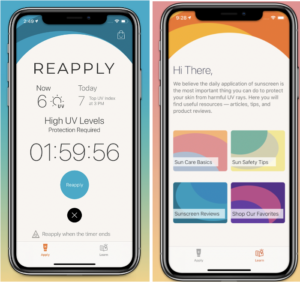
Reapply is a free app that uses AI technology to remind you to apply sunscreen when you’re outdoors. It tracks your UV exposure and suggests when you need to reapply sunscreen. You can set the time that your sunscreen will stay effective against UV rays. So, if you set it to, say, 2 or 3 hours outside, the app will remind you at that time to reapply it. Also, if it’s time to reapply but you forgot to do so, Reapply will send a notification reminder.
Strengths: notification system specific to your needs, customizable, smart reminders based on UV, provides educational material
Weaknesses: one dimensional purpose to just apply sunscreen, no personal recommendations beyond reapplying (for instance, recommendation of good sunscreens)
Opportunities for improvement:
- This requires the user to 1) own sunscreen (not all of our participants did) and 2) be in a place that’s convenient to reapply it (not all of our participants carried sunscreen with them)
- Seems to target the user group that is very adamant about reapplying sunscreen, but could improve on appealing to a wider audience (people who use sunscreen in the mornings only might find the reminders a bit tedious)
5. Sun Index – Vitamin D and UV
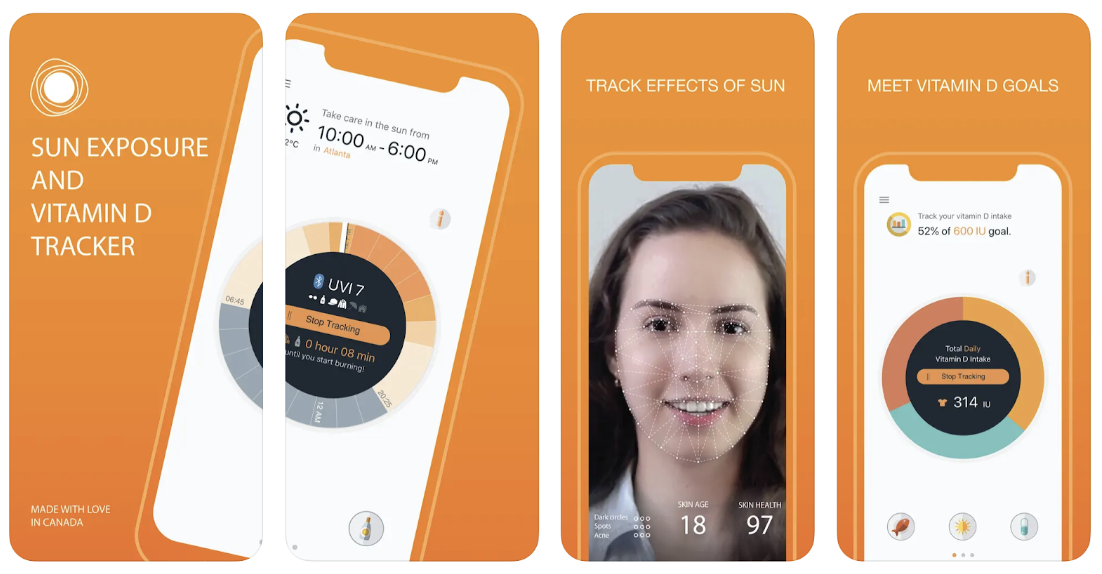
Sun Index provides information to balance sun exposure and vitamin D, avoid sunburns, find the current UV (ultraviolet) index, and get personal sun safety tips for healthy & young skin. It does so by providing information on when it’s time to seek sun protection, and helps you prevent skin aging and skin cancer. It can provide a UV map for any location in the world, push sun safety notifications when the UV index reaches high levels, inform you about how much sunscreen to wear based on size and clothes, scan a sunscreen barcode to help you decide if it’s best for you, as well track skin health scores and moles with your camera and AI technology.
Strengths: serves for two goals, personalized AI skin tracking, personalized sunscreen amount and timing information
Weaknesses: unclear how users can set goals, may be privacy concerns with AI face tracking, no action required on notifications which means they are easy to ignore, unclear how vitamin D goals are determined
Opportunities for improvement:
- Education factor associated with what sun index/UV index means, why it’s important to avoid sunburns
- AI skin tracking might not be completely accurate
6. Sola: Sun UV & Vitamins
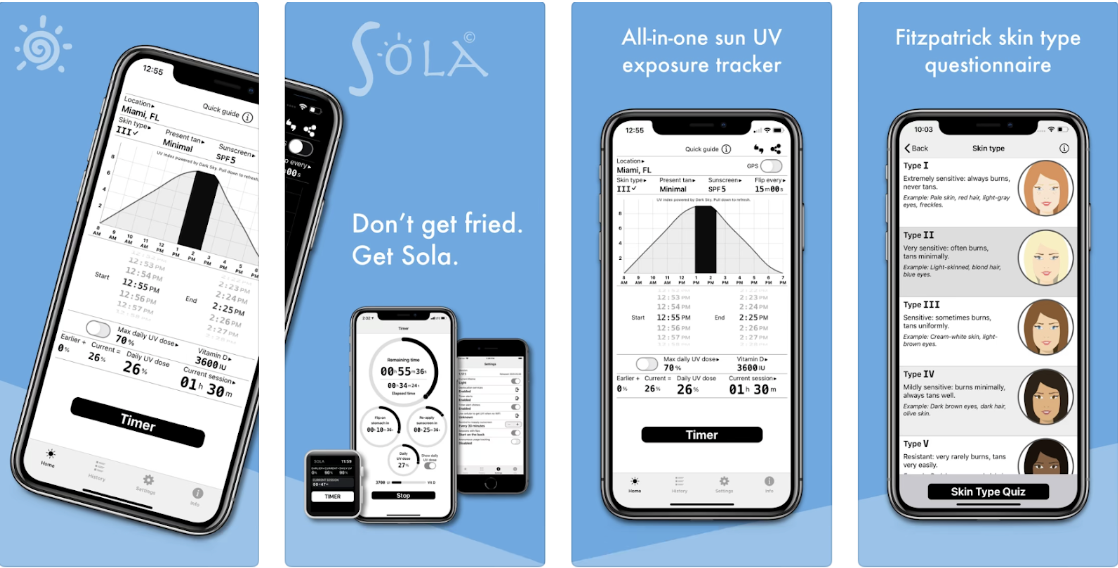
Sola calculates and tracks how much sun exposure a person is getting based on current UV index forecast, skin type, existing tan, sunscreen SPF and whether a person changes sides when they sunbathe. It has a convenient timer that reminds a user when they should reapply sunscreen as well as when to flip over for a person who is sunbathing. Sola integrates with Apple Health app to read a person’s Fitzpatrick Skin Type and to keep track of the UV index that a person is exposed to. It has another feature where it also tracks Vitamin D. Their target audience are users who sunbathe and people who go out in the sun a lot.
Strengths: Added a tracker for Vitamin D which definitely makes this app unique, also has a time for sunbathers to flip over, takes into consideration different types of people to give them the right personalized information
Weaknesses: Seems to just focus on people who sunbathe and go outside a lot; not really for people who don’t do those things. They consider user skin type and UV index forecast but not a person’s health history or if skin cancer runs in their family
Opportunities for improvement:
- Seems primarily focused on the extreme user group: people who sunbathe. There would have to be improvements/modifications made to target people who are out in the sun more generally
- Consider a user’s health history with being out in the sun, family history with skin cancer, etc.
- Also having a means of encouraging the user to head indoors when needed, as staying outside for extended periods of time is not healthy as well
- To improve the user experience on this app it would be best to also consider a user’s healthy history as well as their history with being in the sun to get proper personalizations on them. Also, adding a timer for people who stay inside a lot and encourage them to go outside to get sunlight would be more inclusive for users who do not go out a lot. This would improve the product drastically and allow it to be more inclusive for different types of people.
General reminder apps
We also did an extensive search of general habit-building or tracker apps and found 5 more apps that could be seen as potential competitors
Done is a habit-building app that focuses on the idea of “streaks”. Users can set tangible daily or weekly goals. Done will keep track of “streaks” for meeting goals in consecutive periods. Done also integrates with Apple HealthKit which lets you set and track goals automatically based on your activity. Done is targeted towards users who want to start or break a habit.
Strengths: Allows tracking multiple times a goal a day, unlike competitors. There is also a home screen widget that doesn’t require app usage for monitoring for users who install timer apps and forgets to use it or finds notifications annoying. Sleek, minimal interface
Weaknesses: Widget shows 4 habits at once which is disliked by many reviewers as it gives the impression that just one habit is not enough to build. App also only allows you to track 3 habits for free, and requires payment for more.
Opportunities for improvement
- Where is the motivation for getting started with streaks–maybe having some sort of reward incentive?
- What is the motivation for the user to keep on using the app even after a day of breaking the habit? Streak-breaking can lower morale and disincentivize users to start again
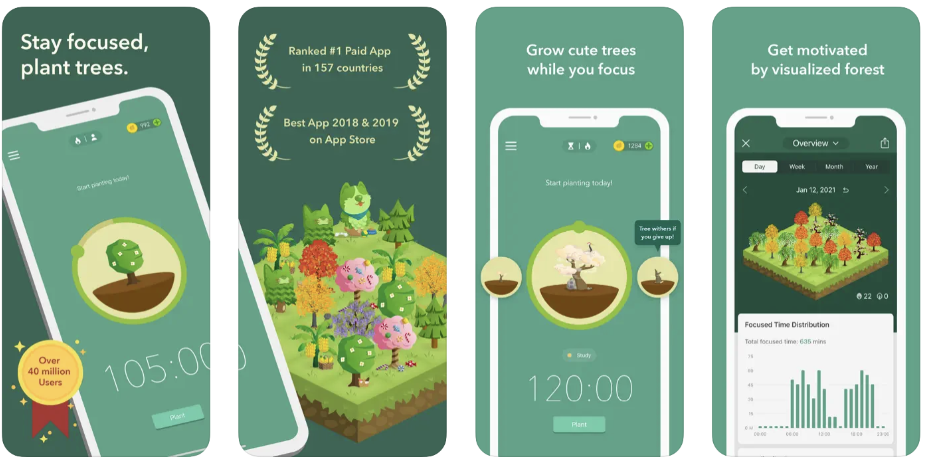
Forest is a timer app that incentivizes people to work by giving them a “visual representation of time” by a growing tree. Users must stop using their phone and focus on their work for a set amount of time to grow a tree, but if they stop halfway the tree dies. Users can grow a virtual forest based on times they have focused, and can also spend coins that they earn by focusing on tasks using Forest to plant trees in real life. Users can also compete with friends and other users. This app is targeted towards users who want to reduce their cell phone usage and focus on work.
Strengths: Gamification of productivity, intuitive user interface that is pleasing to the eye. Helps users to visually see a plant that is a positive reinforcement to them focusing. Definitely accomplishes to goal of helping a user focus.
Weaknesses: Gamification might not appeal in the long run as it can get boring over time. Not ideal for non-study purposes as the concept of growing a plant does not generalize to all habits.
Opportunities for improvement
- This app isn’t necessarily related to forming habits around skincare or sunscreen but we can take inspiration from some of the gamification aspects that this app uses to get users to come back (earning coins to plant trees in real life, building a virtual forest)
- We can implement some sort of reward system for wearing sunscreen every day
- We can build further upon the social aspect present– users can share their achievements with their friends
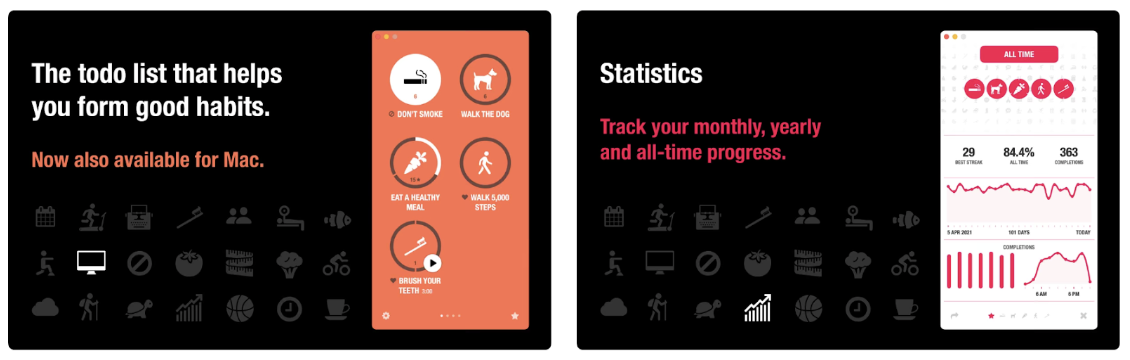
- Streaks: Streaks is a habit tracker that focuses on the idea of finishing a task every day to create a “streak”. Similarly to Done, Streaks can also connect with Apple Watches to automatically track fitness goals. It also allows users to define what days tasks can be done on, in case that they are not able to be done on consecutive days, to avoid breaking the streaks. You can share tasks with friends, to help keep you accountable, and Streaks will also remind you to complete tasks automatically.
Strength: Shared tasks allows users to build a habit with friends for greater accountability and more encouragement for a user to meet their goals.
Weakness: User interface feels a bit intimidating and crowded for beginners. Especially for users who are starting out with building their habits the UI color design is not demonstrating anything positive or encouraging. This is ultimately the reason why this is not actually accomplishing the goal of the users. There’s also no encouraging factors either of this app which would not accomplish the apps goal of helping users their process.
Opportunities for improvement:
- We can build on top of the sharing aspect and find a way to be more social with the friend that you are keeping the habit with
- More fluidity–do you need a friend to have the same habit in order to track it?
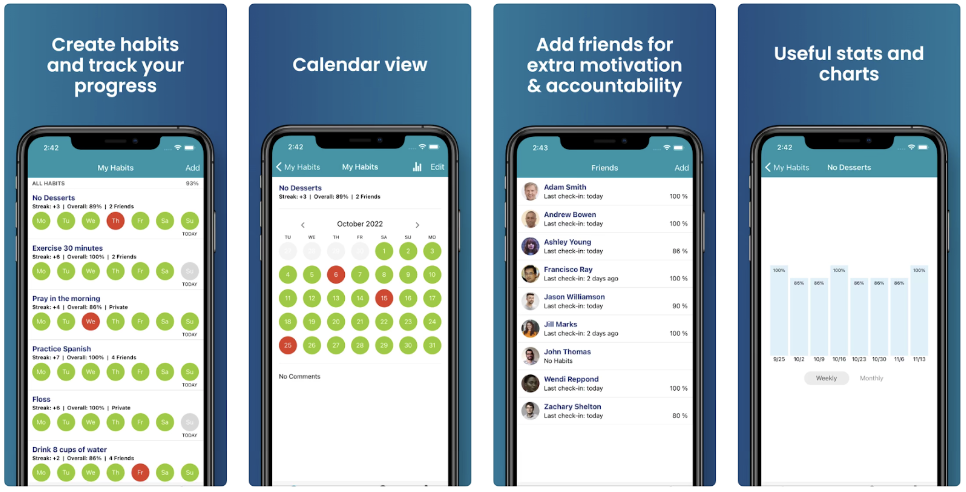
HabitShare: Share habits with friends for extra motivation & accountability. This app allows you to share your habits with yourself or with other friends that a user can add on the app. The purpose of adding friends to the app is because they can see their friends progress and motivate them to keep going. The app allows for users to share motivational gifs like a high five to help their friends stay motivated. The target audience are people who want to stay motivated with their habits and have their friends involved. I think it is also safe to say its for users who are open to sharing their habits with others. This app is unique because it gives users a sense of healthy motivation with their friends. It gives a different form of motivation to get to a users goals.
Strength: Novel use of Qualtrics-like multiple-choice quiz for habit-tracking. Has a social aspect to it for users to add their friends to feel extra motivated and accountable. Contains a virtual chart for a user’s stats as well to inform them of how consistent they have been with their habits.
Weakness: More suited for “power users” of habit-building and not a regular user who is trying to build habits. It also seems to be very tailored to users who want to share their habits with their friends. Some people do not want to share their habits with others which would not result in this app not being very effective for those users.
Opportunities for improvement
- Tracking a habit by using colors (red/green) can discourage users if they have had a lot of red–maybe a different way of tracking instead of using colors
- This is not suitable for color blindness so we would have more inclusive colors

Kinhabits.com: Share habits with a support system to hold you accountable. It allows users to organize and track all of their habits and notes in one place. It utilizes visualizations for users to always see their progress visually. This gives users insights on their behavior patterns. This app also has a community within the app that allows users to share their progress and get encouragement from friends and community. This app is unique because it allows a user to have a community of other users and share their progress on their habits. This sense of community and being accountable gives a very healthy environment. A lot of apps similar to this one do not have that community aspect so the fact that this app has this makes it a very unique app. The target audience is people who have habits that they want to work on regularly. We can even say that the audience are people who are big on self improvement and want to be accountable for their actions to make this change.
Strength: Suitable for starters who would benefit from social support as an added incentive
Weakness: User interface is designed to make people feel as though they need to track many habits altogether. Not suitable for people who are looking for just building a singular habit
Opportunities for improvement
- Some sort of summary per month that highlights your accomplishments for the month? Could take it above the streak level because the user can see a more high-level overview of how far they’ve come
- Scaffolding: For users who want to build one habit at a time, we could rearrange the app’s user interface in a way that does not require filling out 6 circles in order to make the app screen complete
- Privacy + moderation + respect when dealing with a community–how can we maintain respect when people are sharing their habits, which can often be a sensitive topic?
Our differentiation
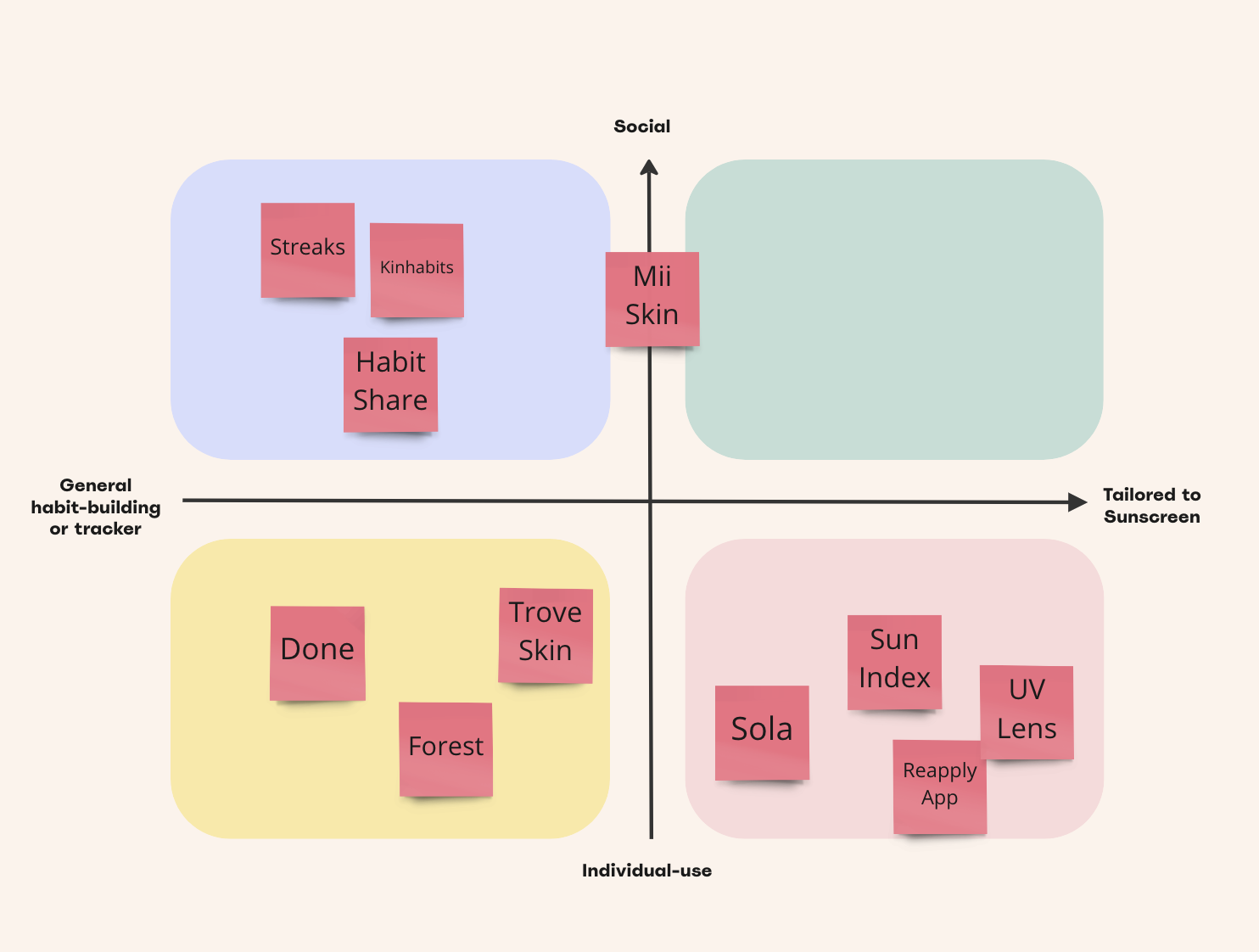
In summary, from this comparative analysis, we found apps that can be categorized on two axes: i) Tailored for sunscreen vs General habit-building/tracking and ii) Social vs Individual-use
[EDIT FROM 4A FEEDBACK] We see that there is an opportunity in the top left quadrant, for social apps that are tailored to sunscreen. We believe that this is a unique area to position ourselves in, as we don’t see anything in the market like it. Social habit-building apps can work, as evidenced by the 3 social habit apps we found, so this would be a good opportunity to create a similar app in the sunscreen space.
Our unique value proposition will be an app that helps you build the habit of applying sunscreen with friend(s). The messaging could be something like: “With our app, you can protect your skin while staying connected with friends. Remind yourself to reapply sunscreen throughout the day, and share your sun-safe moments with friends to encourage one another to protect your skin.”
Users can stay on top of their skin protection while also staying connected with friends and family by incorporating features into a sunscreen-focused app.