
From Individual Change to Systemic Change: Comparing Incentives for the Adoption of Reusable Coffee Cups
After broadly considering individual lifestyle choices that reflect sustainable consumption, the behavior that we’ve honed in on is the use of reusable coffee cups. Specifically, how can we motivate people to use reusable cups—what people and environmental factors make it more likely for us to be willing to give up the perceived convenience of to-go cups? In search of compelling directions to pursue, we’ve looked into a range of existing solutions: from cup borrowing programs to to-go mugs that make your coffee. Below, we document some of our findings for the 10 solutions we found, including their target user, value-adds, and advantages/drawbacks.
Overall, we found that solutions that incorporated raising awareness of sustainability, monetary and/or social incentives, and matched the perceived convenience of to-go cups were strong approaches to the problem. Interestingly, when it comes to monetary incentives it seems that charging people for a disposable cup is more effective than discounts for bringing your own mug.
Comparative Analysis of potential solutions to replace paper/plastic cups:
- Buy a personal mug and leave it in the store (the cabinet idea)
- Store lends you reusable mug and you bring it back next time (not customized per person)
- App that tracks carbon footprint with cups
- Gamified app where you can compete with friends on your coffee footprint
- Charge for plastic cups or reward for bringing in reusable cups
- Third party app present in multiple stores that allows customers to borrow disposable coffee cups
- Smart mug that makes it preferable to bring your own coffee
James Coffee
https://jamescoffeeco.com/pages/reuse
Category 1: Store lends you reusable mug and you bring it back next time (not customized per person)
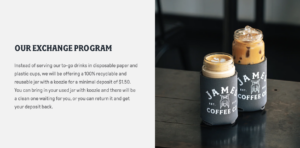
James Coffee The James coffee program aims to reduce coffee cups by serving the drinks in glass jars, where there is a minimal deposit of $1.50. One can bring the used jar with koozie in order to get a clean one the next time or have the deposit returned. The glass jar will come with a koozie and a metal lid, which one can keep and continue reusing it. This program contains a lot of strengths as it addresses several of the key pain points that we heard from coffee drinkers that struggle to use a reusable mug. Their system is easy, and simple, where automatically everyone gets the reusable jar so users do not need to remember to bring one in the first place to the coffee shop. Further, one can still order ahead and get the reusable jar for their coffee, as most of the time when people order ahead they loose the opportunity to use their reusable container, as they need to go into the store and bring their own container in person so that the coffee is served in the personal container. Further, if any of the components no longer work, such as the koozie or lid, it will be an easy swap, which will makes sure that people do not give up on using the product because one of the components is broken. Furthermore, one of the weaknesses of the James Coffee exchange program is that one needs to bring it cleaned and rinsed in order to deposit it back. However, one of the main user’s pain points is having to wash the jar, as it is time consuming and hard to remember. One way our product can resolve this issue is not to require the consumer to wash their jar, instead the coffee shop can have a small system where they can safely and quickly sanitize all returned jars. Another pain point from users is that mugs are easily losable and unfortunately this reusable jar does not meet those needs as it penalizes the user for loosing a jar. One way our product could resolve this, is to have a program that reminds the users to return the jar, so they do not loose the jar nor forget to bring the jar back.
By: Anna Edmonds
Huskee Swap
Category 1: Buy a personal mug and leave it in the store (the cabinet idea)
Category 2: Store lends you reusable mug and you bring it back next time (not customized per person)
Category 3: Smart mug that makes it preferable to bring your own coffee
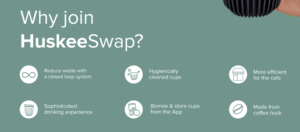
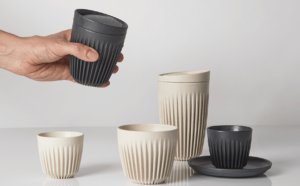
Huskee Swap Huskee is an american company that has recreated how we use cups. They have not only built a more sustainable coffee cup but have also built two different systems, HuskeeSwap and HuskeeLoop, which redesigns the way we consume coffee at coffee shops in a more sustainable way. The Huskee Swap system, is a cup exchange system designed to make reusable cups more convenient and enable cafes to transition away from using single-use disposable cups. The coffee cup systems is free for all users once you have purchased a HuskeeCup and Lid. The sizes are interchangeable at the cafe and are hygienically cleaned by the cafe, which is a substantive strength, as the reasoning why several consumers avoid using their own mugs is because of the cleaning process. There is an app that indicate the coffee shops that partner with Huskee. Further, the cafe can store the mug for you once you are done. This part of the system would be a huge strength as a lot of user’s main paint point was that they had no place to store their reusable mug as well as they were very susceptible to loosing their mug. Hence, given that a lot of people drink their coffee in around 10 minutes or only buy coffee if they are gonna sit down, then having the optionality to leave the cup in the coffee shop is a huge bonus. However, one weakness to this part of the solution is that you can only drink your coffee wherever you leave your disposable mug. Further another weakness with this solution is that there are only specific stores that partner with Huskee, so not every store will clean the Huskee mug and swap it for a freshly clean mug.
By: Anna Edmonds
Minipresso
Category 3: App that tracks carbon footprint
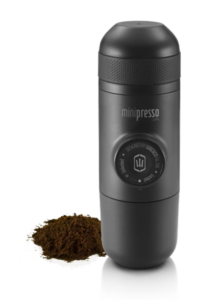
Minipresso is a portable espresso machine that allows users to make their own espresso on the go. As indicated by many of the reviews for the product, this product is great for folks who are camping, on a hike, or in some location where they either can’t buy coffee or don’t want to pay for coffee. For many avid espresso drinkers, the crema of the espresso shot (which fades in about two minutes) is an important element of the coffee drinking experience. Minipresso allows for users to enjoy a shot of fresh espresso regardless of where they are. There are a couple of issues, though—the first being that if you enjoying drinking your espresso with milk, or like any of the fancy drinks that Starbucks offers, this product probably isn’t going to be used as a portable device. It seems that a lot of people actually use it as a cheaper alternative to a home espresso machine. The second problem is that even if you do enjoy espresso on its own, this portable device can only make about 2 espresso shots per tank of water (which you can’t leave in for that long because it’ll cool). Getting a refill of hot water might be kind of difficult depending on where you are…
By: Alanna Sun
Earth Hero
Category 7: Smart mug that makes it preferable to bring your own coffee
 .
. 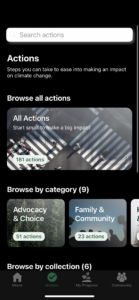
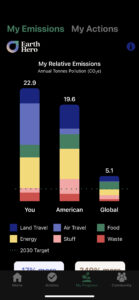
Earth Hero is an app that allows users to track their carbon footprint through lifestyle choices, advocacy, and accountability through a sustainability-oriented community. While this isn’t specifically targeted towards coffee consumption or increasing reusable cup usage, it seeks to help build behavior change in users who want to make more sustainable lifestyle choices. Upon first opening the app, the user is prompted to fill out a few questions about their lifestyle (ie how much do you drive, what kind of diet do you have, etc.). The app creates impact scores around actions that users can take that range from learning about climate change to reducing food waste. The app seems most helpful in its ability to help users set sustainability goals and provide actionable recommendations for achieving those goals. By reminding users of the actions they’ve chosen to commit to, the user can progress in their sustainability journey. There are a few weaknesses to the app, namely that the scoring system is a black box, and the reminders need to be set in advance and the work falls on the user to stay proactive. Furthermore, it seems that the app is rather inflexible in allowing users to create their own actions, perhaps because unrecognized actions cannot be assigned a score on the spot. Overall, it seems to be a high effort, low reward system for users, and sustained engagement with the app will have to be derived from the user’s intrinsic motivation.
By: Alanna Sun
Vessel
Category 6: Third party app present in multiple stores that allows customers to borrow disposable coffee cups
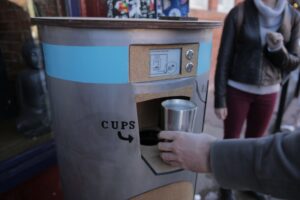
Vessel is a company that ‘leases’ cups (stainless steel to-go mugs with silicone lids) for to customers of subscribed companies for 5 days. The app allows customers to check a cup out at any businesses that has Vessel available by using the cup’s QR code. After 5 days, they can return the cup to any participating location or a Vessel return kiosk. The service is free for customers since Vessel partners with the restaurant, but it requires a smartphone and credit card to use. (A $15 fee is charged for each lost cup; $2 per mug top.) The process was meant to be simple and familiar, especially to those who use services like public bike-sharing. Although Vessel sells directly to the coffee shops (a target market since they must be climate-conscious to adopt), the real users of the service / app are the customers who frequent coffee shops at least 2 times per week to pick up and drop off the cup. The unique aspect of this idea is that there is a low barrier to entry, since the service is free, easy to use, and familiar to other lending services. I think it is very smart that the customers don’t have to pay for the product, as that increases the chances to opt in. Additionally, I like that the service is not constrained to one shop, but a more “universal” solution— for example, I can grab the cup at Starbucks and return at Verve. A weakness that I see is that the aesthetic of the cup doesn’t lend itself to be a super viral product— it is very simple and metallic… in one of the studies in our lit review it was suggested that coffee drinkers don’t enjoy metallic coffee cups because the change the flavor of the coffee. Additionally, I see how customers could get scared of losing the cup and subsequently being charged $17. However, I think that overall, this could be a successful solution, especially because of its relative convenience and it has the potential to attract social status if it becomes a trend to carry your Vessel, like it once did with the Starbucks cup.
By: Michelle Vinoccur
Club Zero
Category 6: Third party app present in multiple stores that allows customers to borrow disposable coffee cups
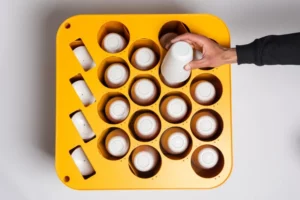
ClubZero is a company which, similar to Vessel, partners with coffee retailers to avoid producing waste out of beverage / food containers. The cups are made of plant-based plastic and any CupClub member can use them when buying coffee at a partnered shop by using a RFID tag. They can later return the cup in a number of locations around the city. Similarly to Vessel, customers are charged if they lose the cup. After the cups have been returned, they are collected, washed, and redistributed to the participating stores. In terms of strengths and weaknesses, this company is similar to Vessel, so reference above for general observations. However, I did want to add that recently, ClubZero announced a partnership with the retail group who owns grocery chain Waitrose, which is popular in London. This is a strength because it will be easy to return a cup when the customer is done without going out of their way. This could be a leg up on Vessel because it will be more convenient to find the returning points, and customers won’t feel like choosing a reusable cup will add hassle to their day by having to also drop it off; they can just do it on their way. In addition, ClubZero now offers reusable packaging for food, which works the same way as cups. This will also give them increased brand recognition.
Observation by “The Spoon” blog post:
On the surface, services like Vessel and CupClub sound like a slam-dunk: they reduce the amount of single-use paper cups without making the consumer or the café pay extra money or do extra work. But the success of both companies hinges on one thing: convenience. And that depends on how many drop-off kiosks they have available, and how easy they are for people to swing by when they’re done slurping down their morning caffeine dose. Because if the drop-off locations aren’t convenient, then Vessel and CupClub’s mugs become the same as any other reusable mug you have to tote around with you all day — a pain in the butt.
By: Michelle Vinoccur
Charging Cups
Category 5: Charge for plastic cups or reward for bringing in reusable cups

As discussed in BerkleySide.org, on January 1st, 2020, Berkley California implemented a new disposable cup law called the “Single Use Disposable Foodware and Litter Reduction Ordinance” that requires a 25 cent surcharge. Interestingly, this is not a tax, but instead a required fee whose profits go to the business. In this phase of the law, cafés and restaurants must apply the surcharge for disposable cups, cups must be compostable, and the charge must be easily visible to customers. The visibility of the charge is presumably to try to change consumer behavior – because if a customer uses a reusable cup, they don’t have to pay the surcharge. This is an interesting incentive arrangement, because it makes it in the stores economic interest to have customers essentially ‘buy’ disposable cups. According to interviewed shop-owners, customers still buy drinks despite the increase, though a few have noticed it and asked. The shops have seemed to embrace the requirement. Some companies like Blue Bottle, who are committed to zero waste, have also elected to give a 25 cent discount to customers who use a reusable mugs, making the price difference between disposable and reusable 50 cents. According to Shin, a customer at Blue Bottle who brings their own reusable mug, they think the reusable mug not only creates less waste, but is higher quality, marking “It’s just nice to have your own cup.” A strength to this strategy is that it gives individual stores and customers a lot of choice and agency in how to change their behavior, which seems to motivate creative solutions and additions, such as Blue Bottle’s. A weakness, though, in addition to the misaligned economic incentives described above, is that the increased demand for plant-derived biodegradable plastic has lead to shortages and prevented some stores from implementing the change. Additionally, according to another source, FreshCup.com, studies showed that 25 cent was the minimum amount required to shift behavior, and that it had to be marketed a price increase or fee for using disposable rather than a discount for using reusable. It also mentions that some customers now feel that the price is too high, though that is due to a multitude of discussed factors including sugar taxes and increased minimum wage in Berkeley.
By: Jamie Ullman
Okapi
Source 1: https://www.okapi-reusables.com
Category 6: Third party app present in multiple stores that allows customers to borrow disposable coffee cups
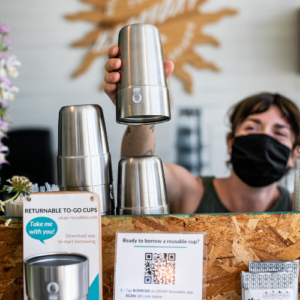
The Okapi-Reusables app allows you to borrow a reusable mug owned by Okapi from participating cafes. You can then return the cup to any cafe in the network within a period of two weeks — borrowing at most two cups at once. If a cup lost, on the other hand, there is a charge of $15. To join the program, there is a one-time $10 fee through the app. They have 16 participating cafes in Portland, Oregon and 4 participating cafes in San Mateo, California. Their goal, as understood from their website, is to break the single use habit by providing a convenient and better alternative. In addition to coffee thermoses, they also have introduced glass containers for boba, juices, and smoothies. According to the San Mateo Daily Journal, Okapi reported saving 1,500 annually at their locations in Portland Oregon. Peculiarly, there are no reviews on the App Store nor Google Play, while Google Play shows that there have been over 100 downloads. The strengths of this app are the interplay between the physical and digital product. This allows accountability for thermoses, as well as an easy to way to find shops that use the thermoses as well as those where thermoses can be dropped off. Weaknesses of this strategy are that it relies on buy in of multiple stores as well as customers being willing to remember to bring the mug back or face a fee. This sudden forced habit change through a monetary penalty may discourage customers from using the product at all — finding it just that much easier to simply take a disposable cup. It also does not discuss how the thermoses are cleaned — if it is the responsibility of the store or Okapi — which could be a major cost and bottleneck in this solution.
By: Jamie Ullman
Turn Systems
https://turnsystems.co/pages/how-it-works
Category 2 and Category 6 – Event/Venue lends you reusable mug and you bring it back next time, paired with third party app present in multiple stores that allows customers to borrow disposable cups.
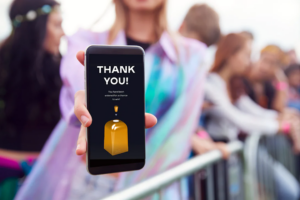
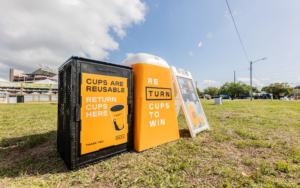
This Australia/New-Zealand born capture-and-reuse system began in 2012, with the vision to bring a reusable cup system to music festivals, sports matches, airports, stadiums, and other public spaces. First, a partnering organization like the American entertainment company, LiveNation, would partner with TURN Systems to set up these return-boxes and cups across their venue. Consumers would download the TURN app when purchasing their drink in a TURN cup and scan the cup on the return-bin’s empty spot when it comes times. Upon return, the user is rewarded with points towards rewards like discounts, prize-draws, and rewards that they can redeem from the distributing businesses (could be repeatable depending on how open the coffee shop is to this!). TURN is unique because not only do they provide the cups themselves, but also the smart disposal bins, that stack the cups as they are filled and alert event staff as the bin becomes full, and the smart washer that was custom engineered by TURN Systems. It is also a unique decision to allow co-branding of all materials with the event organizers. However, on the flip side, adoption of TURN appears to be difficult unless the suite of solutions is purchased by the partnering organization, since the primary return site would be the smart disposal bin. Additionally, the main audience for these products seem to be large event organizers with a large budget and many dispersed events (e.g. LiveNation, Lollapalooza, NFL, NBA, etc.), while, a solution for everyday coffee consumers at college campuses and working setting may have to be more transportable and modular.
By: Kyla Guru
One Small Step
https://www.onesmallstepapp.com/
Category 3 – App that tracks carbon footprint
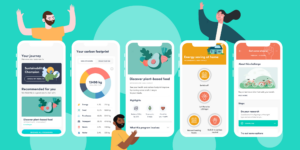
This Australian-born app (but globally used) vows to “use behavioral science to help millions achieve zero emissions.” It works by first asking you to take a survey upon setup that gauges your total carbon impact. From here, it starts offering you a free, personalized, climate action plan with steps you can readily implement. Currently, there are 22,000 One Small Step app users with over 9,095 green habits in total set up. One Small Step incorporates several features of gamification, including points, personalized action plans/goal-setting based on input lifestyle choices, and learning/education through courses (all positive elements), as well as gamified UI/UX elements like satisfying button presses, swipes, and animated point totals that go up as CO2 emissions decrease. A user’s profile also shows their journey of where they started with their carbon footprint (how many kg of CO2 consumed), and what they have achieved/how much carbon they have saved since joining the app. These sorts of metric speak volumes in helping a user digest their own seemingly small impact on the environment at large. However, since this app mostly relies on user-input to generate quantitative carbon footprint estimations (using Australian Bureau of Statistics information) and daily challenges, one improvement includes implementing plug-ins with camera or receipt-checks to verify what container was used to hold the coffee. Additionally, integrations with US or local country-specific statistics are required for globalization and scaling. Also, although there are social elements incorporated in this app (invite friends, Community feature where one can post about advice they are seeking), our literature review showed that behavioral change is further incentivized if there is more of an emphasis on the aspect of ‘play’ with friends.
By: Kyla Guru
Green Caffeen
https://apps.apple.com/au/app/green-caffeen/id1417913455
Category 2 and Category 6 – Store lends you reusable mug and you bring it back next time, paired with third party app present in multiple stores that allows customers to borrow disposable coffee cups.
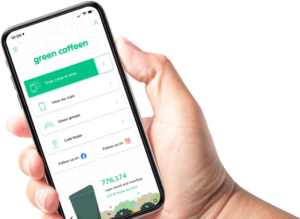
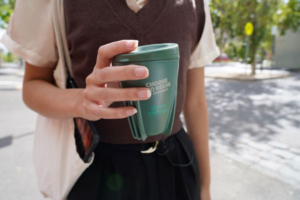
With over 760 cafe locations across Australia, Green Caffeen places custom-made reusable coffee cups in cafés. The process works as such: you enter the participating café, tap to scan the QR code on your app (and scan it back upon return) and take a reusable cup to-go (you can check out up to two at once). The next time you enter a participating location, you can either scan again and swap your cup for another clean one, or return the cup and head out. If the cup does not get returned within 30 days of borrowing, the user is charged a “late cup fee” of $12.99. The unique nature is the whole-of-society approach: the user downloads the app, the participating coffee shop is supplied with cups that they can throw in the dishwasher like their other cups, and the QR codes are supplied/equipped to connect the user to the team in the case anything goes wrong. Some strengths of this product include the clear messaging, distinct cups that are also made from recycled plastic, the counter that shows how many plastic cups you have saved based on how many times you used your “Green Caffeen” cups at the store, and the simple UI/UX that helps locate participating cafés and track your cup check-in and check-out. However, one aspect that is missing that we could aim to incorporate is the gamification aspect—we could potentially apply a similar model in the United States, but include a shared leaderboard among those in the same location, or friends that you might connect with on the app itself. What we love about this app? Green Caffeen stops the use of single-use cups at the source, by presenting it visually as a key alternative at the counter itself as the user orders.
By: Kyla Guru



