1) Duolingo
Target audience: Very broad: casual learners, beginners, busy people who want “quick daily practice” and low friction
Market need it fulfills: Makes language learning feel approachable and consistent by turning practice into a daily routine with fast, bite-sized sessions.
Unique features
- Gamified habit loop: streaks + rewards + “come back tomorrow” mechanics designed to encourage repeated daily use.
- Personalized, quick lessons: short sessions that feel easy to start, with personalization over time.
- Social comparison hooks: leagues/leaderboard-style progress can add motivation through competition.
Logo analysis
- Logo/mascot (Duo the owl) is playful and memorable (brand-as-habit-cue). It’s a visual trigger that reinforces “fun + daily” identity.
- The overall product language (“free, fun, effective”; “quick lessons”) signals low commitment + high consistency as the core value prop.
Strengths
- Extremely low friction to start (micro-lessons) => good for forming a habit.
- Clear retention loop (streak pressure, rewards) keeps many users coming back.
- Social motivation can boost engagement for competitive learners.
Weaknesses
- Streak dependence risk: losing a long streak can feel like a “gut punch” and cause people to quit
- Extrinsic-heavy motivation: some users optimize for points/streaks over real-world skill transfer
- One-size-fits-many: broad audiences can mean less tailored support for specific barriers
Gap we can address
- “Consistency without guilt”: replace streak-loss punishment with graceful recovery (“restart rituals,” flexible goals, self-compassion framing) to prevent drop-off after missed days.
- More intrinsic motivation: anchor habits in identity + meaning (“I’m becoming a speaker,” “I learn for travel/family/community”) instead of only points.
- Action planning: add implementation-intention features (“If it’s 9pm after dinner, I do 3 minutes of speaking”) to help users practice even when motivation is low.
2) Babbel
Target audience: More “serious” or goal-driven learners who want practical conversation skills with a structured curriculum (often adults learning for travel/work). Babbel explicitly emphasizes getting you speaking and lessons designed by experts.
Market need it fulfills: A guided path for learners who want real-life phrases + structured progress without the “gamey” feel.
Unique features (what makes it distinct)
- Practical, real-life conversation focus: dialogues and scenarios meant to mimic real situations; “speaking from day one.”
- Bite-sized but more curriculum-forward: lessons commonly framed around ~10–15 minutes, designed to fit routines while still feeling “substantive.”
- “Scientifically proven methods” positioning: Babbel markets a more methodical approach (grammar/vocab/pronunciation).

Screenshot
- The simple, bold wordmark feels more “professional/serious” than playful—signals credibility and adult learning.
- Their messaging foregrounds effectiveness + real-world conversation, which can support intrinsic motivation (“I can actually use this”) more than pure gamification.
Strengths
- Clear value proposition: practical language for real-life conversations, confidence-building through dialogues
- Structured learning path appeals to learners who want guidance and progression
- Session length is routine-friendly while still feeling meaningful (~10–15 minutes).
Weaknesses
- Higher activation energy than “gamey” apps: 10–15 minutes can be harder for inconsistent schedules
- Less “sticky” habit scaffolding (for some users): if retention is mostly curriculum-based, users who rely on external prompts may fade without strong habit mechanics
- Motivation mismatch risk: structured lessons are great for planners, but can feel rigid if users need flexibility, social energy, or emotional support
Potential Gaps
- Micro-commitment mode: offer 2-minute “minimum viable practice” options for chaotic days
- Adaptive goal setting: dynamically adjusts daily target based on past week behavior
- Accountability / social layer: lightweight buddy check-ins or small cohorts to boost follow-through without forcing public leaderboards
3) Speak
Target Audience: Built for an audience that wants to practice speaking and overcome the anxiety of real conversations. Mainly for adults who feel like they “know words but can’t talk.” Also those are usually busy and motivated, and want short and fast growth.
Market Need it fulfills: bridges the gap between knowing a language and speaking a language by offering the low pressure and readily available practice and feedback. Creates an atmosphere where talking out loud is safe, readily repeatable, and judgement-free.
Unique features (what makes it distinct):
- AI Speaking practice: where users talk out loud to an AI tutor instead of passively learning content
- Low-anxiety conversation environment: no fear of embarrassment, and encourages experimentation/practice
- Immediate feedback loop: real-time corrections and feedback, emphasizing active learning
- Scenario-based conversations: speaking practices that are real life scenarios that teaches practical real life conversations
Logo analysis:

- Clean, sleek, and modern wordmark: showing the simple and seriousness of learning that isn’t gamified
- Brand language emphasizes building confidence, real speaking, etc instead of streak studying
- Portrays itself as an actual learning tool and not a game
Strengths:
- Directly targets a major pain point of most language learners which is speaking confidence
- Strong motivation as progress is felt through auditory improvement
- Lower emotional barrier for conversation making it easier for shy or nervous learners to practice
- Very different from tap and reading heavy competitors
Weaknesses:
- Speaking first learning can be very intimidating
- Less long-term curriculum focus
- Requires quiet or private moments for practice
- AI conversations may lack emotions and human like qualities
Gaps we can address:
- Gentle on-ramping:
- normalizing mistakes and pre-speaking practices
- Habit formation:
- light weight cues instead of streaks, and modes for low-energy and busy days
- Identity-based motivation:
- Progress framed via identity instead metrics
- Reflection prompting?
- Social transition support:
- Optional non-AI oriented practice?
- Try to reduce gap between AI practice and real life
4) Mondly
Target Audience:
Casual learners who want visually guided language learning with tech-forward features.
Market audience:
virtually rich and modern compared to normal learning apps that blends AI conversations, structured learning, and immersive features.
Unique features:
- Conversation-driven lessons with chatbots
- Practicing conversations in simulated real-life scenarios
- Focus on being able to communicate as well as read
- AR / VR positioning
- AR lessons and VR experiences for learning
- Immersion and learning by doing
- Broad language coverage
- Supports many languages including less well known ones
- Short, guided lesson format
- Lessons are well structured with realistic result
- Lessons are well structured with realistic result
Logo:
- It is clean and geometric wordmark with a tech-feel, less playful
- Visual language emphasizes the innovation and global reach aspects
- Marketing visuals often show off AR/VR as a next generation of learning
Strengths:
- Visually engaging UI, seems like it reduces boredom and increases motivation
- Conversation framing helps bridge the gap between vocabulary and actual use
- novel/new tech features differentiate Mondly in the market space
- Short lessons used help keep activation energy low
Weakness:
- New tech features may feel more like a gimmick than an actual core learning driver
- The scripted practice feels shallow at higher levels
- Less depth in the long-term curriculum
- Weak habit mechanics, relies on curiosity and not routine
Gap we can address:
- Depth over novelty:
- Transition users from cool features towards a sustainable skill building path
- Make progress more cumulative not exploratory
- Speaking confidence escalation:
- Gradually increase the unpredictability of the conversational practices to prepare users for real conversations
- Stronger feedback for pronunciation, fluency, and other patterns
- Motivation stability:
- Add identity or goal motivation to add to the cool novelty aspects
- Support users after the novelty of learning wears off
- Consistency support:
- Flexible commitment
- Context aware reminders to deal with real-life cases users may face soon
5) Rosetta Stone
Target audience:
Learners who want an immersive and “no-translation” approach. Often older adults, professionals, or institutions who value credibility and long-term learning over speed or fun.
Market need it fulfills:
Provides a traditional immersion-based language learning experience that emphasizes intuition and exposure rather than explicit grammar rules.
Unique features (what makes it distinct):
- Immersion-first pedagogy: no native-language translations; meaning is inferred through images and context
- Pronunciation focus with speech recognition: emphasis on accent and phonetic accuracy
- Linear, comprehensive curriculum: designed for full language mastery rather than casual use
- Institutional trust: widely adopted by schools, libraries, and corporate programs

Logo:
- Classic wordmark + stone icon signals longevity, seriousness, and authority
- Visual identity communicates “this is real learning,” not experimentation or play
Strengths:
- Strong immersion philosophy can support deep language intuition
- Pronunciation feedback is a core pillar, not an add-on
- Trusted brand for long-term or formal learning contexts
Weaknesses:
- Very high activation energy, especially for beginners
- Minimal flexibility for learning styles that need explanation or reassurance
- Weak habit scaffolding; relies on user discipline rather than behavioral support
- Can feel slow or frustrating for users who want quick wins
Gaps we can address:
- Scaffolded immersion: combine immersion with optional explanations and emotional reassurance
- Habit-first structure: lighter daily commitments that still preserve immersion benefits
- Motivation framing: show progress in confidence and identity, not just lesson completion
6) Busuu
Target audience:
Learners who want a balance between structured learning and social feedback. Often intermediate learners or adults who value correction from real people.
Market need it fulfills:
Combines curriculum-based learning with community-driven correction, bridging solo study and real interaction.
Unique features (what makes it distinct):
- Community corrections: native speakers correct written and spoken exercises
- CEFR-aligned curriculum: clear proficiency levels (A1–C1)
- Structured lesson paths with grammar, vocab, and dialogue-based progression
- Optional premium feedback: adds quality control to social learning

Logo:
- Clean, friendly wordmark that sits between playful and professional
- Visual language emphasizes global community and mutual learning
Strengths:
- Real human feedback increases credibility and learning depth
- CEFR alignment provides clear progress milestones
- Social element adds accountability without heavy gamification
Weaknesses:
- Feedback quality can vary depending on community engagement
- Social correction can trigger anxiety or self-consciousness
- Habit formation depends heavily on user motivation, not system design
Gaps we can address:
- Emotion-aware feedback: normalize mistakes before correction
- Consistent habit cues: predictable, low-effort daily loops
- Safer social transitions: gradual exposure to human feedback
7) HelloTalk
Target audience:
Learners who want real conversations with native speakers and are socially motivated. Often younger adults or highly motivated learners comfortable with messaging.
Market need it fulfills:
Provides real-world language exposure and cultural exchange through direct communication with native speakers.
Unique features (what makes it distinct):
- Peer-to-peer language exchange: text, voice, and call-based conversations
- Built-in correction tools: inline corrections and translation
- Cultural exposure: language learning embedded in real social context
- Feed-style interaction: discovery through posts and moments

Logo:
- Feels friendly, conversational branding
- Emphasizes connection and exchange over curriculum
Strengths:
- Extremely authentic language practice
- Strong intrinsic motivation via social connections
- Cultural learning emerges naturally
Weaknesses:
- Very high emotional and social activation costs
- No structured progression or learning path
- Can drift into social chatting without deliberate learning
- Safety and comfort vary widely
Gaps we can address:
- Structured confidence ramps: prepare users before real human interaction
- Learning-focused framing: keep conversations aligned with goals
- Safer practice spaces: bridge from private AI practice to public interaction
8) Pimsleur
Target audience:
Busy professionals, commuters, and auditory learners who want to learn while driving or multitasking.
Market need it fulfills:
Allows language learning without screens, focusing on listening and speaking through repetition and recall.
Unique features (what makes it distinct):
- Audio-first method: no reading required
- Spaced recall system: timed prompts to reinforce memory
- Conversation-centric: teaches speaking patterns early
- Hands-free learning: fits into commutes and daily routines

Logo:
- Simple, understated branding
- Signals seriousness and method over trendiness
Strengths:
- Extremely low friction for busy schedules
- Strong pronunciation and listening skills
- Habit-friendly through daily audio lessons
Weaknesses:
- Minimal visual or contextual support
- Limited flexibility or personalization
- Can feel repetitive or slow
- Weak sense of progress beyond lesson count
Gaps we can address:
- Multimodal reinforcement: pair audio with lightweight reflection or feedback
- Identity-based progress: show growth in confidence and real-world readiness
- Adaptive pacing: respond to user energy and performance
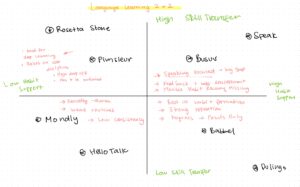
2X2: