
How We Selected These Assumptions
Our team reviewed the assumption map we created during David Bland’s lecture and focused on the top-right quadrant: assumptions that are both critically important and have zero evidence to support them. We asked ourselves one question: “If this assumption is wrong, does our entire product strategy collapse?”
Three assumptions immediately stood out. First, if farmers won’t adopt our digital inventory tools, our $800K investment in logistics tech becomes worthless—we’re building software for users who don’t want it. Second, if we’re prioritizing the wrong feature (inventory tracking vs. delivery flexibility), we waste three months building something that doesn’t solve our 8.3% churn problem. Third, if flexible delivery doesn’t actually reduce churn, our entire financial model—which assumes cutting churn in half—falls apart, and our $115M revenue projection disappears.
These aren’t small risks we can ignore. Each one, if wrong, invalidates a core pillar of FarmLink Flex. That’s what makes them worth testing before we invest $2.5M and six months building the wrong thing.
Test Card 1: Farmer Tool Adoption

Test Card 1’s Significance: If farmers won’t adopt our inventory tools, our entire FarmLink Flex tech solution fails. We’re betting $800K on logistics tech that assumes farmers want digital transformation—but we have zero evidence they’ll actually use it.
Test Card 2: Feature Priority Survey
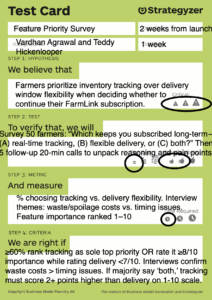
Test Card 2’s Significance: We’re prioritizing inventory tracking over delivery flexibility in our roadmap, but 78% of churned customers cited delivery issues. If we build the wrong feature first, we waste 3 months and lose more customers while competitors solve the real problem.
Test Card 3: Delivery Flexibility A/B

Test Card 3’s Significance: Our financial model assumes flexible delivery reduces churn from 8.3% to 4%. If this assumption is wrong, our $115M revenue projection collapses and FarmLink Flex’s ROI disappears.
What We Learned
Testing assumptions forced us to admit we’d designed FarmLink Flex without validating whether farmers would use it or whether our features solved the right problems. The hardest realization: our biggest risks weren’t technical—they were behavioral. We assumed demand existed, but had no proof.
These test cards make our risks explicit and give us a roadmap to validate before we invest $2.5M in building the wrong thing.



