
Farmlink Product Requirements Document
Andrew Lee, Teddy Hickenlooper, Sunny Yu, Madison Huang, Peter Lee, Vardhan Agrawal
Product Overview……………………………………………………………………………………………………………………….. 2
Scope and Objectives………………………………………………………………………………………………………………….. 2
Primary Objective…………………………………………………………………………………………………………………. 2
Secondary Objectives……………………………………………………………………………………………………………. 3
User Personas……………………………………………………………………………………………………………………………. 3
User Stories………………………………………………………………………………………………………………………………. 4
User Story Map (Discovery, Select, Checkout, Retain)……………………………………………………………… 4
Functional Requirements…………………………………………………………………………………………………………….. 5
Non-Functional Requirements……………………………………………………………………………………………………… 7
Mockups/Prototypes…………………………………………………………………………………………………………………… 8
Constraints and Assumptions…………………………………………………………………………………………………….. 10
Constraints (Technical, Operational, Regulatory)……………………………………………………………………. 10
Assumptions (User Behaviors, Ethics)…………………………………………………………………………………… 10
Milestones and Timeline……………………………………………………………………………………………………………. 10
Phase 1: Tech Revitalization Build (Months 1-6)…………………………………………………………………….. 10
Phase 2: Regional Expansion (Months 7-24)…………………………………………………………………………… 11
Resource Requirements……………………………………………………………………………………………………………… 11
Metrics and Success Criteria………………………………………………………………………………………………………. 12
Key Performance Indicators (Customer, Operational, Financial)……………………………………………….. 12
Decision Gates (Proceed/Pivot/Perish)……………………………………………………………………………………. 12
Go to Market…………………………………………………………………………………………………………………………….. 12
Overview and Strategy………………………………………………………………………………………………………….. 13
Phase 1 Launch (Tech & MVP)……………………………………………………………………………………………… 13
Phase 2 Launch (City Rollout Playbook)………………………………………………………………………………… 13
Proceed / Pivot / Perish Logic …………………………………………………………………………………………… 13
References……………………………………………………………………………………………………………………………….. 14
Product Overview
FarmLink is a digital marketplace connecting consumers with local farms for fresh, seasonal produce. Our prototype demonstrates a streamlined consumer experience that directly addresses several pain points identified in FarmLink’s current operations.
Our solution aims to resolve FarmLink’s most pressing problems. FarmLink faces stalled growth at 50,000 subscribers and rising churn (now 8.3%, up from 5%). Meanwhile, the current mobile experience is a WebView wrapper that takes 8 seconds to load, creating friction at every touchpoint for both our farmer partners and our customers.
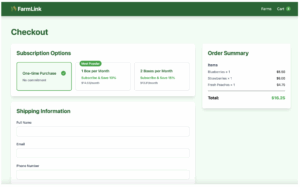
Our interface tackles these issues through three key design decisions. First, we provide a frictionless discovery flow. Rather than forcing users into a subscription immediately, we let them browse farms in their area and explore produce before committing. This reduces the intimidation factor for new users who aren’t ready for a $75/week commitment. Second, we offer flexible box building. Users can build custom boxes or choose presets at different price points. This directly responds to the case’s insight that 67% of consumers would accept trade-offs for a 30% price reduction—we’re giving them control over what they pay for. Third, our subscription optionality at checkout addresses the pause problem. By offering one-time purchases alongside 1x/month and 2x/month subscriptions with clear savings (10-15% off), we let users choose their commitment level rather than forcing all-or-nothing subscriptions that lead to churn.
This prototype leans toward the “Premium Ecosystem” strategy—keeping the local, curated experience while adding flexibility that could improve retention and reduce the 8.3% monthly churn that’s threatening the business. We plan to complete FarmLink’s tech stack revitalization and use it to drive expansion across the board.
Scope and Objectives
Primary Objective:
Transform FarmLink from a stagnating 5-city, 50K-subscriber operation into a scalable regional leader capturing 10-15% market share within 5-7 years through the tech infrastructure overhaul. Ideally this enables 4x delivery capacity and sub-2-second app performance, which can be used to drive geographic expansion to 15-20 cities with flexible price tiers sourcing from farmers within 200 miles.
-Scope Includes: Complete mobile app and backend rebuild, scalable routing algorithm, farmer inventory management portal, flexible subscription features (pause/skip/customize), city-by-city implementation playbook.
–Scope Excludes: Owned delivery fleet in new markets (Phase 1), international expansion, meal kit offerings beyond produce boxes, brick-and-mortar retail presence, and phone-based customer support—we focus exclusively on subscription produce delivery mastery before adjacent opportunities.
Secondary Objectives:
Establish data moat through predictive analytics providing farmers actionable harvest planning (replacing “Google Sheet” system), build referral engine driving 50%+ organic customer acquisition.
User Personas
- The Premium Locavore (Current Power User)
Ages 30 to 48. Urban or near-urban. High-income professionals who cook frequently and care about freshness, sourcing, and sustainability. Their grocery spending is intentional rather than price-driven. They enjoy produce that feels local and personal, and they often treat food quality as part of their identity.
Needs: Consistent produce quality. Transparent sourcing. A smooth ordering flow.
Pain Points: The current app loads slowly which makes weekly ordering feel tedious. Inventory changes after checkout reduce trust.
Goals: Maintain an ongoing subscription with minimal friction while feeling connected to the farms behind their food.
- The Conscious Convenience Seeker (Primary Expansion Target)
Ages 24 to 37. Young families or shared households in second-wave rollout cities like Portland or Denver. Motivated by healthier eating but more cost conscious than the Premium Locavore. They want better produce and like supporting farmers but only if the price and effort make sense for their schedule.
Needs: A low-commitment introduction, like one-time boxes and visible pricing. The ability to build a box in a specific price range.
Pain Points: A mandatory $75 subscription at signup feels risky. Weekly frequency is often too much.
Goals: Start gradually and increase commitment as trust builds. Spend within $35 to $55 per order while still feeling good about food quality.
- The Small-Scale Farmer (Supply Partner)
Typically runs a 5 to 40 acre farm. Strong at production but stretched thin on admin and sales. They want reliable demand and simple tools that do not add time to their day. They already track crops, weather shifts, and yield estimates, so managing inventory manually is stressful and often inaccurate.
Needs: A portal for quick inventory updates and price adjustments. Forecasting tools for harvest planning.
Pain Points: Google Sheet based tracking leads to errors and overpromising. Demand fluctuates unpredictably.
Goals: Reduce waste, plan yields with real demand signals, secure a stable channel for recurring orders.
- The Occasional Buyer (Churn-Risk User)
Ages 26 to 50. Likes FarmLink but does not always cook consistently. Travel, work schedules, or irregular meal planning lead to skipped deliveries and eventually cancellation. They often want to return but do not want to restart a full subscription.
Needs: Easy pausing, skipping, and one-time ordering without reactivation friction.
Pain Points: Weekly deliveries create spoilage and guilt which pushes them to cancel.
Goals: Rejoin occasionally without commitment and scale usage when life is stable.
User Stories
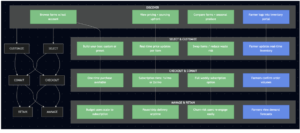
Discovery
- As a new user, I want to browse farms and produce without creating an account so I can evaluate value before committing.
- As a price-sensitive shopper, I want to see pricing and sourcing information upfront so I can determine if FarmLink fits my weekly budget.
- As a farmer, I want to onboard through a simple portal so I can list inventory without spreadsheets or manual processes.
Select & Customize
- As a customer, I want to build a produce box or choose a preset so I can quickly order based on my preferences or time constraints.
- As a shopper trying to control spending, I want real-time price updates so I can stay under a self-determined budget.
- As a farmer, I want to update item availability in real time so customers only see what I can confidently supply.
Checkout & Commit
- As a first-time buyer, I want a one-time purchase option so I can try the service before subscribing.
- As a returning user, I want multiple subscription tiers (1×/month, 2×/month, weekly) so I can match my delivery frequency to life changes.
- As a farmer, I want to confirm order volumes so I can plan harvest and pickup efficiently.
Manage & Retain
- As a subscriber, I want to pause or skip deliveries easily so I don’t have to cancel when I have too much food or I’m traveling.
- As a churn-risk customer, I want a frictionless re-entry path so I can return without starting from scratch.
- As a farmer, I want demand forecasting so I can make informed planting decisions and reduce waste.
Functional Requirements
- Frictionless Farm & Produce Discovery
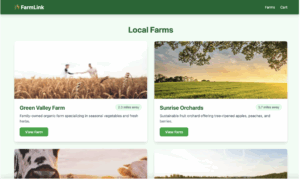
This feature allows users to browse local farms and view available produce inventory immediately upon launching the app, without being forced to create an account or commit to a subscription first. The purpose of this flow is to directly address the “intimidation factor” and high friction identified in the current user journey, where users are forced into a $75/week commitment before seeing value. By lowering this barrier, we aim to improve the conversion rate from visitor to registered user. This is a P1 (Critical) requirement for the Phase 1 MVP (Months 1-6) as it is fundamental to the new user experience strategy. Technically, this feature relies on the PostgreSQL database to serve farm profiles and requires the Farmer Inventory Portal to be active so that the stock displayed is accurate and real-time.
- Flexible “Build Your Box” System
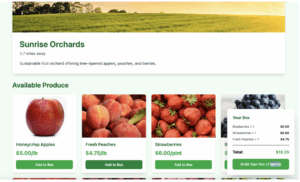
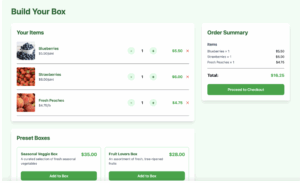
Users must be able to create a custom order by either selecting individual items (e.g., Honeycrisp Apples, Fresh Peaches) or starting with a pre-set box (e.g., “Seasonal Veggie Box”) and adding or removing items as desired. As visualized in the wireframes, the UI must update the total price dynamically as items are manipulated. The primary purpose of this feature is to reduce the 8.3% churn rate by giving users control over their trade-offs; our data indicates 67% of consumers would accept trade-offs for a lower price, and this feature enables that flexibility. This is a P1 (Critical) priority for the initial launch. It depends on the inventory management backend to handle real-time stock deductions and complex pricing logic to calculate custom totals versus preset bundle discounts.
- Hybrid Checkout & Subscription Management
At checkout, the system must present users with three distinct options: a One-time Purchase (no commitment), 1 Box/Month (Subscribe & Save 10%), or 2 Boxes/Month (Subscribe & Save 15%). Additionally, users must be able to pause or skip deliveries easily within their account settings. The purpose is to solve the “pause problem” and “all-or-nothing” subscription model that drives users away. By capturing users who aren’t ready for a full commitment, we can retain them as occasional buyers and increase Lifetime Value (LTV). This is a P1 (Critical) requirement essential for the “Win-back campaigns” targeting churned customers in Month 5-6. Implementation depends on deep integration with Stripe payment processing for recurring billing logic and the User Profile database to track subscription status.
- Farmer Inventory Portal
We require a web-based portal that allows farmers to input their harvest availability, view upcoming orders, and manage their profile, effectively replacing the current manual “Google Sheet with weather API” system. The purpose is to ensure the produce listed on the consumer app is actually available, establishing the “data moat” through predictive analytics and operational efficiency required to scale beyond 50,000 subscribers without logistical failures. This is a P1 (Critical) requirement, as the consumer-facing “Build Your Box” feature cannot function without accurate supply data. This tool will be built using Retool and connected directly to the central PostgreSQL database.
Non-Functional Requirements
- System Performance (Latency)
The mobile application is required to load all core pages, specifically the “Local Farms” feed and “Cart,” in under 2 seconds on standard 4G/5G networks. The purpose of this requirement is to eliminate the user friction caused by the current app’s 8-second load time, which is a primary driver of friction and churn. Achieving this speed is a P1 (Top Priority) for Phase 1, as the current WebView wrapper is considered unusable. To achieve this, the team depends on a complete migration from the current wrapper to a native React Native application and the optimization of the Node.js/Python backend queries.
- Scalability & Concurrency
The backend routing algorithm and order processing system must be capable of handling a minimum of 1,500 deliveries per city simultaneously without crashing or suffering performance degradation. The purpose is to remove the current growth cap; the existing infrastructure crashes above 500 deliveries, which makes the planned expansion to 15-20 cities impossible. This is a P1 (Critical) requirement that must be met before the “Go/No-Go” decision gate at Month 6. This relies on the implementation of scalable AWS cloud architecture and a custom routing algorithm leveraging the Google Maps API.
- Data Security & Compliance
The platform must be SOC 2 certified and fully compliant with PCI DSS standards for payment processing, with all user data encrypted at rest and in transit. The purpose is to ensure legal compliance and build trust with our “Conscious Convenience Seeker” demographic as we scale from a small operation to a regional leader handling sensitive personal and financial data. This is a P2 (High) priority; while security is an ongoing effort, the budget specifically allocates $50-100K for initial SOC 2 certification during the tech overhaul. This requirement depends on third-party audit services and secure integration with Stripe.
Mockups/Prototypes
- Login and browse local farms
- Browse offerings and select a pre-set box or curate a box
- View your produce box and choose to include any add-ons
- Checkout and become a subscriber to save on monthly deliveries
Constraints and Assumptions
- Technical constraints
- App load times (8 seconds) create a hard upper bound on acquisition and retention until the full mobile overhaul is complete.
- All discovery and “Build Your Box” features depend on reliable real-time data entry from small-scale farmers.
- Operational constraints
- Farmer Capacity Variability: Small farms face unpredictable yields from weather, labor shortages, and seasonal variability.
- Regulatory and compliance constraints
- Food Safety and Traceability: Multi-state expansion introduces varying requirements for cold-chain management, labeling, and traceability.
- Assumptions about user behaviors
- Lower Commitment → Higher Conversion: The strategy assumes that enabling one-time purchases and monthly options will reduce churn and boost conversion from “Conscious Convenience Seekers.”
- Ethical and societal constraints
- Equity in farmer relationships: As FarmLink scales regionally, there is a risk of inadvertently favoring larger or more tech-savvy farms.
- Transparency in Pricing and Sourcing: Price flexibility and regional sourcing broaden access but may dilute the “hyper-local” identity.
- Timeline constraints
- The entire plan hinges on $5–8M allocated to Phase 1 tech revitalization.
Milestones and Timeline
FarmLink executes a 24‑month, two‑phase plan with explicit milestones, KPIs, and decision gates to manage risk while scaling. The strategy starts with a 6‑month tech rebuild, then transitions into an 18‑month regional rollout governed by performance thresholds at Months 6 and 18.
Phase 1: Tech Revitalization Build (Months 1–6)
Phase 1 allocates $5–8M to rebuild the mobile app and backend, improve routing, and prepare for scale. Months 1–2 focus on core architecture, UX implementation, and routing algorithm development; Months 3–4 run beta tests with select farmers and power users; Months 5–6 deliver a full rollout to 50,000 existing subscribers plus win‑back campaigns explaining the new flexible subscription model. A go/no‑go decision gate at Month 6 checks whether technical KPIs are met (app rating ≥4.0, capacity ≥1,500 deliveries per city, churn ≤6.5%) before committing to geographic expansion.
Phase 2: Regional Expansion (Months 7–24)
Phase 2 rolls out FarmLink to two new cities per quarter using a standardized 90‑day city playbook. Launches are sequenced as Month 7–9 (Portland, Denver), 10–12 (Seattle, Minneapolis), 13–15 (Nashville, Austin), and 16–18 (San Diego, Boston), with each city receiving 60 days of pre‑launch farmer recruitment and setup, a launch month with promotional pricing and local marketing, and 60 days of optimization before a success/fail call. A second decision gate at Month 18 evaluates whether the first six cities hit scale thresholds (≥3,000 subscribers each, CAC <$60, margins ≥30%) to warrant aggressive scaling, while ongoing monitoring uses weekly, monthly, and quarterly reviews of cohorts, unit economics, and operational dashboards to enable early course correction.
Resource Requirements
FarmLink’s execution requires scaling from 45 to 110-120 employees over 24 months with estimated fully-loaded costs of $12-15M annually by Year 2. Phase 1 (Months 1-6) demands a dedicated engineering squad of 8-10 people including 2 senior full-stack engineers ($180-220K each), 2 mobile developers ($150-180K each), 1 DevOps engineer ($160K), 1 product manager ($140K), and 2-3 QA specialists ($100-120K each), totaling ~$1.5M in engineering payroll for 6 months, plus 1 UX/UI designer ($120K), 2 customer success managers ($80K each), and our existing 5-8 overseas support agents ($15-20K each). Phase 2 (Months 7-24) adds 35-40 field staff across 12 cities with each market requiring a local operations lead ($70-85K), 2-3 farmer relationship managers ($60K each), and part-time marketing coordinator ($40K)—approximately $200K per city—plus central expansion of 3 regional sales directors ($90K + commission), head of growth ($160K), 2 data analysts ($100K each), and scaling support to 15-20 agents. Technical infrastructure centers on AWS cloud architecture ($500K annually), React Native mobile apps, Node.js/Python backend with PostgreSQL database, custom routing algorithm leveraging Google Maps API ($15-20K monthly) and Route4Me optimization software ($500-1,000/month per city), farmer inventory portal built with Retool, Twilio SMS notifications ($5-10K monthly), Stripe payment processing (2.9% + $0.30 per transaction, ~$750K annually), Intercom customer support with AI chatbot Fin ($10-15K monthly), delivery partnerships with Uber Direct/DoorDash Drive ($5-8 per delivery), temperature monitoring IoT devices from Tive ($50K for 500-1,000 units), Snowflake/BigQuery data warehouse ($2-30K monthly scaling with growth), Looker/Tableau BI dashboards ($1-3K monthly), AWS SageMaker for machine learning demand forecasting replacing the “Google Sheet with weather API,” and food safety compliance software like SafetyChain ($5-10K monthly) plus SOC 2 certification ($50-100K initial, $30-50K annual audits). Total technology spend estimated at $1.2-1.5M in Year 1, scaling to $2.5-3M in Year 2 (10-12% of revenue), with total project investment of $50-100M across both phases to achieve the $1-2B revenue target and 10-15% market share by Year 5-7.
Metrics and Success Criteria
FarmLink measures success across customer health, operational efficiency, and financial viability, using explicit targets to guide investment and course correction. Performance against these metrics determines whether the company accelerates, optimizes, or exits markets at each decision gate.
Key Performance Indicators
- Customer: App Store rating (target ≥4.0; current 3.2), monthly churn (target ≤6.5%; current 8.3%), Net Promoter Score (target ≥40), customer lifetime value (target $600–700+; current $450), and referral mix (target >50% of new customers from word-of-mouth vs paid acquisition).
- Operational: System capacity (target ≥1,500 deliveries per city in Phase 1; ≥2,000 in Phase 2), app load time (target <2 seconds; current 8 seconds), customer support ticket reduction (target 30–40% decrease), farmer retention (target ≥85%; current 85%), and farmer satisfaction score (target ≥7/10).
- Financial: Customer acquisition cost (target <$60 in new markets; current $75), gross margin (target ≥30%; current 35%), subscribers per new city at 6 months (target ≥3,000 for breakeven; ≥5,000 for profitability), and healthy monthly revenue growth.
Decision Gates (Proceed/Pivot/Perish)
Two formal decision gates govern major capital allocation: Month 6 for Phase 1 validation and Month 18 for Phase 2 validation. At each gate, if KPIs meet or exceed targets, FarmLink proceeds and accelerates expansion; if metrics are mixed, the plan pivots via pricing, product, or market focus changes; if metrics fall materially short with no clear path to improvement, FarmLink pursues strategic alternatives, including slowing or exiting markets.
Go to Market
FarmLink’s go-to-market strategy uses a phased rollout to solve two constraints: stabilizing the current tech stack, which crashes above 500 deliveries per city, and expanding into new markets in a capital-efficient way. The plan aligns segments, positioning, channels, and economics with explicit metrics and decision rules that govern whether to accelerate, adapt, or wind down.
Overview and Strategy
FarmLink targets two core segments: 50,000 existing “Premium Locavores” (urban professionals paying about $75 per week who prioritize local sourcing) and more than 300,000 “Conscious Convenience Seekers” (millennials willing to pay $50–55 per week for regional organic produce with better delivery reliability). The value proposition intentionally evolves from “hyper‑local only” to “local spirit, regional reach,” backed by data showing 67% of current subscribers would accept sourcing within 200 miles for roughly a 30% price reduction, positioning FarmLink between Amazon Fresh’s impersonal scale and Imperfect Foods’ budget focus. Distribution combines an upgraded App Store/Google Play presence with sub‑2‑second load times, a website optimized for acquisition, and Uber/DoorDash partnerships for last‑mile in new markets, while marketing leans on farmers market presence, a $50K micro‑influencer seeding program (around 200 creators), and “give $20, get $20” referrals to keep CAC below $60.
Phase 1 Launch (Tech & MVP)
Phase 1’s MVP delivers three non‑negotiable components: a mobile app with sub‑2‑second load times, a routing engine that scales to 2,000+ deliveries without crashes, and a proper farmer inventory management system replacing the current “Google Sheet with weather API.” Success metrics include improving the app store rating by at least 1.0 point, cutting monthly churn from 8.3% to 6.5%, and proving at least 3x volume capacity relative to today, all feeding into a Month‑6 decision on whether to proceed, extend, or exit.
Phase 2 Launch (City Rollout Playbook)
Phase 2 rolls out two new cities per quarter using a repeatable playbook: 60 days of pre‑launch farmer recruitment (30–40 farmers per city), a Month‑0 public launch at $45 per week promotional pricing, and explicit targets of 3,000 subscribers by Month 6 for breakeven and 5,000+ by Month 12 for profitability. Funnel improvements aim to lift website conversion from 5% to 8% through “build your box” customization and flexible frequencies (weekly, bi‑weekly, monthly), while retention initiatives target reducing churn to 5.5% and extending LTV from $450 to $700+.
Proceed / Pivot / Perish Logic
Go/no‑go decisions follow quantitative thresholds at the end of each phase. For Phase 1 (Month 6), FarmLink proceeds if app rating is at least 4.0, churn is at most 6.5%, support tickets are down 30% or more, systems handle 1,500 deliveries per city, and farmer satisfaction is at least 7/10; it pivots if ratings and churn land in intermediate bands (for example, app rating 3.5–3.9 or churn 6.5–7.5%), potentially extending the timeline by three months or adding senior engineering talent; and it “perishes” if ratings fall below 3.5, churn exceeds 7.5%, crashes persist, or farmer defection rises above 20%, triggering acquisition conversations or an orderly wind‑down. For Phase 2 (Month 18), FarmLink proceeds if each new city reaches at least 3,000 subscribers, margins of at least 30%, and lifetime value of at least $600; pivots if cities sit in the 1,500–2,500 subscriber range or CAC is $60–80, using pricing tests (for example, $48 vs $55) and delivery partner experiments to fix unit economics; and “perishes” if cities remain below 1,500 subscribers after six months, CAC exceeds $80, margins drop below 25%, or core churn accelerates above 10%, which would trigger retreat to the original five cities as a lifestyle business or a regional sale. Across both phases, referral mix is the key leading indicator: less than 30% referrals signals unsustainable acquisition costs, while more than 50% indicates strong product‑market fit and justifies more aggressive growth.
References
[1] Grocery Delivery – United States | Statista Market Forecast
[2] United States Online Grocery Market Size & Forecast to 2033
[3] Renub
[4] Community Supported Agriculture | National Agricultural Library
[5] The Size and Scope of Locally Marketed Food Production | Economic Research Service
[6] US Meal Kit Delivery Services Market
[7] Organic Agriculture | Economic Research Service
[8] Growth of U.S. Organic Marketplace Accelerated in 2024 | OTA
[9] Grocery Delivery – United States | Statista Market Forecast
[10] The next S-curve of growth: Online grocery to 2030 | McKinsey
[11] eGrocery Lookout: Market Trends
[12] United States Organic Food Market Size & Forecast to 2033



