
I really loved conducting the intervention study and the data collection process. Prior to this class, when we had to come up with an idea to develop, that would mostly be based on needfinding interviews. Even though we did conduct interviews, this was the first class I took that based an entrepreneurial app idea on a study’s results. I believe that this method led to more natural discoveries in needfinding because it didn’t include the investigative and super-conscious undertone of a needfinding interview. Seeing a research study turn into an app was extremely rewarding because our ideas felt super grounded.
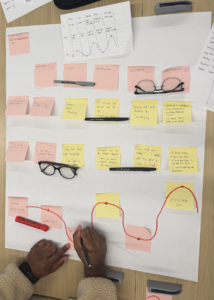
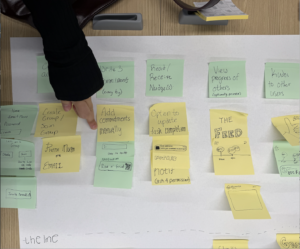
I also really enjoyed learning about some of the frameworks in this class, both from a product designer, developer, and manager perspective. Creating user archetypes and personas was an interesting exercise to see how we can categorize different types of users based on their thought processes and behaviors, and using those to create storymaps was a truly empathetic experience.

I thought that the ethics discussion we had was very necessary as most of these topics are being neglected both by startup founders but also big companies that are currently dominating the world. To me, these discussions highlighted the importance of involving many different stakeholders in the AI development conversation such as policymakers, educators, artists, neglected workers, etc.
I believe that the assumption tests were really helpful as well because product designers and developers often tend to make assumptions on behalf of the users to guide their design decisions which may be completely constructed in their own mind, uninformed by actual user behavior. This way, we had an opportunity to see if our assumptions were justified or not.
I was not a big fan of sketchnotes because I think it supported a certain type of student profile. For me, learning happens when I first read about something and speak about it later. Drawing doesn’t really enhance my learning process and it wasn’t the best way for me to invest my time into retaining information. I think in the future, a great alternative to the sketchnotes assignment could be recording a video of ourselves (to prove that we are not reading from a script) talking about what the reading is about and what we learned. I believe that this would be more inclusive of other learning styles.
Additionally, I think this course would benefit from more diverse readings because many of the readings, especially about “habit-formation” felt a bit too repetitive and very similar to each other. I also believe that readings should optimize for quality and new insights for students over quantity, and sometimes valuable information can get lost while reading a paper that is too long.
A surprise during the project was how much users’ reactions to the social accountability aspect varied, especially during testing with new users that were not involved in our baseline or intervention study. Some participants felt motivated by the idea of sharing goals with others, while others were skeptical or uncomfortable with that level of visibility. This showed us that group dynamics and trust play a much larger role in productivity tools than we initially assumed.
One specific challenge we encountered was translating insights from the intervention study into concrete product features. While the study revealed patterns in behavior, it was sometimes difficult to determine exactly how those insights should exist in the interface. We addressed this by referencing the personas and storymaps we created earlier in the process to ensure that our design decisions stayed grounded in user behavior.
Something that is still a bit unresolved for me about the project is how well the social accountability mechanism would scale outside of a small, controlled testing environment. The idea works well conceptually and for some users, but it is still unclear how broadly people would adopt a tool that requires them to share daily goals with others.
This project also showed underlying societal questions about productivity culture and the pressures people feel to constantly optimize their time to me. Designing a productivity tool inevitably raises questions about whether we are helping people prioritize meaningfully or simply reinforcing broader cultural pressures to always be doing more, now with other people watching as well.
The work on this project connects strongly with other work I have done at Stanford, especially in courses related to human-centered design and product development. It reinforced the importance of grounding product ideas in real user behavior instead of assumptions and highlighted how research methods can meaningfully shape the direction of a product.
Ten years from now, I think what I will remember most is the intervention study process and how powerful it was to see raw behavioral data turn into a design direction for a product. That connection between research and product design feels truly meaningful.
One thing I wish had gone differently is that we had more time to iterate on the prototype after conducting usability tests because the turnaround was really short after we had a functioning app. Additionally, at earlier interview stages as well such as baseline and intervention study, having more time to reflect on the post-study interviews would’ve been nice to dig deeper insights and get a bit more creative without the time pressure. I feel like the post-study interviews would’ve been more valuable that way. Many of the insights we gained during testing highlighted design improvements that we would have liked to implement more fully.
From a personal perspective, the main ethical consideration in this project is the use of social accountability as a behavioral nudge. By having users declare goals in a group and see others’ progress, the app encourages follow-through. I see this as an acceptable nudge because users choose their goals and groups voluntarily. However, for some users this mechanism could become manipulative if they feel pressured to complete tasks mainly to avoid embarrassment or social judgment.
Privacy is another concern since the app involves sharing personal goals. The project respects privacy by assuming that users should have control over who can see their goals and which groups they share them with. In future versions, stronger privacy controls, such as private goals, would be important to prevent users from feeling exposed.
From a design perspective, we tried to account for different user behaviors through personas and by limiting daily goals to reduce cognitive overload. In terms of well-being, the app aims to promote a sense of progress and prioritization, but it could also risk reinforcing unhealthy productivity pressure if users feel constantly evaluated by others. Designing features that normalize breaks and flexible goals would help balance accountability with well-being.
Overall, I really really enjoyed this class and the chance to conduct multiple research studies to build a thoughtful app. Getting to know and work with my teammates was amazing and I would like to thank the teaching team for an amazing quarter.



