
I did design for behavior change as part of CS147 in which behavior change was category I was assigned to. I really enjoyed the process and the learnings that came I out of it but it felt like the class was teaching us to create things for humans without actually understanding the psychological part of it. I figured taking this class would help me flesh out those mindsets more and understand the logic and thought processes that go into habit building and accountability. I understood that more than the app and its design itself there was a larger element fo understanding human cognition and fixations that we weren’t being taught and I was hoping CS247B would delve into those details, which it did.
I liked the creativity this class demanded of us, from the sketchnotes to the actual prototypes to Deb Aoki’s lecture. I think class feel shorter and chiller and I really appreciated that in a 9:30 lecture. I think it also forced me into being comfortable with things that I ‘created’ since by nature I tend to be a little nitpicky and end up throwing away anything creative that I was involved in making. Moreover, I felt a little more pressure at the beginning of the quarter but the credit/no-credit grading made me a lot more comfortable with taking risks and doing out-of-the-box things since I had the room to experiment without the possibility of being penalized for ideas that didn’t resound with the teaching team.

I also found that I just love playing with colors and visual/aesthetic design and that I’m not too shabby at it. Maybe visual desing is my calling?

The lack of a hi-fi prototype also really gave me to room and comfort to be able to play around with the design and layout without worrying about breaking code or functionality and I think so often that’s the problem with robust design in CS classes – I just don’t want to because the actual coding part of it can be a huge pain. I think this class takes a lot of pain points in the design process and makes them a little less intimidating.
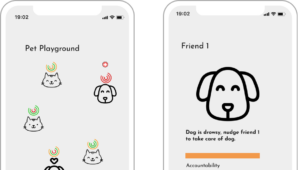
What surprised me a little in this class was how well asynchronous working styles could mesh together. I”ve always been a very meet-in-person-do-everything-at-once kind of person but everyone on my team this quarter just had different commitments and course loads of varying intensity, making synchronouswork a little hard. But with regular updates on a group, generally self-motivated incentives to start assignments early and on time and everyone’s consideration for each other’s busy schedules, asynchronous work was super efficient. My group was especially great about covering for each other when one of us got a little overwhelmed with work or life or recruitment. It felt like a very seamless iteration process and we generally had everything in good shape by their deadlines using this system. It really changed the conceptions I had of what a ‘good’ work ethic/dynamic involves.

One of my reservations about this class is that it’s hard to think about an actually valid problem space and ensign a solution in 10 weeks. People spend years brainstorming and coming upwith solutions to problem. As a consequence I feel like every app that was created in this class ended up being some version of BeReal + don’t kill a plant/tree + When2Meet. It felt like so many of the systems existed for the sake of existing and needed to address spaces that have already been addressed. I wonder how different it would be if the staff identified a single problem and every team had to design to solve those problems. Intuitively, it seems like that might solve the general sense of design fixation to begin with. In hindsight I don’t this gamification was the way to go for financial tracking but it’s challenging to come up with something that is truly innovative, can target the root causes of careless spending and is ethically sound.
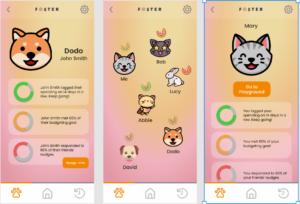
From an ethical perspective, I think we worked hard to find the balance between privacy and manipulation. As someone whose spending habits gives them a lot of anxiety, I think throughout our neefinding and interface development process, we did a good job of keeping in mind that finances are private and sensitive and enabled volunteers and users to share and unshare personal information as they see fit. I like that the pet personas abstract very literal financial information while still providing the gamification element that reduces the gravity of money management slightly.
Now I think the usable design process is not as unachievable or intimidating as I always thought it would be. But I’ve also figured out that maybe PM or PD is not the path I want to take. I’ve learned that I actually enjoy the coding part of making usable pretty things so best place to situate myself is somewhere in between UI/UX design and development.
The next time I’m faced with the challenge of designing something from scratch, I know to make parts of the design process work together and more importantly, I know to iterate effectively on multiple ideas to achieve some sense of usability. I also know that design isn’t linear or reproducible – its a series of lightbulb moments and that knowledge makes it easier to be less hard on myself about not achieving THE solution every time.



