
Team Members: Henry Greenman, Isabelle Levent, Emily Hsu, Zoya Garg, Athena Shiravi
I. Baseline Study
A. Baseline Study Overview
This study is part of SolMate, a research project aimed at understanding sun behaviors with opening up low-friction ways for people to get more sunlight. Our team consists of Stanford undergraduate & master’s CS students Emily, Henry, Athena, Isabelle, & Zoya (CS247B’s Team Anemone).
In this study, the behavior we were trying to change is to help people get more sun. The type of participants we were looking for were people who may want to get more sun on a daily basis for various reasons, whether that be for physical, emotional, and/or mental health. It may also be tied to other habits like going outside, going for a walk, opening the window, or getting exercise. Since our study was conditioned on the environment, we’re looking for people who live in cities with some access to sunlight or who may already have substitutes like a daylight therapy lamp. For the purposes of this study, we screened out people who found it very hard to get physical access to sunlight or didn’t already have a working substitute. We also screened out people who get a lot of sun exposure (1+ hour of direct sunlight and 3+ hours of indirect sunlight a day) and believe they already have enough sunlight.
Key Research Questions:
To make our study more focused, we framed it around the following key research questions:
- When do participants get more sun?
- What are their goals around getting more sun?
With these guiding questions, we aim to provide a structured analysis of our participants.
A few avenues we looked to recruit participants were Reddit threads of people who have been prescribed “light therapy” for symptoms of depression / ADHD, new grads who spend most of their days working in the office, and grad students who may feel more isolated and find it difficult to leave their apartments. The key characteristics that we were looking for were people who have access to sunlight and were highly motivated to get more sunlight but still struggle to do it at the cadence and in the amount they hope for.
Screener Document
Screener Data
Baseline Study Design:
An important part of the baseline study was to understand the mental model of the participant, what related behaviors might be creating roadblocks to getting more sun, and what related behaviors can be used as opportunities to get more sun. Therefore, we wanted to understand how much sun a participant is getting, why they may or may not be getting enough sun, and what activities or behaviors cause them to be in direct or indirect sunlight.
Some key areas we explored included:
- Why were they going outside?
- What mode(s) of transportation do they use to get places?
- If they stay inside all day, what were they up to?
- How does sun exposure (or lack of it) make them feel?
To capture this information, we asked participants to log where they were and what they were doing when the sun is up and after the sun goes down.
Before the study, we conducted screening interviews.
Data Collection Plan:
For our study, we asked participants to fill out a Google form every hour and every time they go outside to track:
- Where are you?
- What are you doing? If you are in transit, where are you going?
- Are you in direct / indirect sunlight?
- How do you feel and why?
- Take a photo of your surroundings.
We were able to see the responses as they came in, so if we noticed that participants had not been filling out the form, we could remind them. We also allowed participants to opt in to hourly email reminders to fill out the survey.
Survey link
Survey participants’ Data
After the study, we conducted Post-Study Interviews
B. Raw Data -> Grounded Theory
Grounded Theory 1: People recognize the benefits of sunlight exposure, but it is often deprioritized due to daily responsibilities and environmental constraints.
Theory: People feel more productive and in a better mood when exposed to sunlight, yet struggle to integrate it into their routines.
Evidence:
- “It made me realize that I feel like I was more stressed when I had something to do that I was putting off… maybe it didn’t help exactly that I was inside the whole day as well.”
- “I really noticed how the sun affects my mood… my energy and motivation levels were much higher.”
- “I think I do feel a little bit more productive when I’m in indirect sunlight in my room.”
Contradiction/Tension:
- Despite acknowledging the benefits of sunlight, participants struggle to incorporate it into their routines due to competing priorities.
- Question: What habits have room to squeeze in sun exposure?
- Implication: A behavioral intervention should help integrate sun exposure into existing habits rather than creating an additional task. This could mean encouraging microdoses of sun exposure (e.g., stepping outside for a few minutes after a meeting) or leveraging habit stacking (e.g., pairing sun exposure with coffee breaks).
Grounded Theory 2: Social interactions play a role in increasing exposure to sunlight, but they are not always intentional.
Theory: People tend to get more sunlight when social plans naturally bring them outdoors.
Evidence:
- “Because I was in the sun more, I ended up running into people… actually having conversations that lasted longer.”
- “Friends make plans, like going to sit on the quad or study outside, that motivates me to go out.”
Contradiction/Tension:
- While social interactions promote sunlight exposure, it remains unclear whether sunlight itself drives social engagement or vice versa.
- “I did get a little bit more sunlight when I actually had a task to do, like going to look at apartments or going out to eat.”
- “I think I don’t necessarily know if going out makes me happier or if I’m happier so I want to go out.”
- Question: Is sunlight exposure a means of social engagement, or is social engagement a means of getting sunlight?
- Implication: Instead of assuming sunlight alone directly improves well-being, an intervention should highlight the benefits of outdoor activities in social settings.
Grounded Theory 3: Structural and institutional factors create barriers to sunlight exposure, especially in academic and professional settings.
Theory: Work and academic commitments keep people indoors, limiting their access to natural light.
Evidence:
- “I needed to go in a building… I have to go into a lot of engineering buildings and stuff like that, and so I was in basements that didn’t have many windows.”
- “Everything I do is in the capacity of either working or helping my family… I don’t think being in the sun is a top priority compared to my other habits.”
- “I have to take a shuttle downtown for my classes, which are three hours long, indoors, with no windows. I heard that the design was intentional because they didn’t want students to be distracted.”
- “I spend so much time behind a monitor… but when I took meetings on a walk, I felt much more present.”
Contradiction/Tension:
- Institutional environments often inhibit behavioral change, reinforcing habits of staying indoors.
- Implication: A behavioral intervention should provide low-friction solutions, such as encouraging walking meetings or optimizing workspace layouts for better natural light access.
Grounded Theory 4: Sunlight exposure is perceived as a passive benefit rather than an active goal.
Theory: Many people do not actively seek sunlight exposure unless prompted by external circumstances.
Evidence:
- “I don’t think about it day to day… I just get it when I’m outside going to class.”
- If I don’t have anything to do, I don’t go outside… I didn’t feel like there was something calling me outside.”
- “I definitely notice that being in the sun makes me a lot happier… but I still wouldn’t say I prioritize it.”
- “I know myself, and I can see this behavior falling by the wayside unless I have a reason to keep doing it.”
Contradiction/Tension:
- Despite recognizing the importance of sunlight, people fail to prioritize it in their daily routines.
- Implication: A behavioral intervention should encourage conscious decision-making about sunlight exposure instead of relying on incidental exposure.
Grounded Theory 5: People modify their environments to compensate for a lack of direct sunlight, but it is not always sufficient.
Theory: Many participants use indirect sunlight or artificial lighting to mimic natural light exposure.
Evidence:
- “I prefer working in indirect sunlight in my room rather than in a dark study lounge.”
- “Even when I did wake up on time, I didn’t go outside… I’d just open the blinds instead.”
Contradiction/Tension:
- It is unclear whether artificial or indirect light provides the same benefits as direct sunlight.
- Question: Can indoor light exposure truly replicate the benefits of natural sunlight?
- Implication: If outdoor exposure is not an option, an intervention could optimize indoor lighting environments by tracking light exposure and offering recommendations (e.g., adjusting workspace layouts to increase exposure to natural light).
C. System Models


Key Takeaways
- Participants don’t think sun exposure is a priority in their busy schedules (it’s a nice to have not a need to have). Therefore, in our intervention study design, we test increasing sun exposure by having participants integrate sunlight into an existing habit or activity, so that it doesn’t seem like an additional burden.
- From the connections diagram, we see that being energized is correlated with being productive, which suggests that we can use the sun’s impact on energy (and therefore productivity) as a lever for habit change. In our intervention study, we track mood and sleep as a proxy for energy and aggregate this data for participants.
- Participants can struggle to get sunlight due to environmental factors such as lack of windows at work or weather conditions. Participants for whom weather is a limiting factor may see little benefit from our app during low-sunlight seasons, while others may be able to modify their environments to improve sun exposure.
D. Secondary Research (Literature Review & Comparative Analysis)
Literature Review
Key Insight 1: Research shows that there are numerous physical and mental health benefits associated with sun exposure.
- Alfredsson et al. found that sunlight positively affects mood and mental health, reducing symptoms of depression, particularly seasonal affective disorder (SAD), because exposure triggers serotonin production, enhancing feelings of happiness and relaxation.
- Hoel et al. found that moderate sun exposure is linked to reduced risks of several diseases, including cardiovascular issues, diabetes, multiple sclerosis, and certain cancers, as vitamin D is essential for various bodily functions.
→ Takeaway: Educating our target audience on the health benefits of sunlight can generate more intrinsic motivation towards building sun habits. Moreover, if we can show evidence of positive effects on mood and physical health in their lives, it can further strengthen this habit.
Key Insight 2: Sunlight plays an important role in regulating circadian rhythms, which in turn improves sleep quality.
- In a study done on over 500 UW students from 2015 to 2018, researchers found that students get less sleep and lower quality sleep in the winter seasons as reduced sunlight hours impact their circadian rhythm.
- Moreover, He et al. shows that sunlight first thing in the morning can improve sleep and night and alertness during the day.
→ Takeaway: Tracking sleep alongside sunlight exposure could be an important metric, especially if we want to encourage habit stacking (i.e.waking up early and getting sun). There are also multiple positive reinforcement loops that we can take advantage of i.e. getting sun → better sleep → wake up early → more daylight hours to get more sun.
Key Insight 3: Researchers recommend public health and policy reforms to shape public sentiment around sun exposure and increase access to sunlight in people’s daily lives.
- Taniguchi et al. advocates for increased access to green spaces dedicated to exercise and recreation, while Wang et al. advocates for structural changes in workplaces, like hospitals to increase access to sunlight like hospitals, such as, “increasing the number of windows in the ward to improve sunlight status or adopting outdoor rehabilitation measures.”
- Weller recommends that public health recommendations should consider individual skin color and geographical factors, ensuring that policies do not overlook the broader, life-extending effects of moderate sun exposure.
→ Takeaway: There are very specific ways that we can tailor the sun habit experience to every person based on their personal living space / work environment. It’s also important to incorporate people’s geography, skin tone, and sunburn risks when recommending the amount of daily sun exposure.
Comparative Analysis
Trend 1: Many sun-tracking apps are incorporating gamification to encourage consistent use and habit formation.
|
|
|
|
|
Sun Screenr uses the “hatch or fry” concept to gamify sunscreen application. |
Sunflower rewards users with a sunflower for meeting their sun exposure goal, encouraging streaks. | Riseroo includes streak tracking and milestone achievements to drive engagement. |


→ Implication: Many apps rely on some form of gamification to help users build habits around sunlight. With our knowledge of the downsides of gamification, we want to differentiate ourselves by helping the user tie sunlight exposure to things they intrinsically care about (i.e. mood, sleep, alertness, etc.) instead of relying on extrinsic motivators that may lead to crowding out.
Trend 2: Many apps employ passive tracking by integrating with Apple Health or wearable devices to reduce user friction.
- Apple Watch Time in Daylight tracks sunlight exposure based on how much time your Apple watch is uncovered and exposed to the sun.
- Sunflower pulls in Sleep and Time in Daylight data from Apple Health to measure whether you’ve hit your sunlight goal for the day.
- Sun Screenr also integrates with Apple Health’s Time in Daylight to track daily sun exposure, whereas the user only needs to log their sunscreen application manually.
→ Implication: From our baseline study, we found that people struggle to actively log their time in daylight and other factors regularly during the day due to busy schedules and being on the move. Further informed by this market trend, we would like to make the tracking process as easy and seamless as possible for our user.
Trend 3: More apps are focusing on providing personalized experience and insights beyond just raw data, helping users optimize sun exposure for health benefits.
- SunSeek provides personalized recommendations on when to go outside for optimal sunlight exposure based on location, weather, and time of day.
- D Minder estimates vitamin D production based on UV exposure and Riseroo recommends a certain amount of sunlight each day based on solar radiation levels measured via the camera.
- How We Feel provides insights of the user across time to help them visualize how their mood changes based on various factors such as time of day, amount of sleep, day of the week, amount of exercise, weather, location, activity, etc.
→ Implication: The experience of building a sun habit can vary widely across individuals who live in different places and have different levels of access to sunlight. We want to tailor the experience to each individual’s experience and give them insights into how their sun exposure is affecting other aspects of their life such as sleep and mood.
For our 2×2 grid, we plot our competitors along two axes: (1) maintenance – indicating the amount of effort required by the user to get functionality out of the solution, and (2) insight – indicating the information density and amount of data-driven insights the solution provides. Maintenance required by the user is important because it is hard to get people to regularly log their information – as we learned from our baseline study. Insight is important as informed by our literature review because sunlight habits are strongly tied to intrinsic motivators like health, wellness, and sleep.
- Apple Watch Time in Daylight and Sunflower are the lowest maintenance solution because it relies entirely on passive tracking through the Apple Watch.
- The hardware solutions Happy Lamp, SunLED, and Hatch Lamp can be grouped into the low-maintenance / low-insight category as they don’t require much effort from the user besides for initial set-up, but they only act as an alternative light source without assisting with habit-building or information-tracking.
- Riseroo, SunScreenr, and D Minder Pro each focus on a specific niche beyond mere sun exposure – morning light, sunscreen application, and vitamin D levels, respectively.
- Sun Seek and How We Feel are the most insightful but also require the most maintenance because you need to input information like mood, physical activity, sleep, etc.
After plotting our competitors out on the 2×2 grid, we noticed the more insight that an app provides, naturally the more high maintenance it becomes because the user is required to input more information that can’t be passively collected. Therefore, our opportunity for differentiation lies on the upper left quadrant: low maintenance and high insight.
E. Proto-Personas & Journey Maps
Homebody Hannah: This persona was informed by our interviews of new grad friends in the interim period between graduation and work. They spend most of their time indoors with very few commitments that take them outside and may get most of their sunlight through a window, especially in cold-climate locations.


Sun-Deficient Sarah: This persona is informed by our interviews with people who work long hours during the day and thus find it hard to fit sunlight into their busy schedules.


Health-Conscious Henry: This persona is informed by another user group that would use an app like ours. These are people who are very health-focused and may own existing hardware to integrate with our app like an Apple Watch.


II. Intervention Design
A. Assumption Map and Assumption Testing
2×2 Matrix:

After identifying a range of assumptions (see above 2×2 matrix), we focused on three in the high importance, unknown quadrant of our matrix:
- Assumption 1: People will be inspired by others going out into the sun to get more sun.
- Assumption 2: People know that sun exposure has positive benefits for mental health and sleep.
- Assumption 3: Reminding people to get sun as early as possible will help them meet sunlight earlier
Assumption #1 and #3 allowed us to test intervention types, so that we could learn about what kinds of interventions might be most effective. Assumption #2 allowed us to probe people’s attitudes, so that we could identify motivations for sun exposure and ways to position our app.
Other assumptions like the effect of gamifying sun exposure, the importance of increasing happiness, and the importance of improving health outcomes through sun exposure are less relevant for our personas. These topics rarely came up during our interviews or emerged within our systems maps as key concerns.
Assumption Testing and Learnings:
TEST cards here: https://docs.google.com/presentation/d/19xUqxUa3ENlDt46NPb-YftjvqT1MzNNj-y6_rEHVC_g/edit#slide=id.p
Learning cards here: https://docs.google.com/presentation/d/1oiuROwuR9HKPpkNSo9WSHfvA1MasrcbtAfePV1W3ToU/edit#slide=id.g32d67095a30_0_17
Test #1: Our first test is based on the hypothesis that sun exposure requires external motivation, knowledge of external conditions, and especially social proof — if participants see their friends getting more sun, they will be inspired to get more sun. To test this hypothesis, we gave participants different examples of “social” notifications to see which one they would respond to most favorably.
Learning Card:

Test #2: Our second test is based on the assumption that people know that sun exposure has positive benefits for mental health and sleep. We tested knowledge about the benefits of sun exposure, via a short, four-question Google Form. If participants largely get the answers correct, our assumption will be validated.
Learning Card:

Test #3: Our third test is based on the assumption that reminding people to get sun as early as possible will help them meet sunlight earlier. We believe that scheduling a sun exposure notification upon waking or in the early morning, when many participants first check their phones, will inspire behavior change. With this plan, we are reducing friction that prevents or disincentivizes sun exposure, by making the sun reminder accessible and prominently displayed. To test this assumption, we will schedule an early morning email, around sunrise. To measure this test, we will see how many participants respond to an afternoon follow-up email, acknowledging they went outside to get sun. If the majority of users respond to our afternoon email, our assumption will be validated.
Learning Card:

Key Takeaways
From our testing, we identified three core learnings:
- Participants were motivated to go outside by both peer pressure and time-based urgency (e.g., the sun is about to set). There was no clear majority winner; different notifications worked best for different participants.
- Most participants vastly overestimated the suggested minimum amount of time one should be outside, while underestimating the effect of sun on decreasing anxiety. Participants mainly associated sun exposure with increased energy levels.
- Participants who were nudged in the morning to be intentional about sun, remembered to get sun in the morning, although they were not always able to link sun exposure to a particular habit.
From our testing, we decided to try an intervention that furthered the insight that a morning nudge could make participants more intentional about sun exposure. We asked participants to link a morning habit to morning sun exposure and pinged them in the morning to remind them about getting sunlight. This also ties into our learning that time-based urgency (e.g., the sun is out now, make use of it while it is!) can motivate participants. Our insights about people’s attitudes towards sun exposure can be applied to our onboarding workflows, adding in one or two educational screens to motivate sun exposure, as we work towards our final prototype.
B. Storyboards — Top 3 Ideas for Intervention
Idea 1: Building sun habits with friends through a social app similar to BeReal.
This idea revolves around taking a selfie at a random time during the day in the sun and being able to see other ways people are incorporating sun into their lives. In the storyboard, our protagonist is driven by social pressures to go outside, and her sun exposure habits are tied to other people inviting them out.

- Pros: This idea creates social accountability, and provides ways for people to reinforce each other’s habits by inspiring people with ideas on how to get more sun.
- Cons: This social pressure of posting each day can become an extrinsic motivator and crowd out a person’s intrinsic motivation to get sun for their own good. Moreover, the solution doesn’t hold the person accountable for staying out in the sun for a certain amount of time, so people can just “fake it” and go back indoors.
Idea 2: Getting sun first thing in the morning for 10 minutes.
In the storyboard, our protagonist is a student who feels tired all the time, falling asleep at 3pm – in the middle of the school day. They use coffee as a temporary antidote to their tiredness, but it just leads to a crash. Following this crisis, they decide to get 10 minutes of sun a day, which leads to feeling energized to do work for the entire day.

- Pros: This solution is simple and straightforward and doesn’t require too much effort from the person. It doesn’t disrupt any other part of the person’s schedule during the day, since they are getting sun first thing in the morning.
- Cons: Because the habit isn’t anchored to any other behavior, it might be hard to start organically.
Idea 3: Shifting indoor activities outside during the day.
In this storyboard, the protagonist is a health-conscious individual and has a yoga habit. However, she has a crisis when she starts working a 9-to-5, which requires her to be indoors all day. Her lack of sun, in turn, affects her circadian rhythm causing her to not get good sleep at night. She, then, decides to move her indoor yoga habit outside, which changes her life forever and helps her get good sleep at night.

- Pros: This solution takes advantage of anchoring, using a preexisting habit (doing yoga) to develop a new habit (getting sun).
- Cons: Some indoor activities can’t be easily moved outdoors, especially in places where it gets really cold in the winter.
For our final intervention, we combine the best parts of ideas 2 and 3 to help people develop a habit of getting 10 minutes of morning sun anchored to an existing morning routine.
We base our intervention off of this scenario:

In this brief storyboard, Sun-Deficient Sarah receives a notification in the morning telling her to prioritize the sun as she wakes up. She opens windows and steps outside for a few minutes while waiting for her morning toast, thus anchoring her sun habit to an existing habit of making toast every morning.

This intervention is informed by our findings in the baseline study, which shows that people are often too busy – their schedules are too unpredictable to fit in the sun during the day – or their commitments force them to stay indoors. That’s why we want to build it into their morning routines, which is consistent from day to day. Our literature review also backs up the advantages of getting morning sun, which can lead to better sleep at night and more alertness during the day.
C. Intervention Study
How did the study go?
In this study, we explored how participants incorporated morning sunlight into their routines and the impact of that sunlight on their mood, energy, and productivity. Participants were asked to integrate an existing daily habit into the sun and reflect on their experience.
Key Research Questions:
- How does intentional sunlight exposure impact participants’ mood, energy, and productivity?
- Does habit-stacking (pairing sunlight exposure with an existing habit) increase adherence to the intervention?
- Does tracking sunlight exposure and its effects increase awareness and behavioral change?
Methodology:
- Recruitment: Participants were selected based on their availability and willingness to participate in a four-day study on sunlight exposure. We didn’t really have any demographic requirements to participate — some of our participants we found off of sun-exposure related threads on Reddit, while others we contacted after they had already completed our baseline study.
- Data Collection:
- Pre-Study Interview: A 30-minute session to understand participants’ baseline behaviors. This was conducted with participants who we hadn’t already interviewed in our baseline study.
- Daily Tracking: Each morning, participants received a text reminder to take a habit outside. In the evening, they completed a survey logging whether they did so and how they felt.
- Post-Study Interview: A final 30-minute session to capture reflections on the experience. This was conducted with all participants in our intervention study.
- Anonymization: To protect privacy, participant names have been removed or replaced with generic identifiers.
Results & Insights:
1. Morning Sunlight Improves Productivity
“I feel like I’m more productive. I don’t delay tasks as much… The sun in the morning actually feels like it gets the day going. It made me more aware of how much time I was spending on my phone.”
- Key Insight: Exposure to sunlight in the morning increased motivation and reduced procrastination.
- Context: One participant reported deleting a major distraction (TikTok) and becoming more intentional with their time.
- Solution Design Impact: To encourage morning sunlight exposure, our solution sends a notification every morning that stacks with a user-selected morning habit to promote consistent morning sun exposure.
2. Routine and Accessibility Matter
“I acknowledged the benefits of sunlight, but it was just too cold to actually go outside consistently.”
- Key Insight: Environmental factors, such as cold weather, were major barriers to incorporating sunlight.
- Context: One participant found that while they recognized the benefits of sunlight, weather conditions made the habit difficult to sustain.
- Solution Design Impact: To work across climates, our solution must account for alternative sunlight exposure methods, such as using sun lamps, or allowing users to adjust their morning notification timing based on seasonal changes (like the sun rising later in winter, or accounting for daylight savings). Initially, we were asking users to input their location data to calibrate their notifications to their time zone/location, but we later realized time zone information was already accounted for if the app was using the phone’s predetermined time information. We also took care to alter the language of our app to be inclusive of alternative forms of “sunlight”.
3. Subtle Habit Shifts Are Sustainable
“It made me more intentional about morning sunlight, and I implemented it by taking my work calls outside. It improved my mood and energy without disrupting my workflow.”
- Key Insight: Attaching sunlight exposure to an existing habit (e.g., taking calls outside) made it easier to maintain.
- Context: A couple participants appreciated the simplicity of the intervention and found it easier to integrate into their routine than previous studies.
- Solution Design Impact: Our solution incorporates habit-stacking mechanisms, allowing users to pair sunlight exposure with existing behaviors (e.g., morning coffee near a window, outdoor phone calls), since in our intervention study we found this is a sticky and impactful way to induce behavior change.
4. Tracking Increases Awareness
“Every day I opened my window, it definitely boosted my mood… I never realized how little sunlight I actually got until I tracked it.”
- Key Insight: Participants became more conscious of the gap between perceived and actual sunlight exposure after tracking their habits.
- Context: One participant found that logging exposure helped them realize they were getting much less sunlight than they had assumed.
- Solution Design Impact: Our solution implements data visualization in a calendar history view that helps users track their daily sunlight exposure and receive insights on trends regarding their mood/energy levels, encouraging self-awareness and behavior change.
5. Potential Placebo Effect
“I thought my mood was better, but maybe it was just because I was tracking it. I had never tracked my mood like this before, so it made me think about it more consciously.”
- Key Insight: Some participants suggested their improved mood could have been influenced by the act of tracking itself, rather than the sunlight exposure alone.
- Context: This raises questions about self-reporting bias and whether future studies should introduce a control mechanism.
Solution Design Impact: To reduce placebo effects, the final design should incorporate passive tracking methods, such as automatic light detection and objective mood-tracking tools, to complement self-reported data. We scrapped this for our MVP, since we wanted to undergo additional testing to see whether such passive methods were even viable mood/sun exposure trackers.
D. System Paths

We based our system map off of our three proto-personas. In this diagram, Homebody Hannah is a returning user and Sun-Deficient Sarah and Health-Conscious Henry are first-time users.
Based on our system diagram, there are two primary workflows: (1) set-up, and (2) check-in. In the set-up process, we ask users to set up their anchor habit—that is, choose an existing habit that they already do every day that they want to pair with sunlight. During the onboarding process, an important step is that they allow permissions to location data and notifications, and if they have an Apple Watch, to connect their Apple Watch so we can get Time in Daylight and Sleep data. The system paths of Sarah and Henry differ because Henry has an Apple Watch and Sarah doesn’t.
During the day, all the personas receive a morning notification to get sunlight. This is the primary reminder that brings the user back to the app and then pushes them out again to perform the habit. For Sarah and Henry, this may be going outside. For Hannah, this may be getting sunlight through a window. Then, all the personas are brought back into the app with the evening check-in notification. All the users then log their sleep and mood. For especially health-focused users like Henry, they may then check their insights (analytical data that shows patterns between sun/sleep and sun/mood). For the average user, they may just look at the history of their logs through a calendar view.
Overall, the system map helped us break down what the core MVP features would be, where users enter and exit the app (i.e. primarily through notifications), and what would be the one-time actions they would require more guidance and repeated core actions that users would take every day.
E. Story Map
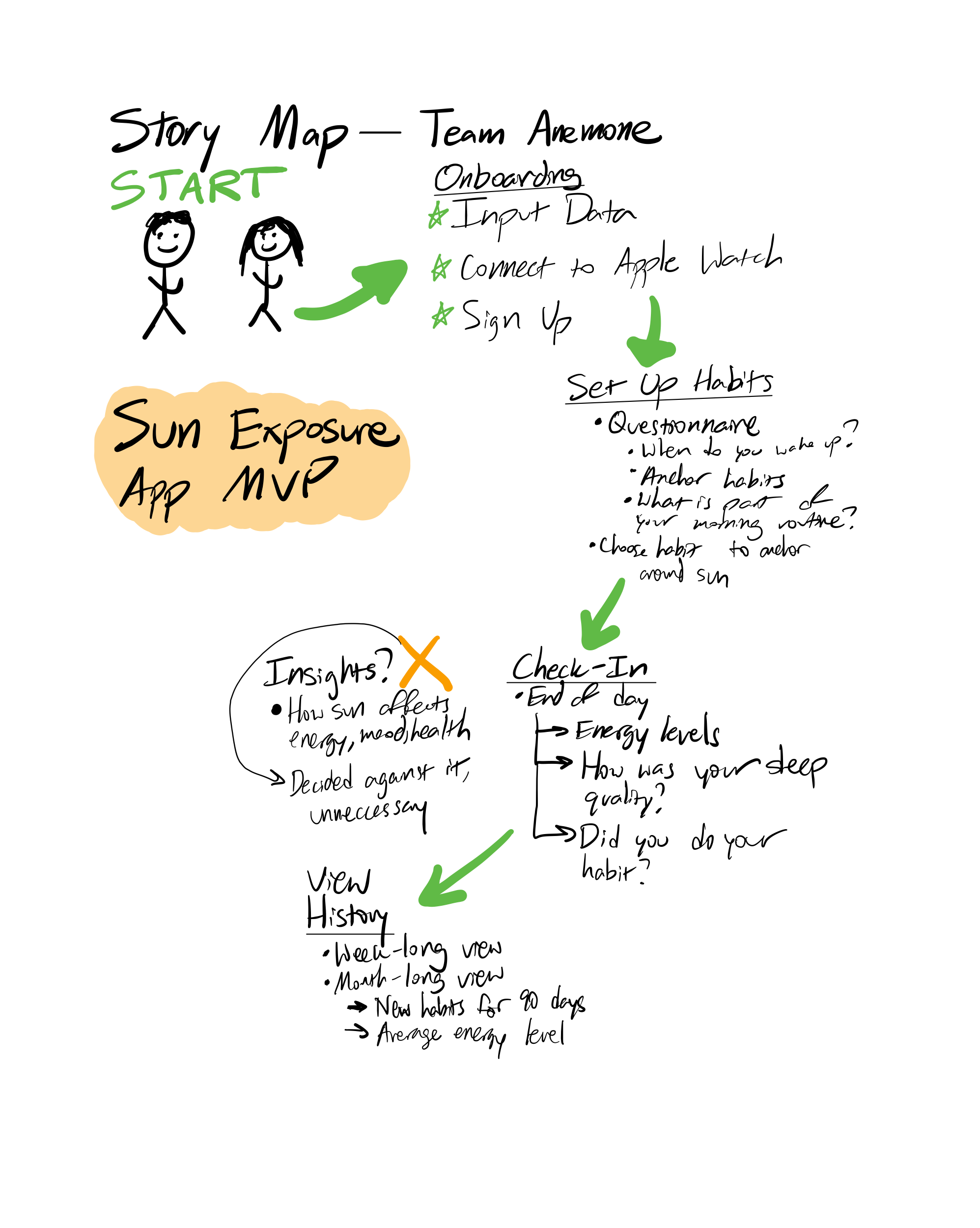
From this step, we understood the importance of habit stacking and anchoring, and integrating sun exposure into a daily routine, rather than viewing it as a chore.
While we want sun exposure to become part of one’s routine, we also understand that people can forget habits, especially when creating new ones. Thus, prompting via encouraging but not overwhelming notifications was necessary.
Additionally, we recognized a need for reducing focus on insights and having a sun history view that shows users how much time they have spent outside in the past week or month. We think including too much information that distracts from our key mission of habit stacking and anchoring would be counter-productive.
At nighttime, we believe that users will have an opportunity to take account of their days’ activities.
As a result, our primary MVP features needed to include a live sunlight display, the option to let users choose their common habits, and real-time notifications.
F. MVP Features
For our minimum viable product, we are focused on building a prototype that included the following key features:
- Alpha feature: A live sunlight display, using location permissions to display the conditions outside. Interviewees, regardless of location, had interest in current conditions.
- Alpha feature: Encouraging habit stacking by letting users choose their common habits. Given the efficacy of habit stacking, allowing users to pair sun exposure with their daily routines would facilitate such behavior change.
- Alpha feature: Real-time notifications to remind users to go outside, with a focus on the morning. Participants wanted live updates.
- Beta feature: Less emphasis on insights and creating a history view so users can see their sun habits over the past week and build a consistent routine.
- Beta feature: A mood/sleep check-in that allows users to log how they are feeling, and their sleep quality.
G. Bubble Map

We created a bubble map by consolidating each of the features of our app into different sections and color-coded the primary sections of the app, separated into pre-onboarding (in pink) and post-onboarding (in orange). As a result, the bubble map helped us to visualize the features associated with each part of the app, and how the user moved through different parts of the app, that is:
- Login/onboarding: creating a new account, allow permissions, change password
- Habit set-up: choosing an anchor habit, setting a notification time
- Notifications: evening check-in, reminder to get sun in the morning
- Logging habit + data: logging energy levels and sleep quality, whether or not the habit was completed
- History: week / month calendar view, correlation between sun and mood/sleep
We derived the following insights from the bubble map:
Insight 1: Although we saw the logging habit + data as the primary part of our app, we realized that the onboarding steps and habit questionnaire also took up a large part.
- Effect on Design: We assigned 2-3 people out of our 5-person team to design the screens in that flow, and took more time to evaluate those steps in the usability test for effectiveness of design (if users were able to complete it).
Insight 2: The bubble map helped us to cluster our features into pre- and post- onboarding, recognizing that once users finished the onboarding process, they are less likely to revisit those steps, while they would spend most of their time post-onboarding half of the app.
- Effect on Design: This informed our interaction design, as the user would need more guidance and explanation for the onboarding stage, while the post-onboarding stage should be more simple as those are repetitive actions and could be personalized.
III. Interaction Design
A. Wireflows

FigJam Link: https://www.figma.com/board/2n0cJjVsVnIkl7oIIhaeGG/Wireflows?node-id=0-1&t=Py3ILcUkMqnBRHQ5-1
B. Sketchy Screens

Sketches done by Isabelle. Habit questionnaire feedback:
- The screens might be one too many onboarding steps for the user, who just wants to see results as quickly as possible (Christina’s point about more time for onboarding leading to more users leaving).
- The open ended question format may overwhelm users (I experience this a lot).
- Can we make a super basic information survey they can then enrich with other data points?

In response, we…
- Decided to go with the selection option for the habit question instead of the open-ended long form box. This also makes the answer easier to parse on the back-end.
- Realized that all three questions are required, but added a marker at the bottom of the screen (1 out of 3, 2 out of 3, etc) to help users track where they are in the questionnaire, so that they don’t exit out of the survey when there are only a few steps left.

Sketches done by Henry. Settings feedback:
- Profile icon on the top left seems a little redundant because we’re already on the profile page, would consider indicating an exit route like a back button to go back to the home screen and same applies to all the screens
- I really like the way you add / change habits, the bubble design looks really good!
- For the change password screen, I think it could just be change password at the top without the name and picture because those aren’t very necessary for changing your password

In response, we…
- Decided to add a back button for ease of access between settings and profile pages.
- Removed the redundant profile logo in order to minimize confusion and excessive UI components.

Sketches done by Zoya. The left screen is her original sketch and the right is her updated version. Home Screen & History (Post-Check-In) Feedback:
- On the left screen, having a full month of calendar dates could be overwhelming for users.
- Additionally, the drawn illustration of the sun rays to represent daily exposure could be confusing.
In response, we…
- Used a bar chart
- Limited number of days from a month to a week

Sketches done by Emily. Check-in feedback:
- Currently, there are no exit paths for the check-in flow. What does this look like with skip options or just being able to x out of the flow?
- What if I opened the app in the evening but not at the exact time ”check in” notification time? What is the check-in pop up / module on the Home Screen?
- I like the character you developed for the energy levels and sleeping! I think we should use those throughout our flows.

In response, we…
- Added an exit path for the check-in flow in case the user wants to leave or go back
- The check-in screen will be the default home screen if the user still hasn’t checked in for the day
- Decided to go with the first variation with a character in the middle of the circle to create more emotional connection with the user

Sketches done by Athena. Onboarding feedback:
- The onboarding flow is clear, but it might have one too many steps—users may get impatient before reaching the main functionality. Perhaps we can combine the name and password screens?
- The home page is SO excellent, not notes
- Apple Watch sync is great, but it’s not clear how a user should connect it, we might need some apple symbols

In response, we…
- Made the design and onboarding more minimal
C. Moodboard

For our moodboard, we focused on channeling an upbeat and warm energy through a combination of orange (as the primary color) and blue (as the secondary color). We also brought in accents of pink. Many of the cutouts feature the outdoors and sunlight in different forms: sun rays, sun reflections on water, natural light from windows, sunsets, sun through leaves. Moreover, we used a health-conscious theme, picking foods like bagels and fruit salads that channel our brand’s city, Los Angeles.
D. Style Tile

Our style choices reflect our product’s mission to integrate sunlight exposure into daily habits in a low-friction way. We wanted the UI to feel warm, so we chose EB Garamond, and Helvetica Bold keeps things modern. We chose this color palette (golden yellow, sky blue, earthy burgundy, soft coral, pale mint) because it’s earthy to create an aura of calm, grounded energy. The icons we chose are to emphasize habit formation, but also positivity so people continue to feel encouraged. We hope people feel invited to bring sunlight into their routines.
E. Usability Testing
For the usability study, we ask users to walk through three core task flows: (1) onboarding and sign up, (2) habit questionnaire, and (3) the evening check-in.
The primary research objectives of the usability study is to:
- Determine the effectiveness of our design, whether users can complete the desired action
- See where we can make the interface more intuitive if we discover points of confusion.
- See if people’s first impression of the app aligns our envisioned brand identity from the moodboard.
To this end, we asked the following questions in the usability test:
Onboarding & Account Setup
- How smooth and intuitive is the onboarding process?
- Are there any points where users feel confused or need assistance?
- What are users’ first impressions of the app’s appearance and design?
Habit Questionnaire & Initial Setup
- How easy is it for users to navigate and complete the habit questionnaire?
- Do the habit options make sense to users, or would they prefer a different structure?
- Would users add or remove any questions or options in the questionnaire?
Daily Habit Tracking & Evening Check-in
- Is the evening check-in process intuitive and relevant to users’ routines?
- Do users find the check-in questions meaningful?
- How useful is the habit history feature, and does it meet user expectations?
Final Questions & Wrap-Up
- Would users incorporate this app into their daily routines? Why or why not?
- How do users perceive the app’s personality and intended audience?
For the sake of concision, we synthesize our findings from the usability testing in the next section so that we can combine them with the improvements we made to the final prototype.
F. Final Prototype
Issues Discovered During Testing
During Usability Testing, we discovered several key issues of severe, moderate, and trivial importance. These were based on the following prototype: https://www.figma.com/design/f7fcqibzbU2JDWpgW3owdo/SolMate-First-Draft-(Usability-Test)?node-id=0-1&t=yQrs6n92MzAJxxLs-1
1. [Severe] Users were unsure why location and Apple Watch is needed when it is not used in the app. A notable quote: “What are they using the location for? I made it through the entire flow without using location.” Solution: In the final prototype, we removed the location and Apple Watch features to make the app more cohesive since we realized that our MVP features did not rely on this functionality.
2. [Severe] Users were unsure why energy and sleep levels are being tracked. Solution: Add screens to the onboarding flow that explain how sleep + energy are impacted by sun exposure and prompt users to select what they want to track daily.

3. [Severe] Users found the habit option limiting and were confused about the language of bringing a habit into the sun. Specifically, we heard: “What does it mean to bring ‘waking up’ into the sun?” It makes it sound like I’m moving my bed next to a window.”
Solution:
- Add screens to the onboarding flow that allow users to select how they might bring a habit into the sun, e.g., standing in front of the window or going outside.
- Expand habit options and link them to specific actions, e.g., “when I [brush my teeth/ exercise/ commute/ call friends] then I will go [go outside/ be in front of a window]”

4. [Severe] Users found the energy + sleep logging method unintuitive. Specifically, we heard: “It’s confusing because the circle scroll doesn’t have a label – what’s the starting point?” and “The circle implies time, but you’re not tracking something time based.” Solution: We added arrow indicators to the ring and started the ring at the top of the circle based on user feedback.

5. [Moderate] Overwhelming/unclear onboarding flow. Specifically we heard that logistics like username + password can be condensed onto one page, and that our prototype lacked functionality to “type” in username + password. The warning sign in the prototype was confusing. Solution: We simplified and condensed the screens and added a transition to show how the text boxes would populate.

6. [Moderate] Users largely liked the history page. They also enjoyed the calendar, which included current and upcoming weather, allowing them to take conditions into account when figuring out their sun plans. However, they had some issues, namely that they were unable to go back after viewing the calendar and that they also wanted to have the current date. Solution: Add indicator of current date + back buttons

7. [Trivial] Users wanted to see what a notification to get more sun would look like. Solution: Add a notification screen and write copy for reminders.

8. [Trivial] Users were unable to navigate easily between screens. Solution: Added back arrows and update flow for simplicity
9. [Trivial] Axis Labels in the Weekly view of History was unclear, they didn’t know which graph was “energy levels” and which was “sleep quality”. Solution: Moved label above the graphs.

10. [Trivial] Users did not know where they were in the onboarding flow. Quotes: “Where was I in the onboarding process?” and “I liked the progress bar for the habit questionnaire but it wasn’t there for the onboarding flow”. Solution: Add a progress bar to the onboarding flow
Final Clickable Prototype Link: https://www.figma.com/proto/hH0aRoTH4iJ7UREPAlCaJa/Sun-Exposure-App-Design?node-id=0-1&t=39XHxgQL5LT4YhVE-1
IV. Citations
Al Anouti, Fatme, et al. ‘Associations between Dietary Intake of Vitamin D, Sun Exposure, and Generalized Anxiety among College Women’. Nutrients, vol. 14, no. 24, 2022, https://doi.org/10.3390/nu14245327.
Alfredsson, Lars, et al. ‘Insufficient Sun Exposure Has Become a Real Public Health Problem’. International Journal of Environmental Research and Public Health, vol. 17, no. 14, 2020, https://doi.org/10.3390/ijerph17145014.
Dunster, Gideon P., et al. ‘Daytime Light Exposure Is a Strong Predictor of Seasonal Variation in Sleep and Circadian Timing of University Students’. Journal of Pineal Research, vol. 74, no. 2, 2023, p. e12843, https://doi.org/10.1111/jpi.12843.
He, Meiheng, et al. ‘Shine Light on Sleep: Morning Bright Light Improves Nocturnal Sleep and next Morning Alertness among College Students’. Journal of Sleep Research, vol. 32, no. 2, 2023, p. e13724, https://doi.org/10.1111/jsr.13724.
Hoel, David G., et al. ‘The Risks and Benefits of Sun Exposure 2016’. Dermato-Endocrinology, vol. 8, no. 1, Taylor & Francis, 2016, p. e1248325, https://doi.org/10.1080/19381980.2016.1248325.
Taniguchi, Keita, et al. ‘Influence of External Natural Environment Including Sunshine Exposure on Public Mental Health: A Systematic Review’. Psychiatry International, vol. 3, no. 1, 2022, pp. 91–113, https://doi.org/10.3390/psychiatryint3010008.
Wang, Jie et al. “Association Between Sunlight Exposure and Mental Health: Evidence from a Special Population Without Sunlight in Work.” Risk management and healthcare policy vol. 16 1049-1057. 14 Jun. 2023, doi:10.2147/RMHP.S420018
Weller, Richard B. “Sunlight: Time for a Rethink?.” The Journal of investigative dermatology vol. 144,8 (2024): 1724-1732. doi:10.1016/j.jid.2023.12.027
Wong, King In. “Sun Exposure, Depression and Anxiety among College Students.” National College of Ireland, 2022.
Zhang, Rui, and Nora D. Volkow. ‘Seasonality of Brain Function: Role in Psychiatric Disorders’. Translational Psychiatry, vol. 13, no. 1, Feb. 2023, p. 65, https://doi.org/10.1038/s41398-023-02365-x.



