Intervention Study:
After conducting our baseline study into the habits of non-athlete college students with regard to spending time outside during a week, we began an intervention study to test the efficacy of a proposed solution in increasing that time.
Specifically, in our baseline study, we observed one barrier to going outside was low motivation where participants simply didn’t find going outside attractive enough to regularly do so. They are generally aware of the health benefits, yet this was not a sufficient incentive to enact change. The participants in their interviews expressed outdoor recreational activity as too burdensome. They often mentioned being too busy to introduce new habits. Moreover, it would take more effort to change their behavior, so they often opt to continue indoor lifestyles.
However, when they did go outside, our participants expressed it had a positive impact, particularly when it was done spontaneously. We took this interview feedback and synthesized a prototype and research question. The central research question of our intervention study was: Will spontaneous nudges at times when convenient get students who already have numerous things on their plate to spend more time outdoors and experience the associated benefits?
To collect the participants for this study, we re-used the participant set from the baseline study. We checked with them individually to ensure they were open to continuing to the intervention study. We conducted the study for 7 days, a full week.
We had a total of 8 participants complete the full process below.
| Before Study: Day 0 | During Study: Days 1-7 | After Study |
| Participant uploads their week’s schedule for our AI to identify free blocks throughout the week and schedule spontaneous calls. | Throughout the day, targeting once per day, Nova (AI agent) calls student when they should be free to nudge them to go outside. Over the phone, Nova can interact and give suggestions.
At the end of each day, participant records what activities they did outside that day. |
Have participants complete survey and submit their activity list for the week as well as health app steps. |
Transcripts of real conversations with Nova, our nature coach AI agent:
Nova helped nudge students to go outside:

Nova helped students navigate weather challenges:
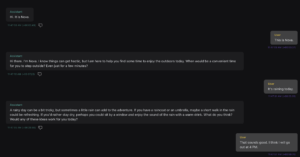
Sometimes, Nova called a student when they were already outside:

Or had just come back from being outside:

Nova helped students brainstorm different ways they could enjoy the outdoors, even when already outside:

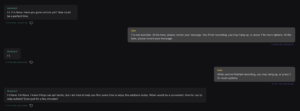
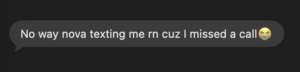
Although we had not programmed it directly to do so, the AI, to our surprise, gained an ability to leave voicemails:

Key Takeaways and Solution Changes
In our survey, we learned about the impact Nova had and ways to improve it. First, we learned that it was an “unusual week” for 7/8 of our participants due to weather and midterm exams: “Very busy schedule (midterm and extracurriculars taking up my time)”, “Very unusual weather, busy schedule.”, “it rained last week a lot”, “there was a lot of rain + a power outage on tuesday. two of my classes got cancelled”.
Despite those circumstances, we were able to gather a lot of usage data and our participants had enough activities to analyze. For instance, one of our participants went on 10 walks total over the 7 days. Another participant walked 7 times, biked 6 times, and skied 2 times in the 7 days.
Our participants told us that their biggest obstacles to going outside were the weather, being busy with homework, and being tired. This is the first key takeaway: busy schedules and unusual circumstances presented the biggest challenge for students. This aligns with our baseline study findings.
All of our participants received calls from Nova, and everyone except one person was able to answer at least one. The frequency ranged from 4 calls total to 4 per day, which we believe might have been a bug (the AI seemed to develop this feature, calling back multiple times a day, on its own too).
6/8 of our participants said the calls were not at convenient times, despite our schedule upload step. This lead to a second key takeaway: we need to improve the accuracy of Nova’s call scheduling and potentially let students have more control over when it will call.
Some people found the cals useful, for instance, one student described the impact as “Increased by desirability to go outside by 20%”. However, a majority of the students actually found the calls annoying, summarized well by one respondent saying that Nova “lowkey really annoyed me lmao”.
The nudges themselves did accomplish our goals, as it made one participant “consider going outside at different times than I usually do (such as in the morning) which isn’t something I typically do” and another “more aware of my goal to go outside and go on walks”.
However, the content of the calls were not ideal. One participant even stated this directly: “the content of the call was less effective than the reminder”. This led to our third key takeaway: the nudge/reminder itself was useful, but the content and medium of talking to an AI over call was actually discouraging and annoying to students.
Product changes: With these insights in mind, we have adjusted our plans for the product to focus more on the accuracy of scheduling nudges and give students more ability to adjust and verify timing. In addition, we will be texting reminders instead of actually calling students. We will also explore how our app can help students better manage their overall schedule and sleep, as these were the biggest obstacles to outside time.
System Paths:
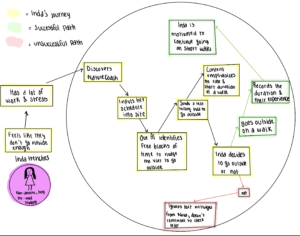
To create this system path, we followed Inda’s thought process. As a busy, goal-oriented college student who understands the importance of outdoor activity yet considers herself unathletic, she wants quick, efficient, and low-effort ways to engage in outdoor activity. The path reflects this understanding, and places emphasis on a low friction process. Simply by inputting her schedule, which she already has ready and updated as a busy and motivated student, the rest of the work is handled by the AI, which identifies free blocks of time in her day. Next, she receives nudges in the form of text messages that remind her to go outdoors, placing emphasis on what she personally values: easy, quick activities. If she responds to the nudge and goes outdoors, she has the opportunity to reflect on her experience, and her positive progress and experience will motivate her to go on a walk with the next nudge she receives as well.
The process of creating this system path underscored the insight that nudges need to align with the user’s specific goals and values, and make it easy for them to engage in the behaviour rather than demanding a new block of time in a busy schedule. By specifically recognizing Inda’s busy schedule, automating the vast majority of the process, and using positive reinforcement after a behaviour, the app creates a clear opportunity for engagement with the outdoors.

To create this system path, we focused on the two main priorities of No Plan Dan: having spontaneity in his schedule, and social time with his friends. This is emphasized through the fact that once he receives a text about going outside, his first priority is to message his friends and ask if they are free to go outside as well. If they are not free, however, he can still be enthusiastic about going outdoors due to the spontaneity involved, and the fact that he is receiving these texts at different times of the day when he is free, even if his schedule looks similar across days. At the same time, his friends not being free can create a barrier to him asking them in the future, thus hindering the social component. Overall, when he successfully goes outside, the positive experience motivates him to go outside more often in response to nudges in the future.
The key insight gained from this is the extent to which spontaneity vs. socializing can influence user behaviour. Specifically, for a persona that values both, even if one element is not immediately present, the other can motivate them to continue engaging in the activity. For instance, new nudges at unexpected times of the day can create a sense of engagement and provide unanticipated breaks amidst a busy day. At the same time, this system path also illustrates how asking friends to join and finding out they’re busy can dissuade the behaviour, as users may be hesitant to continually text their friends and ask them to join.
Story Maps:
In class initial draft:
Cleaned up and revised:
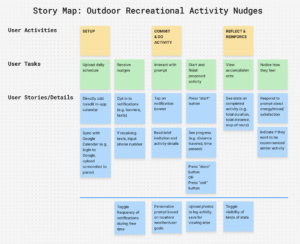
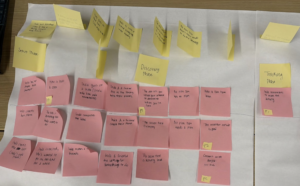
The user flow led to the development of several key MVP features based upon this analysis. Specifically, we realized the first step was the upload schedule step. It is necessary to *accurately* account for the user’s schedule so the nudges are actionable. Thus, some sort of Google Calendar integration or ability for the user to manually input/edit the schedule is necessary. Next, we heard from users and see in the story map that having control over frequency of nudges is important as well as inputting the phone number. From the study map, we realized this needs to happen soon in the flow, otherwise nudges cannot be sent. We also realized that our personas would appreciate logging activities in order to later see accomplishments, and thus, these became MVP features. Finally, another takeaway was that tailoring the nudges would be beneficial after the end reflection process in our story map. The user is able to go through a cycle of improvement, and mapping the story map helped us recognize this possibility.
MVP Features:
- Google Calendar Sync or ability to upload photo of calendar and manually edit schedule
- Ability to choose how many nudges per week the app will target
- Ability to input phone number for receiving texts
- Ability to log activities and view progress
- Ability for user to adjust their goals so they can receive a tailored nudge
Bubble Map:
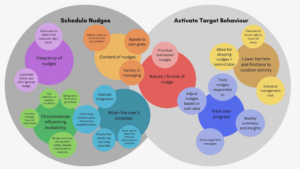
The sizes of the bubbles indicate the importance of the topic’s role in our solution.
We considered the most important aspects of our solution, informed both by our goals and user feedback from the intervention study. This led us to select the two main categories of scheduling effective nudges and actually activating the intended behaviour of outdoor activity. Next, we considered the main takeaways we obtained from our post-study survey: the impact of busy schedules and unexpected circumstances, the accuracy and customization of scheduled nudges, and the format/medium of the nudge.
The first takeaway informed the “circumstances influencing availability” bubble, which highlights both expected challenges (a busy week due to midterms, lack of sleep from a stressful week) and unanticipated factors (becoming sick, rainy weather). It also informed our understanding that free blocks within a user’ calendar do not necessarily mean they would be available to go outdoors at that time, as they may be tired and using it for downtime, or to get ahead on an assignment. This understanding also informed the “lower barriers and frictions to outdoor activity” bubble, which focuses on addressing these challenges by helping students with their sleep and calendar, therefore facilitating outdoor activity as a byproduct.
The second takeaway led to bubbles focused on customizing the times when nudges are sent to a user, as well as making sure they align with a user’s schedule. Given that many users stated they received nudges when they were not available, our bubbles consider how a user can be given more control and autonomy regarding when they are nudged. This includes selecting timeblocks themselves rather than based on a calendar, confirming free blocks the AI detects, and also ensuring those blocks are recorded accurately.
The third takeaway informed the bubbles on the content and format of the nudges, which influence not only how these nudges are scheduled but also whether they lead to tangible outdoor activity. Specifically, we plan to shift from a call-based solution to a text-based one, informed by user feedback. Furthermore, to make the messages more relevant and less redundant, we plan to customize it based on users’ reactions and preferences, circumstances (e.g. unexpected weather or a busy week), and align content with the user’s goals.
Overall, one key insight from this bubble map is to consider various possible avenues through which the nudges can be customized. Having greater user autonomy over the nudges entails not only when they receive a message, but also the nature of the content, its frequency, and a differentiation between when a user is available vs. truly free. Another insight is that other circumstances beyond immediate availability can influence one’s desire to go outside, whether it is bad weather or tiredness from a busy week. Therefore, our platform needs to be attuned to evolving conditions and preferences. Finally, a third insight is that our platform can facilitate the desired behaviour of outdoor activity by helping users with other areas of their lives that currently serve as constraints, notably lack of sleep and a busy schedule. By helping them be more intentional about blocks of time and helping them know how their time is being spent, we can help them maximize how their time contributes to personal or academic goals.
Assumption Map

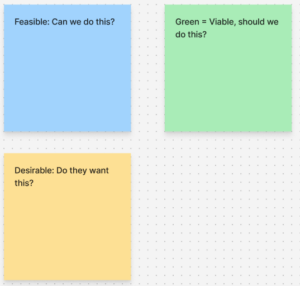
Link: https://www.figma.com/board/VTHt14TjGIi880VHpbPnoJ/Assumption-Map?node-id=0-1&t=GCIgvabLZSSdg6lB-1
Assumptions most crucial to our app’s success:
1. Students prefer going outside spontaneously rather than planned
2. A nudge from an AI assistant is strong enough to motivate change
3. Students will look at and read the texts they get
4. There exists a correct amount of texts to send in a given day
5. Students will look at and read the texts they get
6. Texts will not get muted after a few days
The core three are chosen below for the assumption tests.
Assumption Tests
Below are our assumption tests. Through this exercise, we were able to gain more insight into the assumptions of our product and importantly what we need to still test.
From our assumption map, it became clear is that most of our assumptions are concentrated around user behavior. That’s partly because the product itself isn’t deeply technical or feature-heavy, the core risk is whether the experience actually changes what students do.
One core insight was that we feel fairly confident in a set of our behavior assumptions: students generally believe going outside is good for them, they do have small pockets of free time during the day, and they often feel “too busy” despite having those openings. They also tend to feel some agency over their schedule and behavior, but still report they aren’t getting enough outdoor activity. This set of assumptions is what led us down this path and is why it sits closer to the “known” side of the map.
From the map, we see three main areas we want to focus on that sit in the unknown and important area:
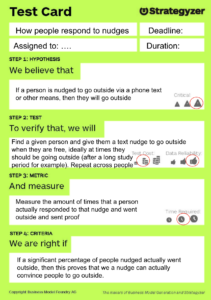
- Do students want to spontaneously go outside? One of our most important assumptions is whether students truly prefer spontaneity over planning. This is a core part of our concept: rather than asking students to plan outdoor time in advance, we want to test whether “right now” prompts and nudges are more effective.
- Will nudges actually cause action?
We need to prove that students will not only notice the prompt, but actually change behavior (go outside when nudged). This sits at the intersection of desirability and feasibility (“can we deliver nudges at the right moment and in the right way without creating friction or annoyance?”). - Is texting the right medium for nudging?
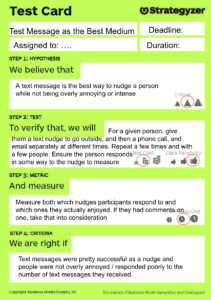
Based on feedback that calls can feel intrusive or annoying, we’ve shifted toward text messages. Now we need to validate that SMS is the best delivery channel (versus email or other formats) for something lightweight, timely, and repeatable. This also builds on the topic above that if nudges are sufficient, a text message is the correct nudge.
These are the three assumptions that we decided to test, and therefore the test cards are built accordingly to test these quickly and provide the necessary feedback.