
Introduction
Hey there! We are four individuals who want to get out of the house, away from zoom meetings, and spend more intentional time outdoors. Our mission during the course of 247B: design for behavior change is to reimagine the way young adults spend their time outdoors. We hope to transform the way people perceive their relationship to the outdoors in favor of a more healthy and nurturing mental framework through a mobile-based app.
Thus, we foraged into the world of mobile apps to explore the existing solution space through a literature review and comparative analysis, which you’ll find here.
Through our literature review, we were able to learn people’s motivations for going outside. These reasons included socialization, mental relaxation, mental acuity, physical exercise, escape from work and responsibility, etc. We also researched factors that may influence people’s access to the outdoors, which included race, gender, age, class, and geographical location.
Those that had access to the outdoors, particularly those with safe surroundings and extra time, enjoyed the outdoors for the mental and physical wellness benefits. However, for most people, they aren’t spending the recommended amount of time, 120 minutes a week, outdoors anymore…especially since the pandemic uplifted everyone and created a culture of seclusion. This is why, now more than ever, it’s critical for us to be creative and explore how to get people back outdoors, safely and thoughtfully.
Analysis of existing comparators
The comparators we chose to analyze represent people’s desire to explore physical spaces and have fun. They include: Geocaching, Pokemon Go, Neighborland, Sky Guide, and Stanford TreeMaps.
GeoCaching

One of the more popular apps designed to encourage outdoor exploration is the GeoCaching app, with over 36k reviews on Apple’s App Store. Upon opening the GeoCaching app for the first time, users are greeted with the app’s tagline: the game to have fun outside. GeoCaching is also described as the “world’s largest treasure hunt” that can “take you to a place in your town that you’ve never been to before”. GeoCaching entails searching for “GeoCaches”, containers with a log book and knick knacks, that are listed on the app by location. The GeoCaching app is a great way to encourage outdoor adventures into the unknown, but it is not necessarily the best for individuals who are struggling to make going outside a part of their daily activities. GeoCaching is less of a casual activity and more so requires intentional planning – especially if one lives in an area that is not rife of GeoCaches.
Neighborland
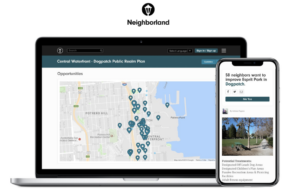
Rather than specifically exploring apps directly facilitating spending time outdoors, we thought it would be useful to discuss how we can address the primary motivators we saw for spending time outside. One of the root issues we saw was the importance of community building and intentional time spent outdoors but the difficulty to find the means to. Repeatedly, we saw that spending time outdoors was more enjoyable and meaningful when connected to friends or a local community, especially when tied to a specific goal or activity. Neighborland is a public engagement platform for connecting individual organizers and civic agencies with community members in order to coordinate on neighborhood projects through facilitating feedback, inter-community conversations, and ways to actionably engage with community projects. Projects typically are urban planning efforts to improve community infrastructure and wellbeing, including the coordination of outdoor recreation spaces and parks. A prominent case study that comes to mind is a coordinated effort between 65,000 residents with their local officeholders to build Dorothea Dix Park, a green park in the heart of an urban space over 18 months. While this product mainly is a service used by government agencies and is not directly tied to promoting the habit of going outside, these principles of intra-communal engagement so that residents have a stake in their community spaces is poignant, especially for those living in urban areas with barriers to accessing green spaces. For our purposes of encouraging people to spend time outside, perhaps a peer-to-peer type community would be more appropriate. The value proposition for this service is ‘allowing members to have a stake in community projects’.
Sky Guide

When thinking about how we could make time spent outside more meaningful, we realized how easy it can be to fail to engage with one’s surrounding environment. Prompting someone to take note of environmental aspects that would have otherwise gone unnoticed is one way to get them to engage with their surroundings, a practice that the Sky Guide app embodies. Using AR, Sky Guide creates an easy to use platform that enables any user, whether they’re a constellation enthusiast or rookie, to identify stars and constellations easily. While the functionality of the app itself won’t necessarily encourage someone to go outside, it enhances the outdoor experiences of its users. Additionally, users can subscribe to notifications regarding meteor showers, eclipses, or other events, and these notifications can serve as encouragement to step outside.
Pokemon Go

Similar to above, people expressed that as they got older, they stopped spending intentional time outside due to time constraints and low-motivation. It was very intuitive to go outdoors and play with friends and create games out of virtually nothing. However, one interviewee stated “social incohesion” as they got older; their friends stopped enjoying the outdoors as much as them, got busy, and left them with less stimuli outside. One way that some have continued to inject this playful aspect into their adult-life through Pokemon Go’s gamified augmented reality. The game intentionally was targeted toward the Pokemon franchise’s audience, but quickly expanded to anyone with a smartphone who wanted to understand the buzz around the app at a time the mixed reality technology was new to the mainstream. Thus, key features of this app that drew users out of their comfort zone and homes were: a unique user experience, competitive nostalgia-inducing gameplay, and natural network social virality. This was an extremely successful app that was able to leave a mass cultural impression around the globe amongst teens and young adults alike during the Summer of 2016.
Stanford Tree Maps
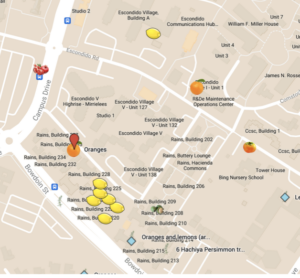
Another compelling insight we found was that once people spend time outside, in order to make their time intentional and sustained over time, people want to build a meaningful relationship with the land around them. One of the main ways people described achieving this was by developing a knowledge of the local flora and fauna around them as well as learning about the history of the land. While the digital UI is rudimentary and non-essential, this idea of developing an intimate awareness of the natural space around you is captured in Stanford Tree Maps. Stanford Tree Maps is an online project that provides an interactive map of local trees on the Stanford campus, including fruit trees for picking and eating (including seasonality), routes you can take on tree walks, and detailed scientific description and historical narratives on trees around you. This information is not general textbook information but includes specific local stories, like when and why the trees were planted there (e.g: These 1900 specimens originally grew at the first women’s dorm … and were transplanted to make room for Sequoia Hall). The Stanford Tree Maps project is more of an interactive encyclopedia rather than a proper digital application, but these ideas are invaluable as a comparator in designing a sustainable, meaningful service for getting people outside. The value proposition for this service is ‘empowering users to learn about the story of the natural landscape around them.
Analysis
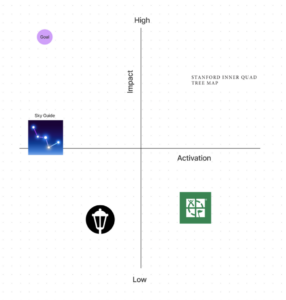
From these diverse sets of products and services ranging from gamification, community engagement, integrated reality, and education, we compared them on a 2D matrix mapping the product’s impact (the influence the app had on sustained, habitual behavior change) and labor / difficulty (the amount of activation energy and effort it takes to consistently maintain usage of the app). Interactive but gimmick-y game based applications like geo-caching had high labor associated with using it with little sustained impact. Interactive and educational applications like Stanford Tree Maps have high labor costs but have the potential for a sustainable impact as users grow connected to the community around them. Low impact but low effort applications include the community forum based Neighborhood, which made it easy to engage with physical communities around you but was not always related to personally spending time outside. Based on our comparison, we want to try to incorporate components of each service but optimize our service such that it is low labor, high impact.



