
Storyboards
Idea 1: Building sun habits with friends through a social app similar to BeReal.
This idea revolves around taking a selfie at a random time during the day in the sun and being able to see other ways people are incorporating sun into their lives. In the storyboard, our protagonist is driven by social pressures to go outside, and her sun exposure habits are tied to other people inviting them out.
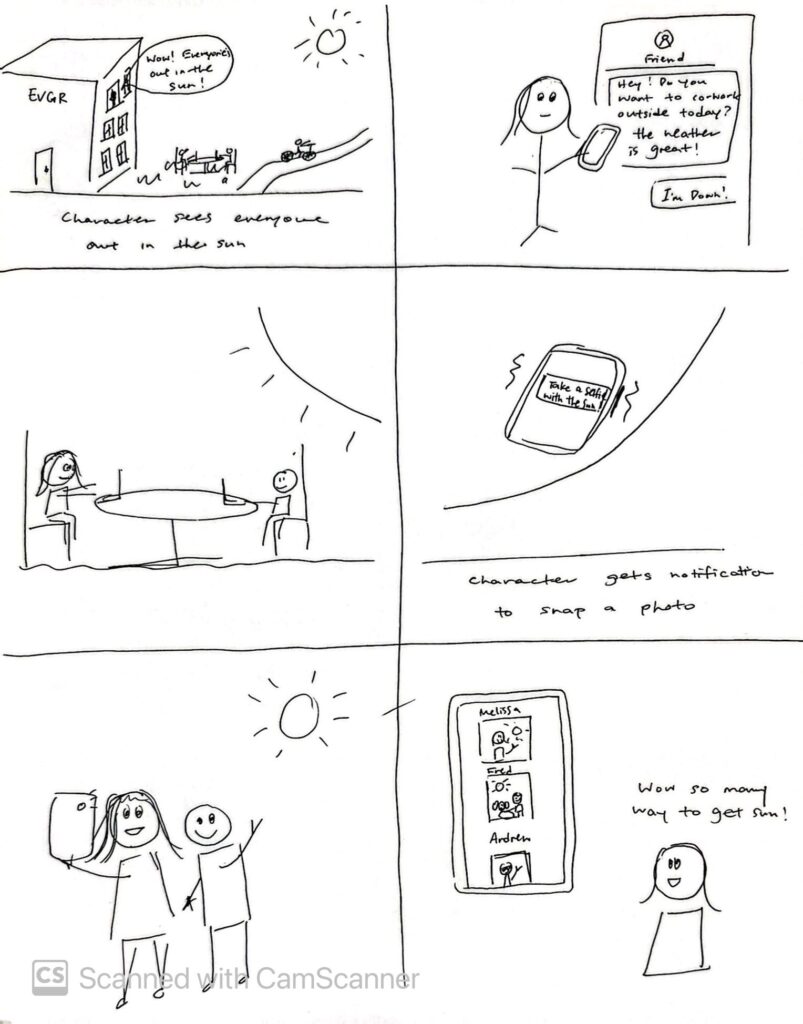
- Pros: This idea creates social accountability, and provides ways for people to reinforce each other’s habits by inspiring people with ideas on how to get more sun.
- Cons: This social pressure of posting each day can become an extrinsic motivator and crowd out a person’s intrinsic motivation to get sun for their own good. Moreover, the solution doesn’t hold the person accountable for staying out in the sun for a certain amount of time, so people can just “fake it” and go back indoors.
Idea 2: Getting sun first thing in the morning for 10 minutes.
In the storyboard, our protagonist is a student who feels tired all the time, falling asleep at 3pm – in the middle of the school day. They use coffee as a temporary antidote to their tiredness, but it just leads to a crash. Following this crisis, they decide to get 10 minutes of sun a day, which leads to feeling energized to do work for the entire day.
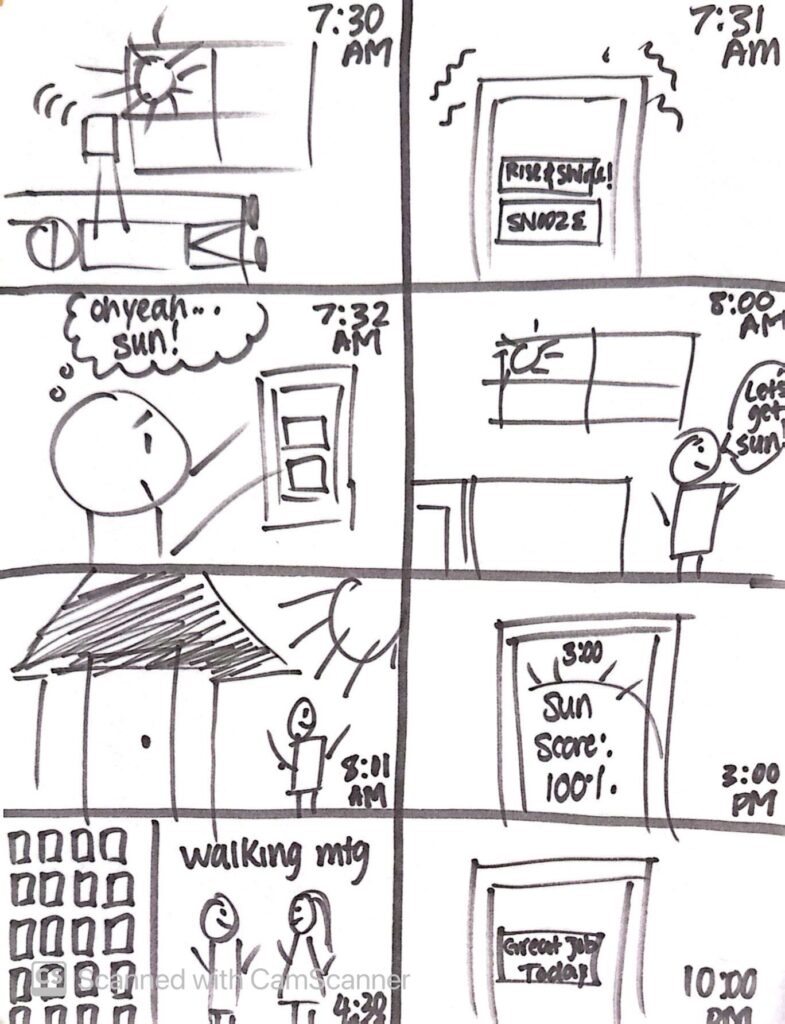
- Pros: This solution is simple and straightforward and doesn’t require too much effort from the person. It doesn’t disrupt any other part of the person’s schedule during the day, since they are getting sun first thing in the morning.
- Cons: Because the habit isn’t anchored to any other behavior, it might be hard to start organically.
Idea 3: Shifting indoor activities outside during the day.
In this storyboard, the protagonist is a health-conscious individual and has a yoga habit. However, she has a crisis when she starts working a 9-to-5, which requires her to be indoors all day. Her lack of sun, in turn, affects her circadian rhythm causing her to not get good sleep at night. She, then, decides to move her indoor yoga habit outside, which changes her life forever and helps her get good sleep at night.
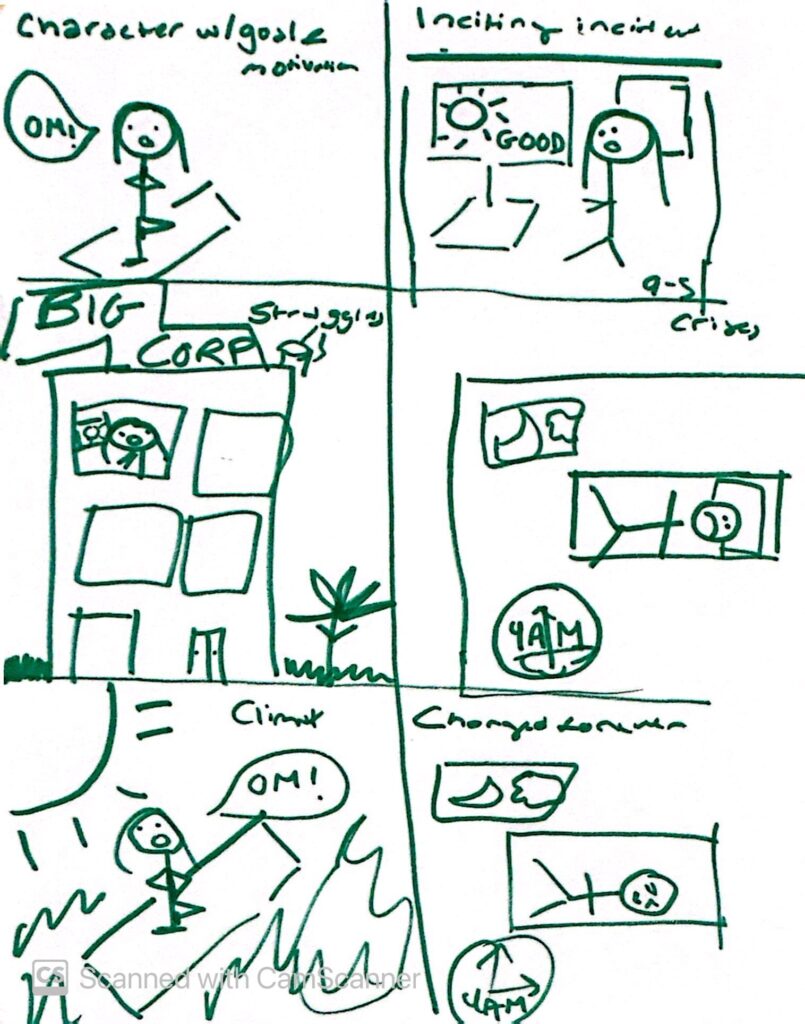
- Pros: This solution takes advantage of anchoring, using a preexisting habit (doing yoga) to develop a new habit (getting sun).
- Cons: Some indoor activities can’t be easily moved outdoors, especially in places where it gets really cold in the winter.
Intervention
For our final intervention, we combine the best parts of ideas 2 and 3 to help people develop a habit of getting 10 minutes of morning sun anchored to an existing morning routine.
We base our intervention off of this scenario:
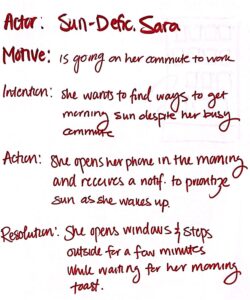
In this brief storyboard, Sun-Deficient Sarah receives a notification in the morning telling her to prioritize the sun as she wakes up. She opens windows and steps outside for a few minutes while waiting for her morning toast, thus anchoring her sun habit to an existing habit of making toast every morning.
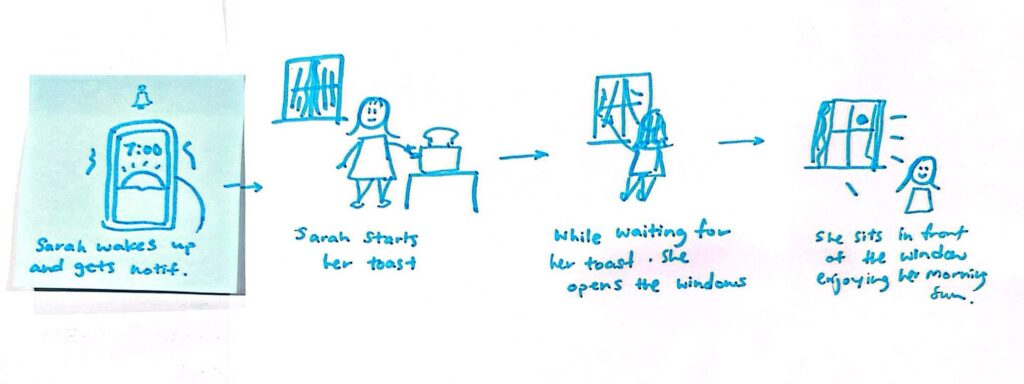
This intervention is informed by our findings in the baseline study, which shows that people are often too busy – their schedules are too unpredictable to fit in the sun during the day – or their commitments force them to stay indoors. That’s why we want to build it into their morning routines, which is consistent from day to day. Our literature review also backs up the advantages of getting morning sun, which can lead to better sleep at night and more alertness during the day.
Intervention Study Design
An important part of the intervention study was to understand the mental model of the participant, what related behaviors might be creating roadblocks to getting more sun and what related behaviors can be used as opportunities to get more sun. Therefore, we wanted to probe how participant behavior would change if they were notified early on to take a habit outside/habit stack to gain sunlight.
Once a day, we will message each participant in the morning to prioritize sun by pairing an existing habit in their morning routine with sunlight (ex taking the habit outside or opening a window while doing the habit), and then send them a Google form around sunset asking them to write down which activity they chose to habit-stack with sunlight, and what time in the day they did this. Below this, we have attached the survey we will be using.
Before the study, we will conduct screening interviews with the new participants. After the study, we will conduct post-study interviews with all participants to see how our intervention did or did not inform a behavior change. All interviews, transcripts, audio recordings, and other information will be linked in the following folder: Pre- & Post-Intervention Interviews
Pre-Study Interview Script: Pre-Intervention Interview Script
Post-Study Interview Script: Post-Intervention Interview Script
Data Collection Plan
In our study, we will collect data from our participants on a daily basis. Each day, participants will receive a text from us in the morning reminding them to get sunlight. We will take advantage of the “Schedule Message” feature on iMessage to automatically set up messages for each of the four days.
We will ask participants to respond by “liking” the message we first sent, or replying with a confirmation message. If we do not receive an update from the participant by mid-day, we will send a follow-up reminder.
Our intervention is based on habit stacking. We will ask participants to choose something they do everyday, and then ask them to continue that habit for 4 days for the study. For example, if Sarah (example participant) makes toast every morning, she would wait for the toast in front of a window with sunlight, and describe that action in the survey. Participants will also be able to send a photo over text, if they so choose, but it will not be required.
At night, for the four days, they will record the activity they usually do (ex: morning toast) with sunlight: SURVEY LINKED HERE!. From this daily survey, we will have text, multiple choice responses, as well as an answer for the activity they took outside. A key metric to evaluate will be the amount of time spent outside on these days, and whether the amount of time increased throughout the four days, decreased, or stayed the same.
These data will populate a spreadsheet, and we will gather insights from this spreadsheet. Additionally, data from the post-intervention interview will be analyzed.
Study Materials
[New participants] Intervention Study Introduction Email
[Subject line]: Did you go in the sun today? A study! ☀️
Hi [Name],
Thanks for helping us make life a little brighter—literally! We’re so excited to include you in our study on sun habits and are following up on next steps:
- Pre-study interview (30 minutes)
- Each day, you’ll receive a text from us in the morning
- At night, for four days, record when you were able to pair a habit you always do (ex: morning toast) with sunlight: SURVEY LINKED HERE!
- Post-study interview (30 minutes)
Please reply to this email with your phone number, so we can reach you to remind you to choose a task to take outside. Thank you so much for your participation.
Best,
Zoya, Emily, Athena, Isabelle, Henry
Stanford University
Study End Email
[Subject line]: Thank you for participating in our sun habits study!
Hi [Name],
Thank you for being part of our study! We can’t wait to share the insights we learn, and hope you enjoyed tracking your own sun habits for a period of time.
Best,
Zoya, Emily, Athena, Isabelle, Henry
Stanford University
[Returning participants] Intervention Study Introduction Email
[Subject line]: Did you go in the sun today? A study! ☀️
Hi [Name],
Thanks for helping us make life a little brighter—literally! We’re so excited to include you in our study on sun habits and are following up on next steps:
- Each day, you’ll receive a text from us in the morning
- At night, for four days, record when you were able to pair a habit you always do (ex: morning toast) with sunlight: SURVEY LINKED HERE!
Please reply to this email with your phone number, so we can reach you in case you need help or anything at all. Thank you so much for your participation.
Best,
Zoya, Emily, Athena, Isabelle, Henry
Stanford University
Study End Email
[Subject line]: Thank you for participating in our sun habits study!
Hi [Name],
Thank you for being part of our study! We can’t wait to share the insights we learn, and hope you enjoyed tracking your own sun habits for a period of time.
Best,
Zoya, Emily, Athena, Isabelle, Henry
Stanford University
Introduction Guide
Welcome to the Sun Study! ☀️
Thank you for agreeing to participate in our class study on sunlight exposure and habits. Our goal is to encourage you to spend a little more time in the sun.
What next?
Joining this study means you agree to a pre-study interview, four days of logging your habits, and a post-study interview.
- Schedule a pre-study interview (~30 minutes). Do any of the following times work? XYZ times.
- Each day, you’ll receive a text from us in the morning reminding you to pair one of your morning habits with sunlight.
- Take a photo of yourself doing your habit with sunlight each morning.
- At night, for four days, record whether you were able to pair a habit you always do (ex: morning toast) with sunlight: SURVEY LINKED HERE!
- Post-interview study (30 minutes). We’ll follow up over email after the study is complete to schedule a post-interview.
Expectations
We really appreciate your time and interest in this study, and hope you complete the full four days and two interviews. If you need to drop out mid-way, please let us know as this affects our study results.
Discussion Guide
Each morning you will receive a text reminding you to spend time in the sun. In the evening, you will fill out a short survey answering the following questions.
- What activity did you pair with sunlight today? Short answer.
- How long were you in the sun? Multiple choice.
- Were you in direct or indirect sunlight? Multiple choice.
- Did anything prevent you from pairing your habit with sun today? Short answer.



