

For our intervention study synthesis, we explored how recent graduates maintain friendships and tested assumptions about digital connection, reminders, and relationship upkeep. Through assumption mapping, user testing, and intervention studies, we identified key insights that shaped our solution, a plant-based widget designed to encourage meaningful interactions.
Assumption Map

Figma link here
Our assumption map highlights key factors influencing post-grad friendships and how our plant-based widget can help maintain them. One major assumption was that time since last contact adds friction, making it harder to reach out. Our tests confirmed this, with participants expressing difficulty maintaining friendships due to life transitions. We also assumed that people will reach out if reminded, which was tested through in-person prompts. While some acted immediately, most acknowledged the need but didn’t take action, suggesting that reminders must be designed for seamless engagement.
Another key insight was that new grads miss their old friends, validated by survey data where 78.6% of respondents rated staying connected as a high priority. We also assumed that friendships can be maintained through check-ins and texts, and our tests found that while participants were generally satisfied with their communication time, they desired more meaningful interactions rather than just increased frequency. The assumption that guilt translates to action had mixed results; some responded immediately, while others simply acknowledged the reminder, suggesting guilt-based nudges should be low-pressure. Lastly, we found that new grads are dissatisfied with current digital friendship styles, reinforcing the need for a more engaging, natural way to stay in touch.
These insights will help refine our solution, emphasizing quality over quantity in digital interactions and ensuring reminders are effective without being intrusive.
Assumption Tests & Report
Test #1: Phone Desirability
Alison Results:
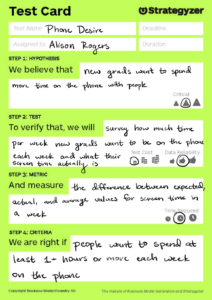
We reached out to six college recent graduates through text and snowball recruiting due to their proximity to our target demographic. While not all of them have moved out in the last year, many of them have moved out in the last two years. Those who had moved out over a year ago were all non-Stanford graduates, which we wanted to ensure we included in our sampling. Our participants reported the following:

Some participants also replied with qualitative data about their time spent: “I just started a long-distance friendship, and it’s going very well” and “I relatively meet my goal for communication time. If anything I want to spend more in person time with friends.”
Our assumption here was incorrect, as our mean desired change was 10 minutes and our median response was no change. This will shift our focus away from increasing time spent and more towards increasing quality of digital interactions.

Test #2: Reminder Feasibility
Nils Results:
To assess whether reminders are an effective method to encourage people to reach out to their friends, I created a sign that said “Have you reached out to anyone today?” And held walking around white plaza and Tressider, areas populated by many Stanford students. If I noticed someone college aged looking at the sign on foot and without headphones in, I directly engaged them and asked if they had reached out to anyone. These participants were picked because they most closely resembled our target audience of recent graduates while being reachable and (at least presumably) open to interaction.
Regardless of their answer, I encouraged them to immediately reach out to more friends and loved ones. Here are the raw responses:

- “I’m good thank you”
- “I have…I will”
- “I have”
- “I have….I will”
- “Not yet”
- “I’ll text my mom right now” (immediate action)
- “I’ll text them right now too” (immediate action)
- “Texting my sister now” (immediate action)
- “Okay”
- “Not yet”
- “I should…I will”
- “I have”
- “No I haven’t but that’s a good idea…I will”
- Ignored with eye contact
- “I have…no”
- “I have…no thanks”
- “I haven’t…yeah yeah I’m going to”
- “I have…sure I will again” (did it immediately)
- “Nah not yet…sure I’ll do it”
In general, the vast majority of people did not take action, although most said that they had already reached out and many promised to take action. However, there’s no way for us to know whether they actually took action and the unique social situation of being accosted by a stranger with a sign is likely to impact their promises.


Test #3: Maintaining College Friendships
Emma Results:
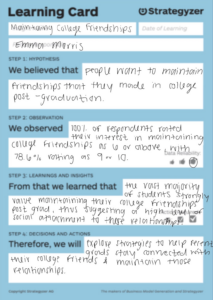
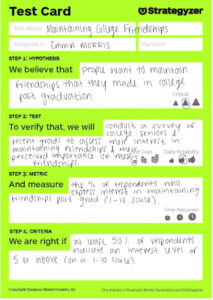
To explore the importance of maintaining college friendships post-graduation, I conducted a survey with 14 recent graduates, asking them to rate their interest in staying connected on a scale of 1-10. I recruited participants through direct outreach and social media, targeting individuals at a transitional stage where friendships may be impacted by career shifts and distance. The results showed that 100% of respondents rated their interest as 6 or above, with 78.6% rating it at 9 or 10, confirming that maintaining friendships is a high priority for most graduates. This suggests a strong emotional and social attachment to college friendships, highlighting the need for tools or strategies to help facilitate ongoing connections. A follow-up study could explore the specific challenges graduates face in staying connected and identify the most effective ways to maintain these relationships.

Test #4: Digital vs Mixed Interaction for Maintaining Friendships
Houston Results:
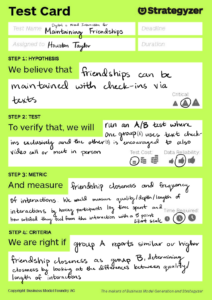
I had two people in Group A and two in Group B
- Group A: Clemson new grad from South Carolina working as an engineer and co-term from Washington studying economics
- Clemson grad was chosen because he is a new grad who is experiencing long-distance friendships due to relocation. He has a mix of new friends from work and old friends from school and his best friend lives in Colorado, giving insight into how text-based check-ins work for distant friendships.
- Co-term was chosen because she is about to transition into post-grad life and has friends who already have, so she is somewhat familiar with long-distance friendships.
- Group B: Stanford senior from Los Angeles studying psychology and Stanford graduate from Florida who studied human biology
- Stanford senior was chosen because she is highly comfortable with texting and maintaining digital friendships, so it would be interesting to see if FaceTiming and such adds value.
- Stanford grad was chosen because she has the opposite behavior to the senior and tends to be passive about digital communication. I thought it would be interesting to see if asking them to reach out changed the behavior of someone who normally does not.
I called each of them or asked them to participate in person and explained their role, having them reach out to a friend in the designated manner and text me how they felt after their day’s interactions, answering the following short questions for each:
- How much time did you spend interacting with this person?
- (For text only) Was this time consecutive?
- How satisfied did the interaction make you feel (1-5)?

Intervention Study

We designed our intervention study to specifically target the findings we found in our assumptions tests that our users a) would reach out to friends if reminded, b) are worried about quality of interactions rather than sheer quantity, and c) that occasionally, guilt can translate into action.
Our intervention study was conducted from February 17 – 21, with each of our five participants completing their diaries over four consecutive days within that time frame. Before the study began, each participant submitted the names of three friendships they would like to track through our study and what kind of plant they would like to represent that friendship as (cactus for low-maintenance, flower for medium-maintenance, or herb for high-maintenance). Each night, they would fill out a diary logging their interactions with each friend; each morning, they would receive a ping with their plants’ statuses for that day.
The study was successful overall. We saw significant results on how our participants affected friendships, though we found that the guilt aspect of our intervention came across slightly too strong. You can view some of our synthesis at this FigJam, and we have distilled our key insights below in more detail. For our participants’ diaries and interview transcripts, please check out this Google Drive folder. For anonymity, all names have been anonymized.
Key Insights
Key Insight #1: The plant metaphor really worked.
All of our participants tied friendship health to plant health, finding the plants to be a direct representation of what their plants looked like. This connection was extremely strong for four out of our five participants and strong enough for our fifth participant. As we hoped, the plant metaphor led people to consider quality and frequency of interactions, as well as providing some salient insights for participants about their friendship dynamics.

Key Insight #2: The visual representation of friendships can cause stress.
The same four participants who tied the plants extremely strongly to friendships reported more stress tied to the plants throughout the intervention study. This brought up concerns of “gamifying” and obligation, as well as contributing to a negative effect on wellbeing.

Key Insight #3: The salience and sensitivity of the plants contributes to this stress.
Our participants mentioned many ways in which passivity would help mitigate this stress. This ties into our eventual goal – to implement the plants as a widget rather than as a constant stream of push notifications. While users appreciated notifications prompting their own input about friendships, they did not enjoy constant reminders about their plant statuses. Tied into this theme was also concerns about frequency, with the daily updates being overwhelming to many participants.

Key Insight #4: Users crave modularity in frequency and method.
Some users found reminders during busy periods of their lives to be helpful; some found them to be stressful; most mentioned that there were slight mismatches between how the intervention functioned and how they view their friendships. Friendships are deeply personal to each user, and there is no one-size fits all approach.

Solution Changes
In our solution moving forward, we want to introduce more modularity in plant selection by allowing users to have more input into the plant maintenance plans and the ability to change what plants friends are represented by. We are also eager to shift towards our final idea of using widgets to create more passive reminders rather than in-your-face notifications that can stress out users. We will still keep interaction logging as a part of our solution, as our users found manual logging to be a helpful tool for internal reflection. To limit the amount of work that this adds to our users and to further minimize the stress and overwhelming nature of our solution that our users reported on, we will limit the total number of friendships that users can track.
System Paths

Figma link here
The system paths revealed a few key aspects about our intended solution. Overall, our solution relies heavily on a strong setup and harnessing that initial energy and motivation the user has when they download the app. The setup flow will be similar for all users, although people invited to plants created by friends won’t have to go through the plant setup in the same way. We discovered that when we have personas such as anxious Ally, who is not just socially anxious but also resistant about giving her data to any old app, it’s crucial to have a way to use the app that doesn’t involve offering your personal information.
One of the most crucial insights we gathered from this exercise revolved around how and when the user adds the widget to their home screen. This is a crucial aspect of the app because our solution clearly doesn’t work without it, but it’s also awkward to add in the onboarding flow because it forces the user to exit the system. In building this system map, we decided the best solution would be to prompt the user to add a widget right after they have added their first friend. That way, they exit the app when the widget will be providing real value. Also, since it’s at the end of the setup, it’s not a worry that we directed them to leave the system because theoretically we don’t need them any more.
Story Maps

This story map shows how users may take many different approaches when completing any one of our tasks, such as adding a plant through their contacts or directly typing in the name associated. When looking towards our MVP, we decided to keep it simple and only have one option for each of the tasks. We also realized that none of our core functionality relies on having an account, so we are able to significantly reduce the scope of the MVP by focusing on the plant visualization rather than unnecessary overhead.
MVP Features
Here is a storymap representing the reduced necessary features for our MVP:

The final list of features and details is as follows:
- Add plant flow
- Enter name of friend
- Choose plant type
- Adjust frequency of goals for calling/texting
- Customize notifications
- Add plant to widget
- Check plants
- Garden widget
- Visualize whether you’ve met goals based on state of plants
- Plant care
- Select option to water/resoil/give sun to plant
Bubble Map

Figma link here
To create the bubble map, we began with listing the core mechanics of the app and using these MVP features as a foundation. From there, we grouped related tasks and elements into the two main areas you see above: Plant Care and Garden; these groups reflect the two major flows that users go through to use the app. From there, we branched into subcategories like Care Logging and Plant Creation, further breaking them down and adding more detail.
Color-coding and size variation were used to group related features and indicate importance/frequency of use, respectively. Dashed outlines indicate optional features.
Key Insights
From this process, we found a few key insights and want to keep the following in mind as we develop our final product:
- Prioritization: Core features like care logging take higher precedence than smaller circles or optional features
- Interconnectedness: Mapping features highlights the elements that need to be more connected, like Widgets and Plant Profiles needing care information
- User Flow: Structuring features showed how uers naturally engage with the app, moving from creating a friendship/plant → maintaining it → reflecting on it



