
Intervention Study
Overall, our intervention study went relatively well. We had 11 total participants who recorded their bedtimes and how they felt in response to our intervention over the course of five days. Our study design focused on the “visualizing tomorrow” section of our final design concept. We created a list of memes and reminders that were sent to participants every hour starting at their intended bedtime. Ideally, in our final design, these memes would be personalized images taken by the participants themselves during the day. We also created a Google Sheet containing five separate sheets for each participant, which they used to record their bedtimes and answer questions related to how they felt as a result of the intervention. Most participants completed their sheets consistently.
Although most participants completed their sheets, we noticed that some responses were oversimplified and might not be very informative. For example, when answering the question, “How did you feel when receiving text messages and pictures reminding you to sleep?”, some participants only used a few adjectives to describe their feelings without explaining the full context, such as what they were doing when they received the message, what they were thinking at the time, and how the reminders changed (or did not change) their emotional state. More detailed reflections would have provided richer insights into how the intervention actually influenced their behavior.
We also noticed that the reminders had completely different effects on the same participant across different days. For example, on one day a participant might feel that the reminders played no role; on another day, the same participant might feel that the reminders encouraged them to commit to sleeping earlier; on yet another day, they might feel guilty because of the reminders but still refuse to go to bed immediately. This suggests that our intervention produced inconsistent effects across contexts. This could be due to variations in daily workload, stress levels, emotional state, or the perceived urgency of competing tasks.
Furthermore, we observed that even when participants reported feeling guilty or reminded by our intervention, they often did not stop what they were doing and immediately go to bed. This pattern was not limited to cases of procrastination; it also applied when participants were working on tasks they perceived as important, such as completing homework or studying for midterms. This suggests that when participants prioritize certain tasks over sleep, they tend to ignore our reminders. In other words, the reminders do not necessarily shift how participants prioritize sleep relative to other responsibilities. This is likely due to deeper cognitive patterns around productivity, deadline pressure, and perceived self-worth tied to task completion. This represents a significant limitation, as our goal is to address the root issue of under-prioritizing sleep. Therefore, we plan to further investigate how to influence participants’ prioritization frameworks rather than simply reminding them to sleep.
In summary, our key insight is that reminders alone can trigger emotional reactions but are insufficient to change how participants prioritize sleep over competing tasks; therefore, our potential solution is to move beyond passive reminders and design mechanisms that reshape prioritization itself. In future iterations, this may involve integrating commitment devices, earlier-day planning prompts, or reflective exercises that help participants pre-commit to stopping work at a specific time. We also expect that once the intervention design is replaced with our final intended design, the effects will be more prominent by emphasizing the priorities of sleep. Right now our intervention with memes significantly compromised this feature of our study. We may also explore reframing sleep as a productivity investment rather than a competing task, so that going to bed feels aligned with, rather than opposed to participants’ academic goals.
System Paths:
Target Persona: “Just one more” User
Meet Sally, she represents the student who always is doing “just one more” before bedtime. Just read one more chapter on her phone. One more game on her computer. One more episode on the show she is watching. Pretty soon it’s 2 or 3am and her sleep schedule is wrecked. This cuts into next day productivity and ultimately future entertainment time. While she tries screen time apps, she needs something that reminds her to avoid clicking “next episode” or “next chapter” before she unconsciously clicks and regrets it!
This is the target user persona that we address in our system path and story map below.
 Process and Insights:
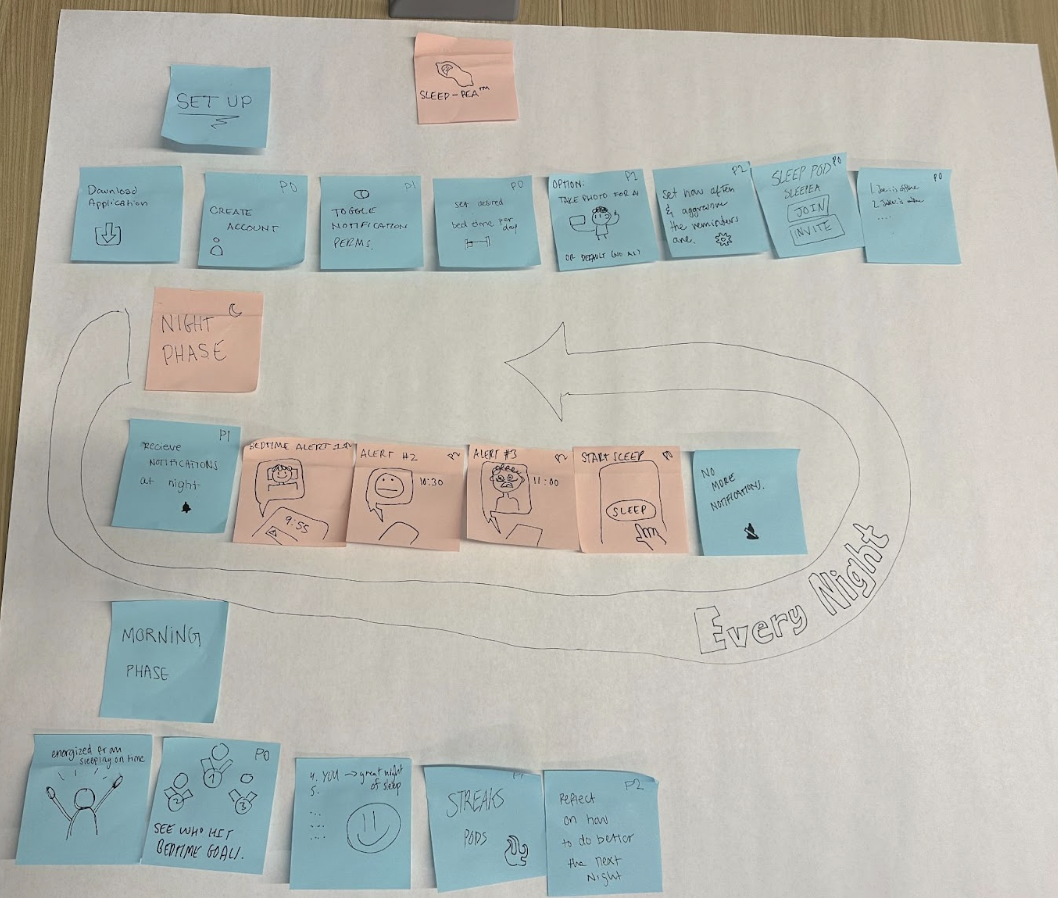
Our system is defined by three key events: Setup, Night Phase, and Morning Phase. For our final project we are planning to implement two key mechanisms/features to help our users develop healthier sleep habits: Bedtime alerts with visualizations of the next day (our intervention study focus) as well as social motivation with steaks and friendly competition.
Setup: The system map helped us define the flow and requirements of our setup. Specifically, we aim to prioritize a quick setup that only requires the bar minimum features to be enabled. In the setup we have the user enable notifications, set a bedtime goal, notification timing, optionally have AI photos, and create a sleep pod. The process helped us to the insight that we want AI generated future photos to be optional – increasing app inclusivity.
Night Phase: This system looks pretty similar to what we’ve been envisioning and testing, alerts on a regular timeline before and after someone’s set bedtime goal. The process helped us consider how the user will signal to the app they are sleeping, highlighting potential integration with wearables for applicable users.
Morning Phase: The process of the system map also helped us address further features we want in the morning/post sleep phase. This includes personalized feedback with streaks and data as well as social feedback seeing how you rank in your sleeping pod (friend group).
Story Maps:
Process and Insights:
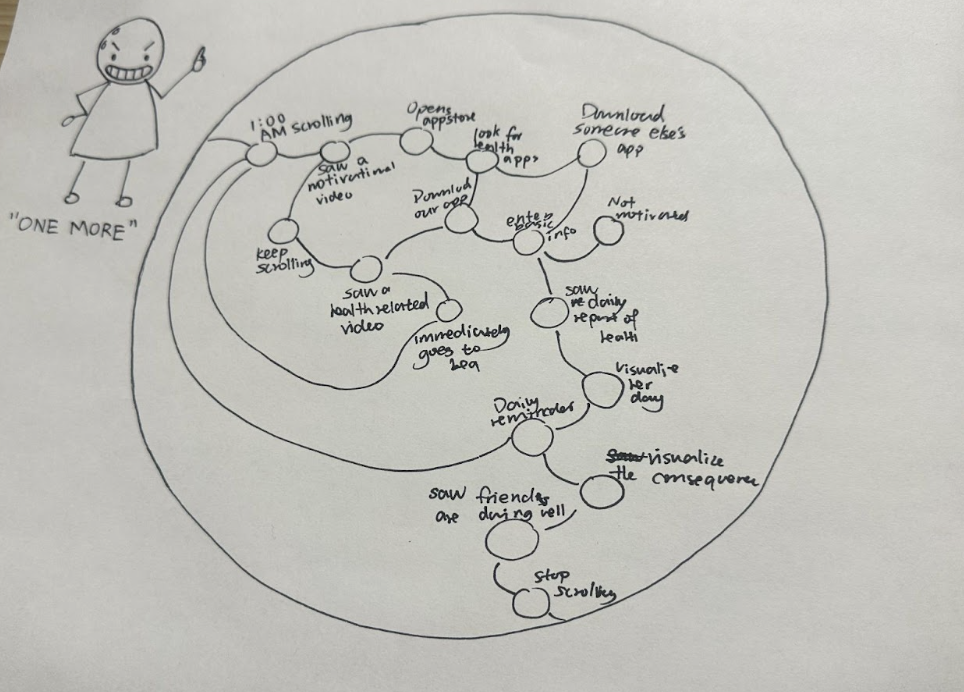
The process of creating our story map helped bring to light how different each person’s night, even within the same “one more” persona, could be. We explored how a user might be motivated on a given night to make a change in their habits and use our app. This brought us to the insight that the the time a user is most likely to download our app is when they are guilty from staying up way too late (we also expect a much smaller portion of downloads to come in the morning/day).
Furthermore, from personal experience and the intervention interview that our app is one mechanism of many that can remind/pressure a user to go to bed. There are already motivational videos on short form platforms that push users to go to bed and take back control of their sleep. This can both be a partner in motivating sleep, as well as motivating the activation to download our solution.
Additionally we explored how the bedtime reminders likely need to be multiple, one is simply not strong enough to enact change on a user that repeatedly is pursuing entertainment instead of sleep. The simple reminder every 30 minutes is helpful, regardless if they hit their exact bedtime goal. 7 hours of sleep is not perfect, but far better than 5 hours.
MVP Features:
Below we describe our MVP features and how our story maps and system paths led to these features:
Feature 1: Setup & Onboarding Our application will include an account creation and onboarding flow where users sign in, set their bedtime goal, customize their notification preferences, and grant app access to Health Data. This feature is tied to the Setup phase of our system path, where users download the app and configure their profile. The story map reinforces this step, showing our persona opening the App Store, looking for health apps, downloading the app, and entering basic information, but end up feeling unmotivated when the setup feels long or irrelevant. By making onboarding quick and meaningful, we are catering specifically to our “Just One More” persona.
Feature 2: Sleep Pods Our application will include a Social Sleep Pod feature where users can join a group with friends or invite others to join their own group. This feature is based on the Sleep Pods section of our system path. The story map highlights a critical motivator: our persona saw friends doing well with their health habits, which directly prompted them to stop scrolling and take action. By incorporating social accountability, Sleep Pods should help support behavior change.
Feature 3: Bedtime Reminders Our application will send push notifications beginning at the user’s target bedtime and repeating at a user specified frequency until the user logs that they have gone to bed or their health data shows they are asleep. This feature connects directly to the Night Phase of our system path, where our “Just One More” persona receives reminders that interrupt the cycle of “just one more” xyz activity. The reminder structure creates repeated, low-friction friction nudges to encourage behavior change.
Feature 4: Morning Summary & Reflection Our application will present users each morning with a sleep quality summary, a view of which pod members hit their bedtime goals, and a short prompt either encouraging them to keep up their progress or offering a kind suggestion for improvement for the next night. This feature is tied to the Morning Phase of our system path. The morning summary allows the “Just One More” persona to see a daily report of their sleep and visualize the consequences of poor sleep. By presenting this info in a supportive, kind, and actionable way each morning, we positively encourage behavior change.
Feature 5: Streaks & Motivation Our application will track consecutive nights where users meet their bedtime goal at both the personal and pod level, displaying streaks to encourage users to keep going. This feature is tied to the Streaks part of our system path and connects to the insight from our story map that our “Just One More” persona is motivated by seeing friends doing well. Streaks provide motivation and reward consistency, to hopefully encourage sustained behavior change.
Bubble Map:
Describe your process and key insights from this step.
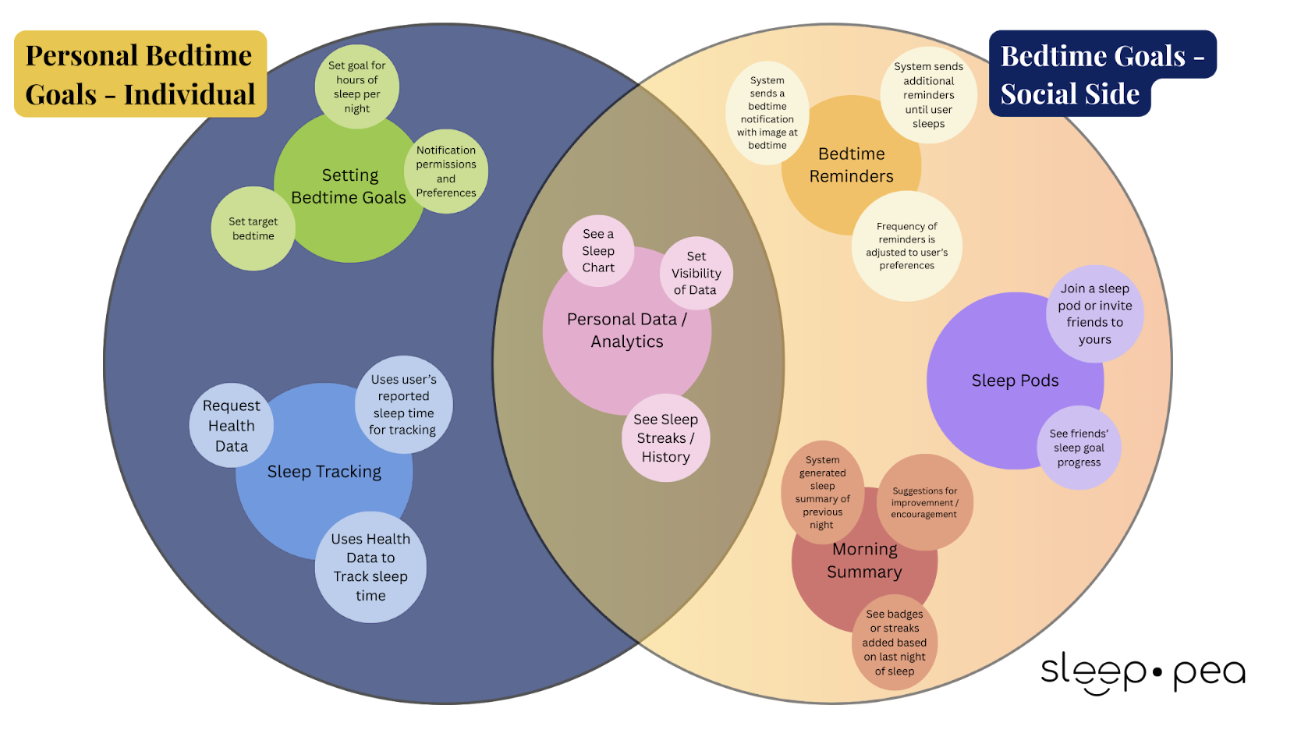
Creating this bubble map helped us see SleepPea as two interconnected systems: Personal Bedtime Goals on the left side, and Social Bedtime Goals on the right side. On the left, Setting Bedtime Goals (target bedtime, hours of sleep per night, notification preferences) feeds into Sleep Tracking, which pulls from either the user’s self-reported sleep time or Health Data to monitor whether goals are actually being met.
In the overlapping center, Personal Data and Analytics sits as the bridge between both sides. Sleep charts, streak history, and visibility settings live here because they are equally personal and social. This is where the user’s behavior is personally visible, and optionally visible to others.
On the right, Bedtime Reminders and Sleep Pods show how the system creates external pressure for users to follow through on sleep goals. The reminders are sent at a user-selected frequency until the user actually goes to bed, which we have drawn directly from the experience of our “Just One More Persona,” who we have chosen to design for. Sleep Pods add a layer of social accountability, letting users see whether their friends hit their goals, and pressuring the user to hit their goal as well .
The Morning Summary is a system-generated recap of the previous night, paired with suggestions for improvement or encouragement, and gives the user a reason to reflect before the next night begins. The bubble sizes reflect where the system is most important. The Bedtime Reminders and Sleep Pods carry the social side, while Sleep Tracking and Personal Data carry the individual side, and both the Individual and Social sides depend on the overlapping analytics layer to connect the users’ desire to change to a quantifiable outcome.
Assumption Map
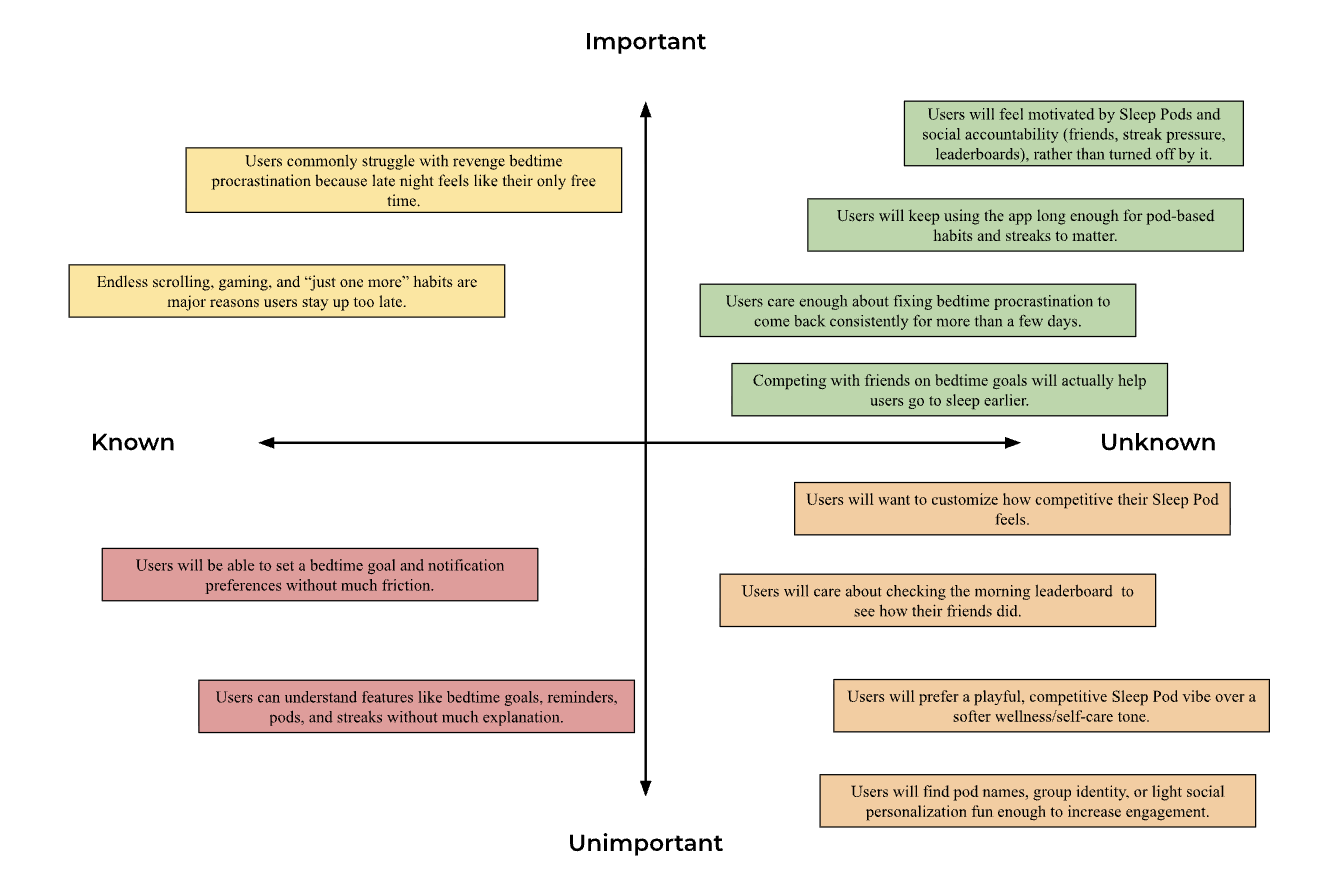
The biggest thing this map made clear is that the risky part of this app is not the app itself, it is the social bet behind it. We already know the problem is real. People stay up too late because nighttime feels like their only real free time, and the whole “just one more scroll, one more episode, one more game” loop is very real. What is still shaky is whether our solution actually works. The biggest unknowns are whether people will want bedtime accountability from friends, whether a little competition will genuinely help them go to sleep earlier, and whether they will stick around long enough for pods and streaks to matter. That is the part we really have to prove.
This also helped separate the stuff that feels core from the stuff that is honestly just polish. Questions like onboarding, feature clarity, customization, and whether the vibe should feel more playful or more wellness-focused do matter, but they are not the things that will make this concept live or die. If Sleep Pods are not actually motivating, then it does not really matter how clean the onboarding is or how cute the group names are. So the clear next move is to test the social accountability piece first, because that is the real engine of the whole idea. If that lands, everything else becomes worth refining. If it does not, then we probably need to rethink the concept instead of just dressing it up better.
Assumption Tests
Test Card #1: Sleep Pod Motivation Test
We believe that users will feel motivated by Sleep Pods and social accountability, like seeing friends’ progress, streak pressure, and light competition, rather than feeling judged or turned off by it.
To verify that, we will show users a simple prototype of the Sleep Pod feature and walk them through the experience of joining a pod, seeing group progress, and being compared with friends. Then we will interview them and ask how motivating, awkward, stressful, or appealing the feature feels.
And measure how many users say the Sleep Pod feature feels motivating, whether they say they would realistically use it with friends, and what percentage react positively versus negatively to the social accountability aspect.
We are right if a clear majority of users say the Sleep Pod feature feels motivating or helpful, and most say they would be willing to use it with friends instead of avoiding it because it feels annoying, embarrassing, or too intense.
Test Card #2: Bedtime Competition Behavior Test
We believe that competing with friends on bedtime goals will actually help users go to sleep earlier.
To verify that, we will run a small pilot where users track their bedtime for several nights while participating in a lightweight competitive pod system with shared progress, streaks, or a leaderboard. We will compare their behavior during the test to their normal bedtime habits and ask whether the competition changed their choices at night.
And measure changes in average bedtime, number of nights users meet their bedtime goal, and how often users say the pod competition influenced them to stop scrolling, gaming, or staying up late.
We are right if users meet their bedtime goal more often during the test period and a strong portion of participants report that the competitive pod feature directly pushed them to go to bed earlier than they normally would.
Test Card #3: Retention and Consistency Test
We believe that users care enough about fixing bedtime procrastination to come back consistently for more than a few days, giving pod habits and streaks enough time to matter.
To verify that, we will ask users to use a basic version of the app over the course of a week, including reminders, pod progress, and streak tracking. We will observe whether they keep checking in, logging progress, and engaging after the first few days instead of dropping off once the novelty wears off.
And measure daily return rate, number of consecutive days users engage with the app, and how many users are still actively participating after the first three to five days.
We are right if most users continue engaging with the app beyond the first few days and enough of them stay active through the end of the test period for streaks and pod accountability to start feeling meaningful.
These test cards make it pretty obvious that the real challenge is not building the app, but proving that the social layer actually works. The core gamble is that Sleep Pods will feel motivating and fun, not awkward, forced, or weirdly guilt-inducing. They also show that it is not enough for users to say the idea sounds good, because the bigger question is whether that social pressure actually gets people off TikTok, out of one-more-episode mode, and into bed earlier. Another big insight is that retention is a huge deal here, since pods, streaks, and accountability only start to matter if people stick around past the first burst of curiosity. In other words, this concept lives or dies on whether users both like the social experience and change their behavior because of it. That gives us a pretty clear next move: test the social accountability piece first, because if that part flops, the rest of the app is basically just a nicer-looking reminder tool.




Comments
Comments are closed.