
Intervention Study
When people don’t respond to messages, there could be many reasons for the delay: the message feels too heavy, the timing feels wrong, or the mental overhead of context-switching makes it difficult to leave contexts just to reply. Our intervention focused on introducing accountability by scheduling a check-in call where users were asked to name messages they’ve delayed. Each team member conducted a one-on-one daily check-in call with a participant who had a known pattern of delaying or avoiding responding to their messages. In these calls, we asked questions about if they finished their delayed tasks and gathered feedback through post-study interviews.
We had five participants complete the study. On average, their response delays became significantly shorter. While the total number of messages they responded to did not change much, the time it took them to finally reply decreased. Participants described the intervention as more helpful than they expected although its impact depended on how busy or mentally overloaded they were that day. We also found that most delayed messages were simple, such as replying “yes” or confirming a plan. The issue was not difficulty, but emotional weight. Messages that felt uncomfortable were avoided longer even if they required little effort. Once participants responded to one message during a check-in, it became easier to respond to others. The primary barrier was starting. Addressing the most emotionally heavy message first often reduced the mental burden of the remaining tasks.
Furthermore, knowing that a check-in was scheduled influenced behavior. Participants became more intentional about their unread messages during the day and some responded earlier to avoid having to explain delays later. However, accountability was not equally effective every day. On high-stress or cognitively overloaded days, participants described the calls as disruptive rather than helpful. Several participants also noted that they avoided messages most often at night when their energy was lowest. This suggests that timing relative to capacity matters as much as the presence of a reminder.
We also observed that the intensity of social accountability can fade over time. After several days, some calls began to feel more casual and less urgent. In one case, a participant delayed responding until the scheduled call, using it as a designated time to reply. While this still reduced overall delay, it showed that accountability systems can shift behavior rather than eliminate delay entirely. Participants also differed in their preferred nudging style. Some preferred receiving a text instead of a call because it allowed more control over when to respond. Others felt calls were harder to ignore and therefore more effective, though sometimes too disruptive.
Two key insights shaped our design decisions. First, making avoidance visible encourages action. Second, accountability only works when it aligns with a user’s daily context, energy level, and preferred interruption style. Based on these findings, we made several changes to Nudgi. Snoozing is a main feature. Because fixed-time nudges failed on busy days, users can defer reminders to a moment when they have more capacity. We also made automatic nudge scheduling flexible, allowing users to define time windows, frequency, and limits so reminders fit into their routines. To prevent notification fatigue, we’re keeping the nudge interface minimal. Nudgi surfaces a single clear visual on the home screen showing the avatar and name of the person who nudged you or whom you have not responded to. This preserves relational meaning without overwhelming the user. We also separated friend-initiated nudges from app-generated reminders, since participants responded more strongly to nudges that felt personal.
Overall, our study highlighted that effective nudging is not about increasing reminders. It is about making avoidance visible, aligning accountability with users’ capacity, and preserving relational meaning so users feel supported rather than pressured.
System Paths
We created two systems maps for a context switcher and the deliberate text ignorer.
System Path 1: Context Switcher
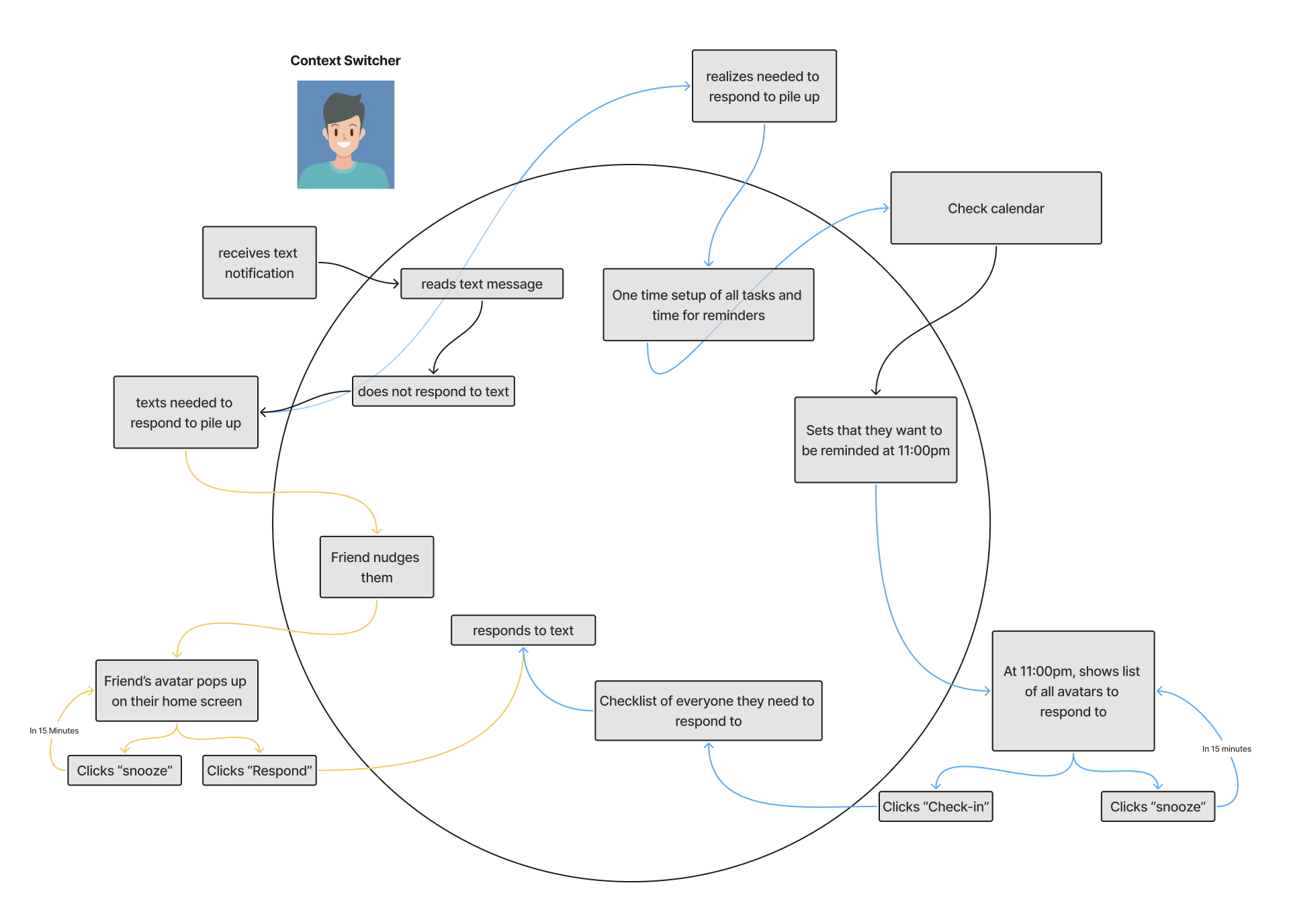
A context switcher is unable to respond to messages because they are unable to disrupt their current tasks and flow to respond, and our baseline study showed that they required scheduled times and an appropriate time and place. Our intervention study validated that they would benefit from a more organized accountability structure to respond. We have two paths, where the yellow path shows how when unresponded texts pile up, they would get prompted by nudges from friends to respond to messages. The blue path shows them setting up a time to get automatic nudges from the system to bring them into responding, similar to our intervention study.
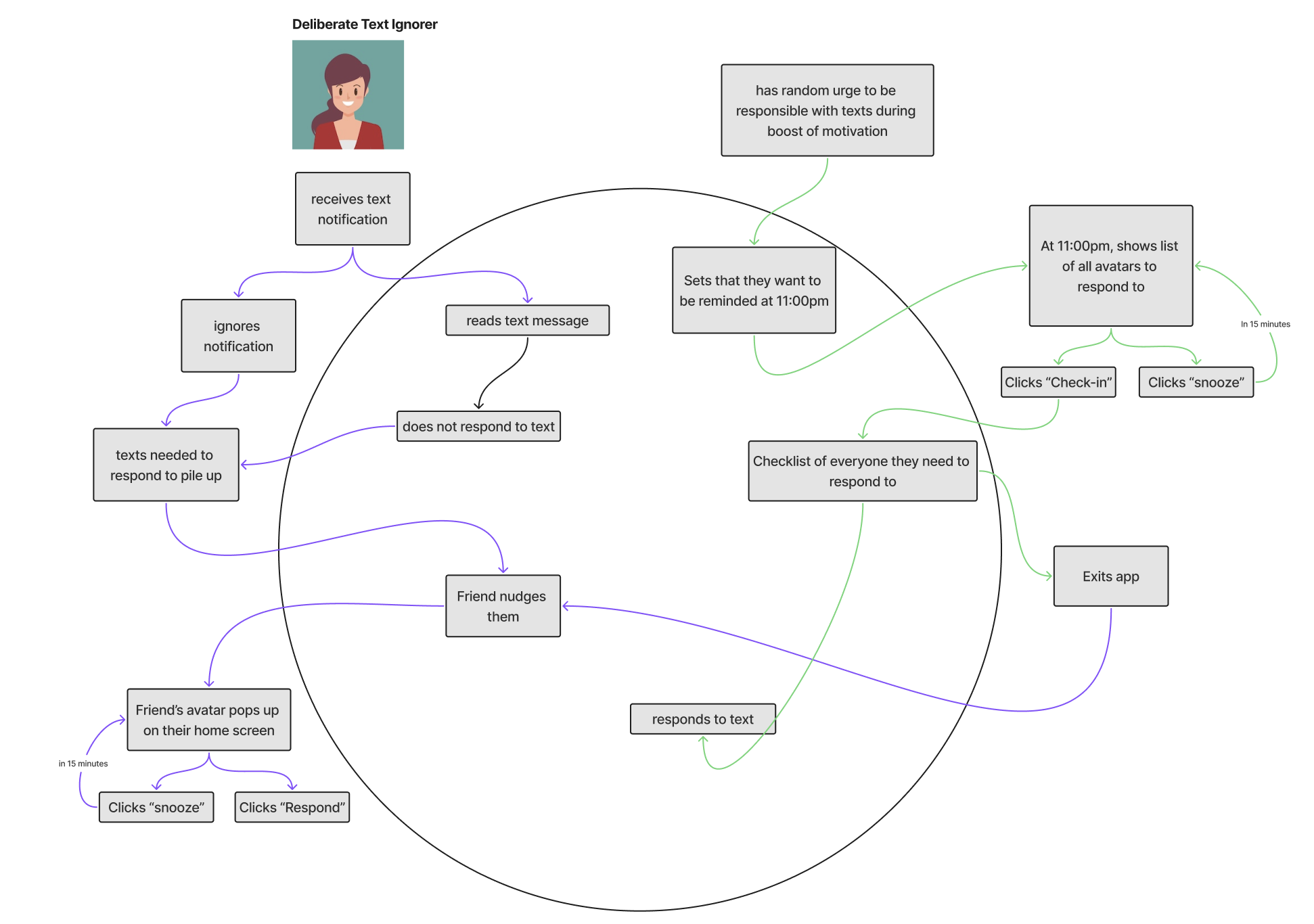
A deliberate text ignorer both consciously and unconsciously delays responding to messages due to internal feelings to not respond and choices to respond later, needing more social accountability and driven by random urges to respond. We expect them to enter our texting system through the purple path, where they are nudged by their friends to respond. The green path shows how they could also have a random urge to set a time to be reminded by the app or urges to respond, where this system is designed for them to be held accountable either by external factors or previous motivations.
Key Insights: We discovered our needs from our top two personas through our studies in which we were able to prioritize them in our system. Scheduling nudges and being nudged by friends in a texting and messaging space was seen to be beneficial for both of our target personas, where the context switcher may care more about setting a deliberate time to respond to texts and the text ignorer may benefit from having social accountability. In our next steps, we hope to lean into these features in how they can serve both of these personas, since there is already overlap in the system paths despite different motivations to enter the system.
Story Maps
To create our story map we decided to focus on our “Context Switcher” persona described previously. We crafted the story of a person who was working on their PSET, randomly remembered in the middle of working how they still haven’t responded to that one important email yet, but decided not to do so at the moment as they were deep in work and didn’t want to leave current task, will allocate time later after this task is done to do email. After crafting this narrative, we categorized the experience into key stages reflected in our user story map: Set Up & Connecting with Friends, Normal Texting, Unresponded Texts, Nudging and Accountability, and Response or Snooze. Our story map images are attached below:
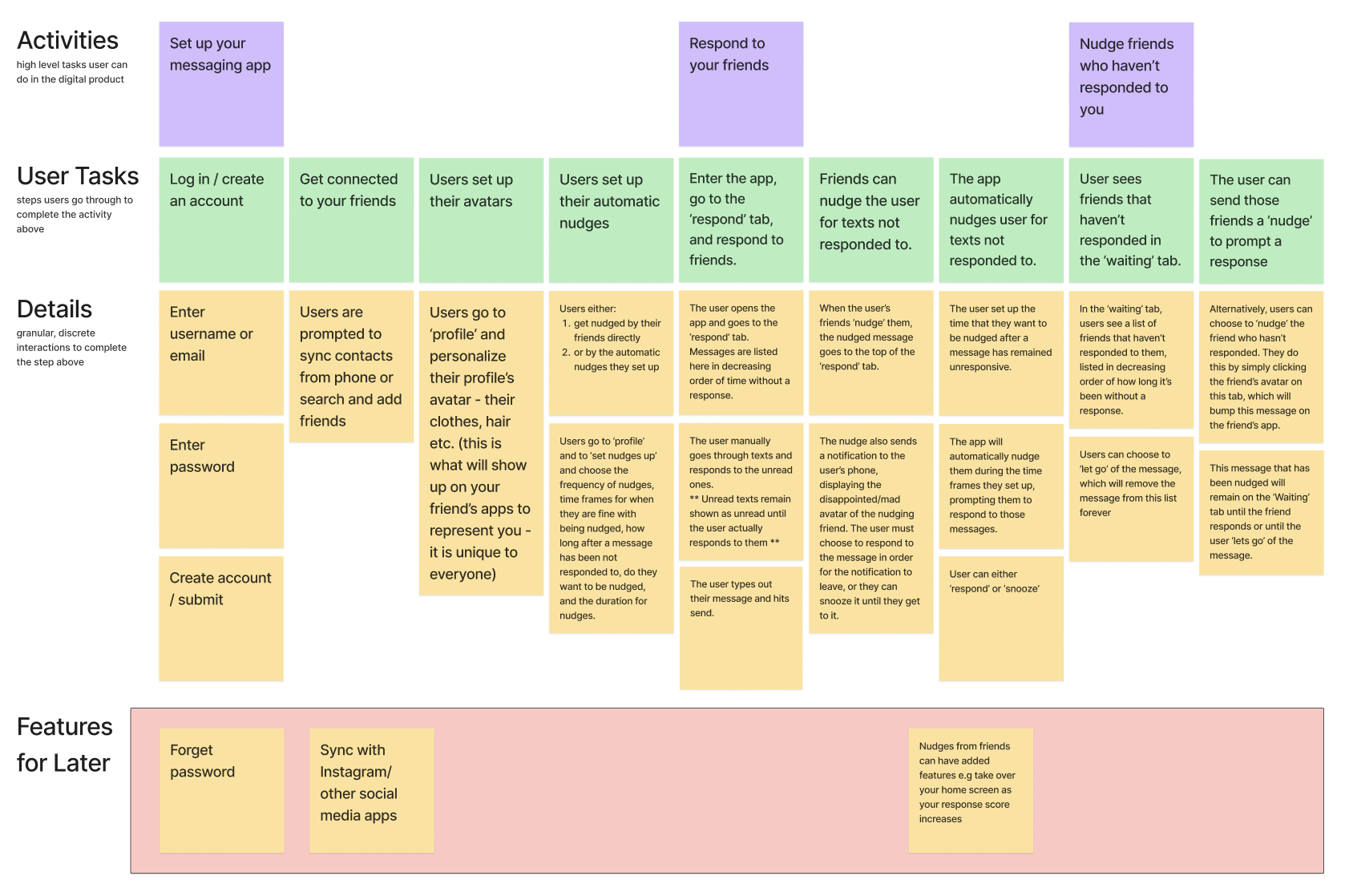
Key Insight: Mapping these stages helped us identify the critical moment for intervention as the period after messages go unresponded to but before avoidance becomes prolonged. Through our studies we discovered that scheduling nudges and receiving nudges from friends (or app) were valuable. This insight guided our MVP features, which are listed below.
MVP Features
Account and Onboarding flow
- Login and Sign up landing screen
- Account creation, which requires phone number or email along with the password
- Login validation and error state handling
- Basic profile setup with display name and simple avatar, which can be customized
- Onboarding walkthrough with 1 to 3 screens explaining responding/waiting
- Permissions prompts for notifications (required) contacts import (optional)
Messaging Surfaces
- Inbox and messages screen showing conversations
- Respond tab of threads where you owe a reply which is sorted by longest time since last response
- Waiting tab of threads where you’re waiting on them which is sorted by longest waiting time
- Thread view where you can open conversation and send a message
Manual Nudges
- Send a nudge from a “waiting or unresponded” thread, done with one tap
- Receive a nudge that
- Shows in-app banner if user is in the app
- Shows push notification if user is off-app
- Bumps the nudged thread to the to
- Nudge actions on the nudged thread
- Respond now and clears nudge state
Automatic Nudges
- Auto-nudge setup screen with user-configurable rules
- Frequency rule to let user set “remind me every X hours” or “x times per day”
- Quiet hours toggle and time window input
- Confirmation or summary screen that gives overview of how/when nudges will happen
Bubble Map
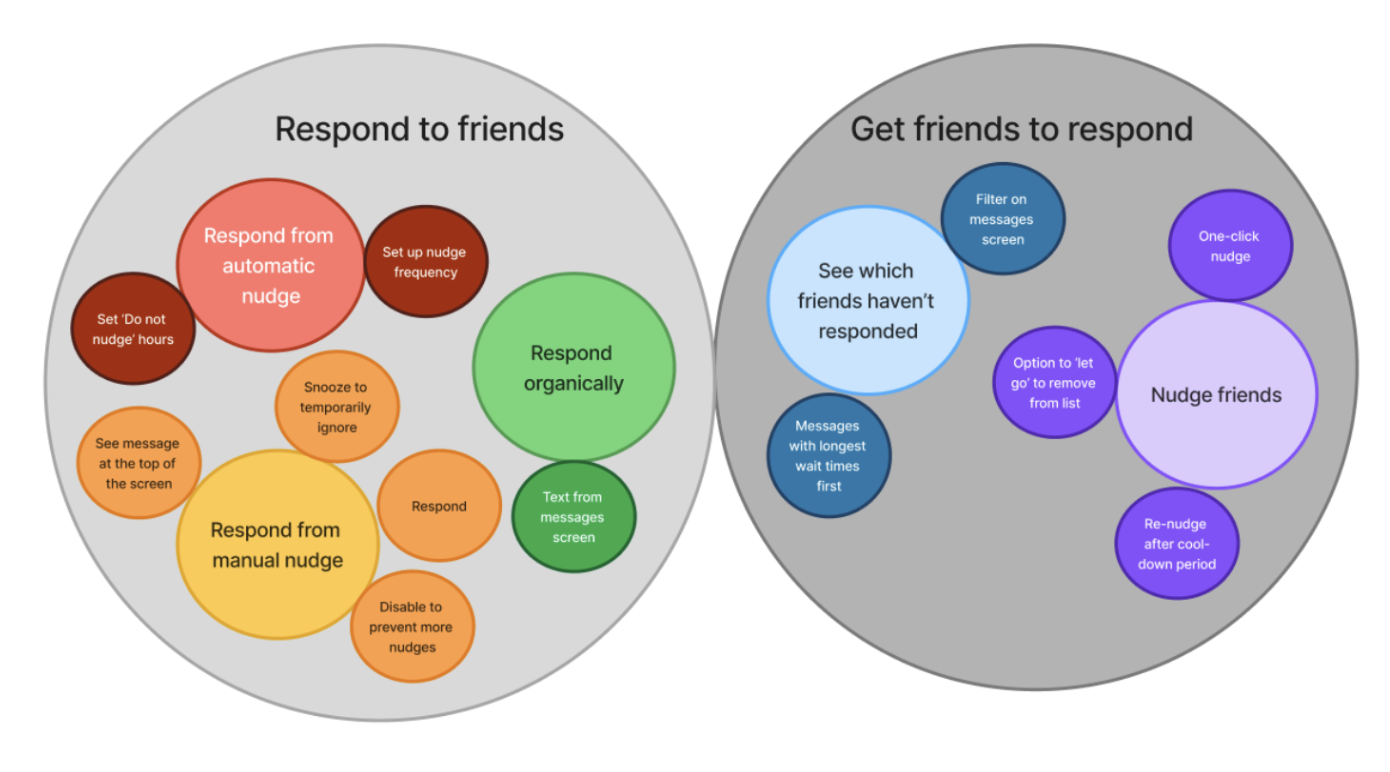
Our process for creating these bubble maps was to think, intuitively, what are the main value propositions from our app? Within each value proposition, we listed the main features of the specific solution. We then separated these into two main categories of functionalities: allowing users to respond to friends, and getting friends to respond. The categories also corresponded with the locations that the functionalities could be found in on the app. For example, the getting friends to respond features are pretty much all found on the messages screen under the ‘no response’ filter. The size of the bubbles corresponds with the importance to the user’s experience.
Key Insights: We gained several insights during this process. For one, we realized that many of our functionalities aligned with our sketchy screens that we’d created earlier. This gave us some validation that our different screens on the app corresponded with the various functionalities, hopefully making the app more intuitive for users. We also realized that our two broader categories of allowing users to respond to friends and enabling them to get friends to respond weren’t as clearly connected or defined on the app. This motivated us to start thinking about how to make it clear to users what purpose each feature has on the app.
Assumption Map
Here’s the assumption map we made in class:
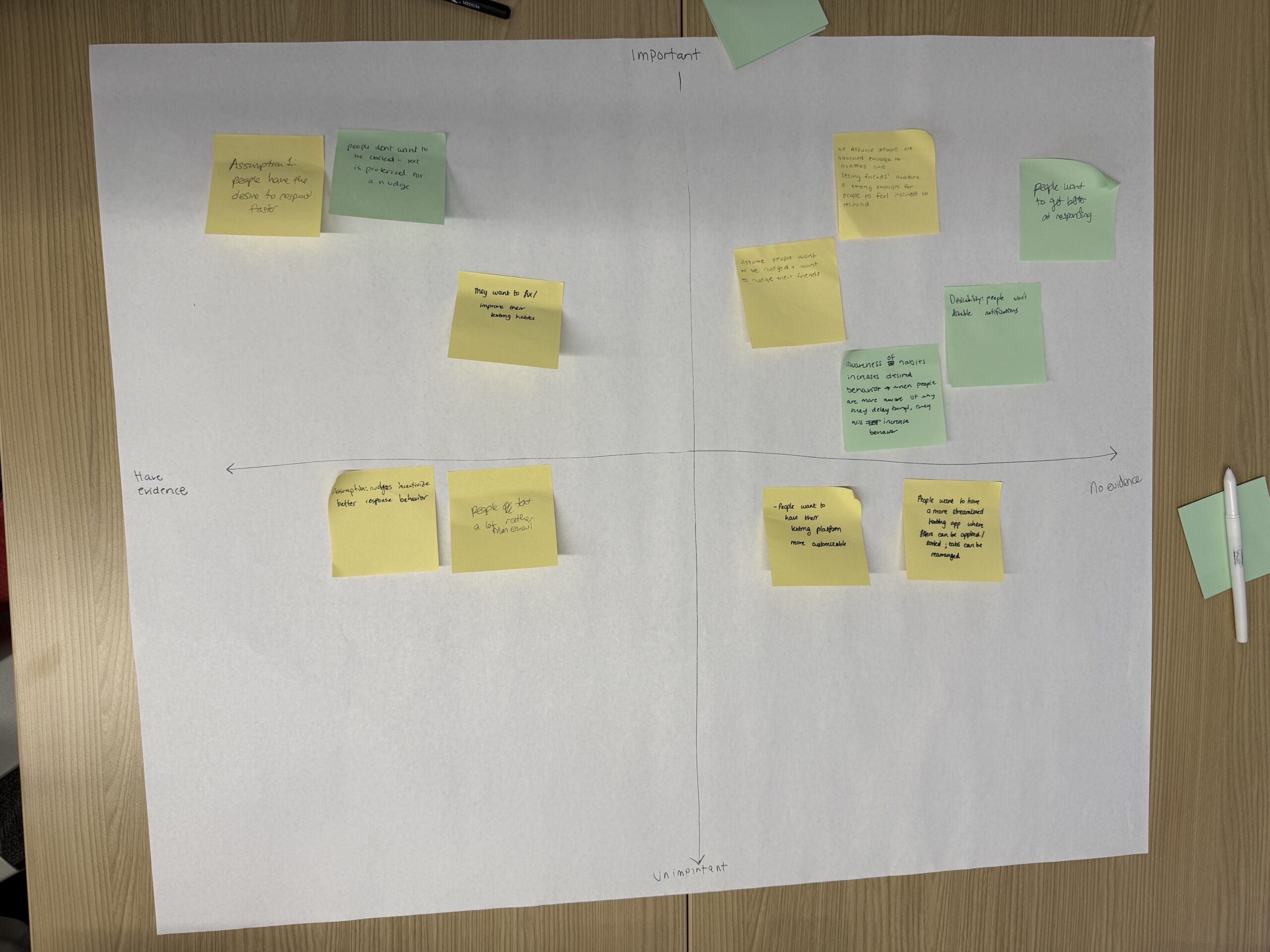
Our final assumption map:

Key Insights
- We have lack of information for people’s implicit preferences within a texting app
- We also need to focus/analyze the sender’s side/preferences. Even if users respond well to nudges, are people willing to send nudges? People need to be engaged in both ends of sending and receiving for the process to work.
- People’s identities are captured through avatar cartoons, and these cartoons need to resonate with the users. In which, we need to have customization to build a stronger connection between our users and the avatar.
- Delaying responses to texts comes with many different motivations and reasons. We need to include features that suggest stronger desires to respond, including social motivation and social accountability as a heavy signal for responding.
- There are different motivations and feelings of pressure that come with nudges that come from friends and nudges that come from scheduling automatically on the app. We learned that we need to think about how to make automatic nudges feel significant to users.
Assumption Tests
- Assumption: Because we are encouraging the behavior of faster responding and decreasing delayed texting, we assume users are in a positive or happy mood to respond to their friends quickly all the time.
- Test Name: Mood & Response Tracker
- Method: At the end of each day, track a user’s mood, along with the number of texts that they’ve avoided that day. Over the course of a week, see if their mood has a reverse correlation with how many texts they avoided that day.
- Objective: Figure out the connection between a user’s mood and responsiveness.
- Success Metrics: A significant majority of participants experiencing heightened moods after responding to friends may indicate that they will want to get better at responding to friends.
- Questions:
- How do you feel today?
- How many texts did you avoid today?
- What may have impacted your mood today?
- Assumption: Because users are being represented as cartoon avatars, we assume our users are attached enough to avatars and seeing their friends’ avatars is strong enough for them to feel inclined to respond
- Test Name: Avatar Presence Test
- Method: Have some users respond to a message thread with an avatar present and other randomly selected group respond to generic notification with no avatar (can be an imessage photo overlay for contact)
- Questions: Does showing a friend’s avatar increase response rate?
- Objective: Find out how impacted users are by seeing their friends’ avatars.
- Success Metrics: A significant majority of participants responding more readily to the message thread with an avatar would indicate that the assumption we made is correct.
- Assumption: We assume that users are willing to participate in nudging others and keep their friends accountable when prompted by a list of people who they are waiting for responses from.
- Test Name: Survey of Comfort during Nudges
- Method: At the end of each day, ask users to find at least one text of theirs that their friend hasn’t yet responded to. We then ask the users to nudge this text by either sending a follow up text or by ‘emphasizing’ the former text. Finally, we ask them if this felt comfortable and natural to them.
- Questions: How did you feel when bumping your previous text? How would you feel about bumping other texts that have gone unresponded to?
- Objective: Find out how willing users are to ‘nudge’ their friends to reply to texts.
- Success Metrics: A significant majority of participants who report feeling comfortable and natural bumping previous texts would indicate that our assumption is correct.



