
Storyboards, Descriptions, Pros + Cons
Storyboard #1
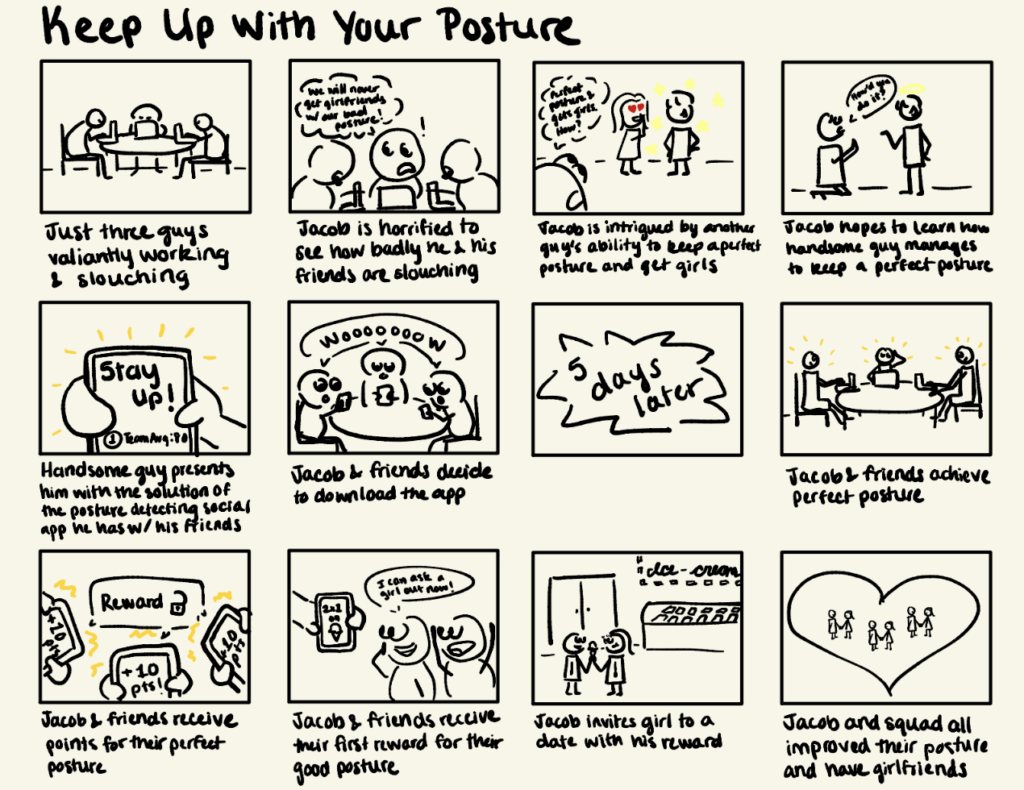
Description: This intervention design introduces a social component to helping you fix your posture! Essentially, the idea is that you and your group of friends will all sign up for an app and use a currently available tracker which essentially sits on either your back or neck. It keeps track of your posture by vibrating whenever you slouch, reminding you to fix your posture, and it also keeps track of the percentage of the day that you spent slouching as opposed to the amount of time that you had good posture. Our app is a companion for this device by allowing you to set benchmarks and use group accountability to improve your posture. There are periods of time (which vary to introduce reward unpredictability) in which your group must hit a certain benchmark of improvement. If you do, then you’re provided with coupons or discounts to visit a restaurant and dine with your friends (which in an ideal world would be a partnership with restaurants in exchange for sending customers their way). If even just one person in the group doesn’t meet their goals, the entire group is ineligible for the reward in this period. This way we hope to introduce social accountability to improve their posture (and the social component seems to matter a lot for posture), reward their personal improvement with individual goals, and track their progress with an impartial device that can’t be rigged to always give them the reward.
Pros:
- Strong Social Motivation – The group component of the app encourages accountability, making posture improvement a shared goal rather than an individual struggle
- Gamification Enhances Engagement – The reward system encourages users to stay engaged and work toward something tangible
- Real-Time Feedback – The device serves as an immediate correction tool, reinforcing the habit of good posture throughout the day.
- Encourages Positive Peer Pressure – Group participation fosters a sense of responsibility, where you don’t want to be the reason the group misses the reward
Cons:
- Users who get too many points to their total may feel unmotivated or discouraged.
- The application requires a physical device, which could be annoying and a barrier to adoption for some people
- The constant buzzing could be annoying to users by the wearable (but that’s also the point)
- Users may not want their posture to be broadcasted to others, and consent would need to be given to share that data
- If rewards are not compelling enough, or too predictable, it will lead to discouragement and dropout
Storyboard #2
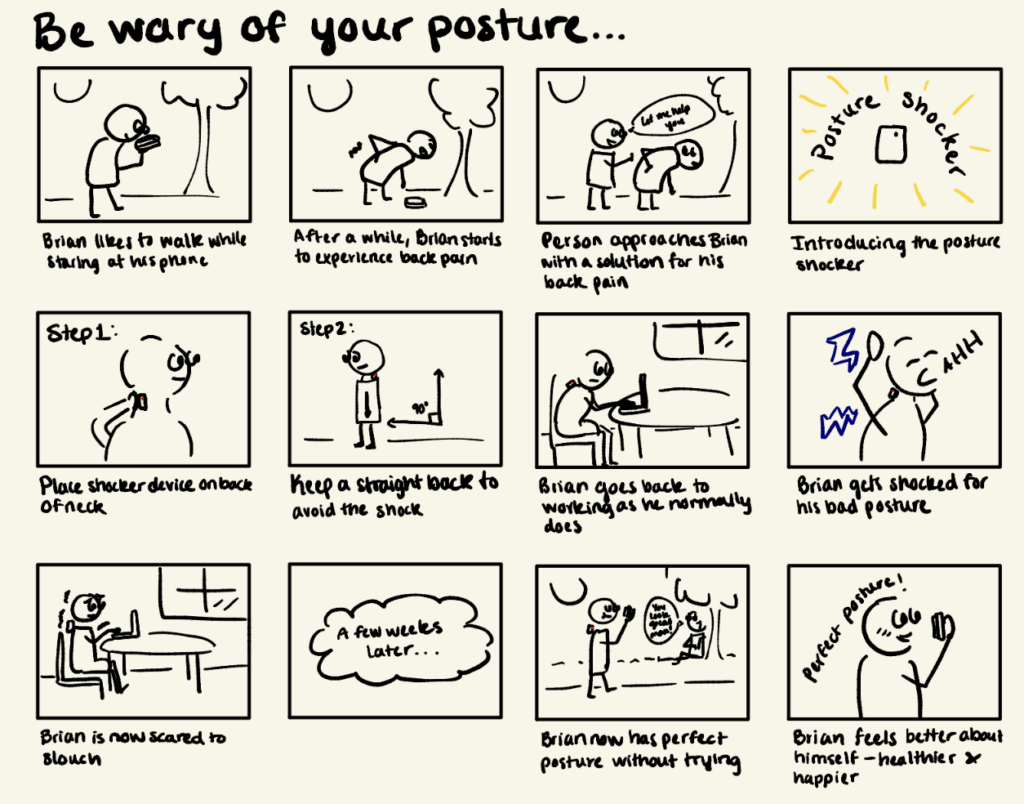
Description: This is an extreme version of the solution before this, but with no social component. Essentially, this is for individuals who are very motivated to improve their posture but don’t want to spend too much time thinking about it or wasting energy on it. As a result, the device functions on its own without much of a tracking component (it exists passively, only if the individual wants to check it but it’s by no means required). Any time that the tracker realizes that the individual is slouching, it will shock the person (not painfully, just strongly enough that they can’t ignore it). The vibration also persists until the posture is corrected. Although they will struggle with the muscle pain at first, we believe that with consistent repeated practice, they will be able to build their muscles more than if they were to just straighten their backs once a day for a few minutes. This is a more passive form with external reminders forcing you to correct your posture, since we found with our interviewees that people will not actually care about gentle reminders as the day goes on with no other reinforcement and they will be too busy to spend additional time thinking about the solution.
Pros:
- Strong Negative Reinforcement – The shock immediately creates an unforgettable consequence for bad posture, making users self-correct quickly.
- Associating slouching with physical discomfort may develop good posture faster than with softer interventions like a wearable
- The intervention is simple and doesn’t require much thought. If you slouch, you get shocked, reinforcing immediate behavior change.
Cons:
- Using such an aggressive solution as a motivator for change may be unethical and also will be unpleasant for the user. Users may quit the intervention due to a lack of comfort instead of learning from it
- Anxiety or fear-based learning may create stress and anxiety related to posture
- A shock response may be unacceptable in settings like academic classrooms or professional environments.
- Users may be hesitant to adopt something that involves physical discomfort
Storyboard #3
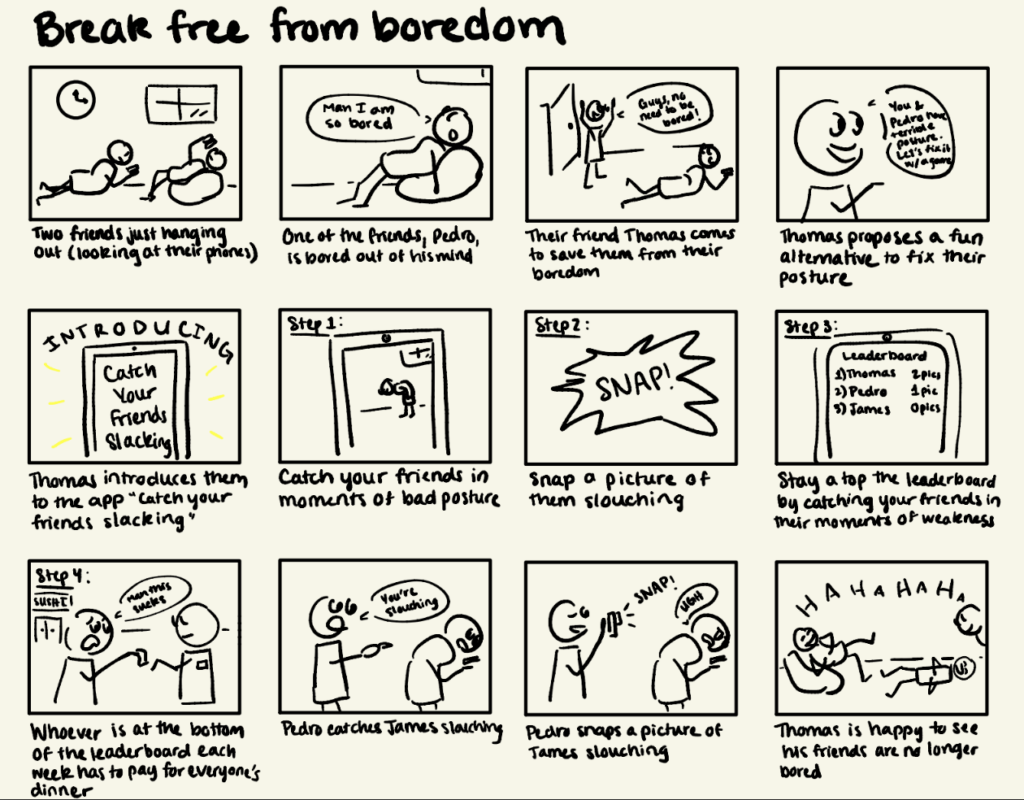
Description: This is another social solution, where a group of friends can sign up together to keep each other accountable. It takes more of a gamified approach, where the idea is that if you see your friend slouching in public, you take a photo of them and can upload it to the app. The app has a leaderboard that will add points based on the photos that you’ve taken of your friends as well as subtract points for when you’re caught slouching. Our interviewees primarily mentioned that they’re most likely to care about their posture in social situations and we also noticed that people are most likely to fix their postures when they see photos of themselves slouching. This intervention takes components of both of these insights to make a more fun, gamified approach. Our hope is that when participants see these photos of themselves, they will be motivated to fix their posture long-term and not get caught in these photos, as well as will want to catch their friends with these poor postures (social component) to increase their points.
Pros:
- The gamified approach is highly social and engaging, making posture correction a fun activity instead of a task
- Users are constantly aware as they are trying to catch friends, as well as not get caught by friends
- The fear of paying for dinner (or other consequences) is a highly motivational tool that can help promote good posture
- Does not require special wearables and only needs a cell phone
- Posture correction is a group activity instead of a solitary activity, making it more sustainable in social settings
Cons:
- This can lead to negative social pressure over the fear of getting “caught” and publicly shamed on a mobile application
- This could create an uncomfortable or overly competitive environment where people are more focused on winning the game rather than maintaining good posture
- Prone to cheating or misuse, where users could fake photos and jump leaderboard rankings, leading to frustration among the players
- Social and negative consequences could cause players to drop out and not want to play the game
- Has the potential to create awkward or uncomfortable group social dynamics, where a common loser or low leaderboard individual feels resentment rather than motivation
- Posture correction will likely not extend to environments where individuals are alone without the existence of this pressure
Intervention Study Plan
Our Relevant Question:
Can group accountability and social rewards motivate people to improve their posture over 4 days? Slouching and bad posture often happens unconsciously. By making people aware of their posture through peer observations (even without a device), we test if social pressure + rewards can potentially help the issue of bad posture.
4 Day Long Study Outline:
We will organize participants into groups of 3 and 2, where each person observes one other group member throughout the day (at some point is the goal). We assume:
- All participants are in the same workplace/campus environment
- They naturally see each other for at least 1 hour total during the day, for example, during class
- Observation can be broken into different time periods (e.g., morning meetings, lunch, shared workspace time)
- Observers maintain discretion to prevent the observed person from knowing exactly when they’re being tracked
Scoring:
For each 1-hour observation period:
- We divide the hour into 4 quarters (15 minutes each)
- For each quarter where the person maintains good posture majority of the time: +1 point
- For each quarter where the person slouches majority of the time: 0 points
- Maximum points per hour: 4 points
Data Collection:
We will provide a private Google Form link to each observer and ask them to record scores within 30 minutes of each observation period including the location or context, patterns and their quarter-by-quarter scoring.
Our Assumptions:
- People can watch peers for ~1 hour/day.
- Observers won’t lie to “help” the group hit the goal(hopefully…since they do not know what the metric of analysis really is so they cannot game the system as much).
- A 5% improvement (e.g., 90% → 95%) is as valuable as 45% → 50% – we want to acknowledge personal progress as well as make sure everyone’s individual contribution is helpful for the group



