
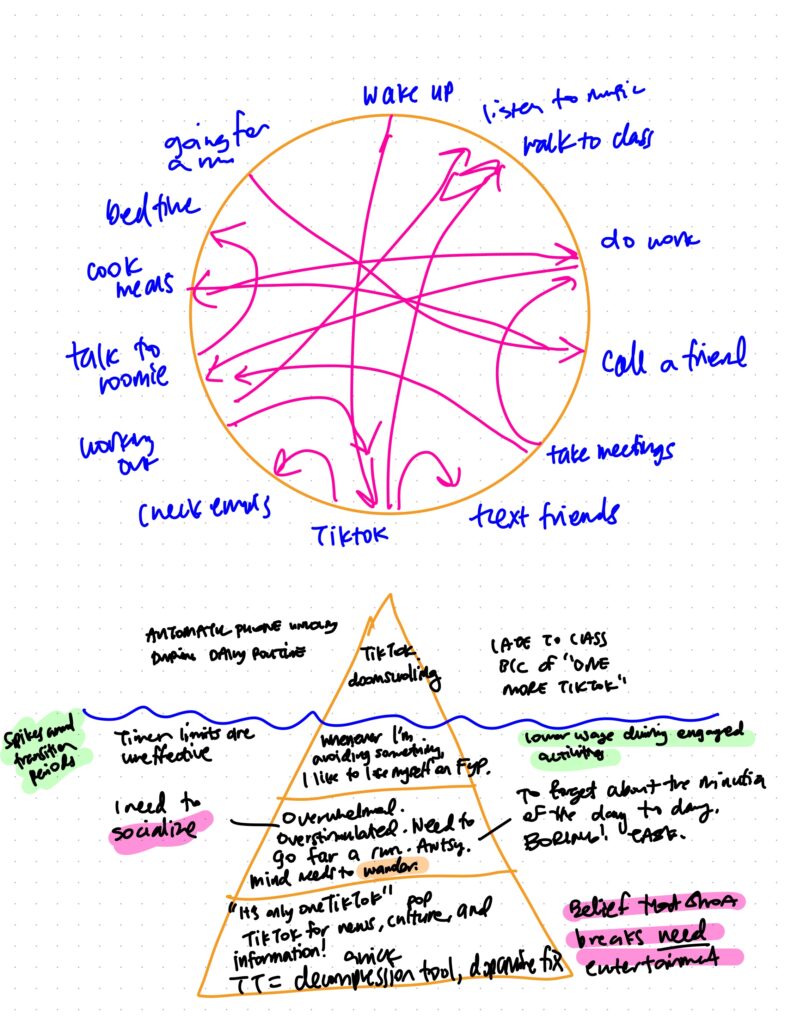
Over the past few days, I decided to take a hard look at my TikTok use and see if I could curb the endless scrolling. My biggest motivation for measuring this habit was noticing how much of my day slips away watching funny rants or catching up on the latest celebrity gossip (as an ex-Dolan twin fan, I’ve been hooked on the latest Emma Chamberlain lore). I tracked my usage across three days (Friday 1/10, Sunday 1/12, and Monday 1/13), logging each TikTok session in a daily schedule.
Honestly, logging wasn’t always easy. The first day (Friday), I was motivated, so I was meticulous: I recorded every instance—from quick checks in bed to longer afternoon “decompression” sessions. By the end of the day, I was a little shocked at how many pockets of time I was letting slip away. Sunday was a bit more relaxed, and I took a big nap in the afternoon (migraine vibes), so my phone time wasn’t as high—but I still snuck in some TikTok browsing in the morning and between tasks. Monday was all about classes and meetings; I tried to be more mindful, especially during the morning routine and before bed.
What struck me most was how often TikTok was my go-to “filler”—waking up, waiting for water to boil, or even brushing my teeth. It’s like my hand automatically unlocked my phone without me consciously deciding. Writing it down every time forced me to acknowledge those micro-habits.
What stood out was how I unconsciously reach for TikTok during daily routines like brushing teeth or eating alone. The logging process made me hyper-aware of these automatic behaviors that I hadn’t previously noticed.
My main learnings were quite revealing. First, I realized my TikTok usage clusters around transition periods – waking up, between activities, and before bed. Second, I observed that my usage significantly decreases when I’m either fully engaged in activities (like cooking dinner with my roommate), during structured commitments (like in-person meetings), or when I was connected to the speaker (if I’m playing music, I can’t go on TikTok). I also noticed that my TikTok consumption often serves as a form of “decompression” between tasks, though not always productively. I gravitate toward TikTok whenever I’m bored, anxious, or procrastinating. Even those “five-minute scrolls” add up, turning into a 15-minute detour more often than I realized and has even made me late for classes. The days I put in a conscious effort to log times were the days I was more aware of how I wanted to spend my breaks—sometimes I swapped TikTok for music, a quick call with a friend, or just letting my brain rest. During dinner prep with my roommate or while walking between classes, I felt calmer and more present when my hands (and mind) were too occupied to open TikTok.
Three days gave me good insights, but I suspect a full week (or two) would show deeper patterns especially helpful for the iceberg model. I wonder if certain weekdays trigger heavier usage (e.g., end-of-week burnout). I’ve had the 15 minute timer limit set for TikTok but now its constant presence is more of a hassle than an actual obstacle. Manual logging also helped me be more conscious of my screen time, and at one point, I finally my phone down after logging a TikTok session. On days that were colder or cloudier, I wanted to spend more time in bed, and thus the “doomscroll.” On days that I worked out, I felt more inclined to be outside, and the endorphins I got from my workout motivated me to call my friends. In the future, I’d experiment with replacing TikTok breaks with short breathing exercises, going for a walk, or calling a friend—something that still feels like an engaging break but doesn’t suck me into a doomscroll.



