
Introduction
Tea is an essential part of who I am, where I grew up, and the communities that surrounded me while growing up. At home, every morning starts with a hot cup of milk tea that we all enjoy together before going about our day. Because of this, I have always gravitated toward tea whenever I am cold, sad, homesick, depressed, tired, happy, ecstatic, or even just content.
In the U.S, most people around me drink coffee, so tea has always felt like a more mindful caffeine choice. There has never been guilt associated with drinking tea, nor any intention to stop. It never felt like a problem to solve. This is the reason I chose to measure it, to understand why its consumption felt so invisible to me. I was surprised to doscover that on an average day, I drink 7 or more cups of tea.
Measurement
I used the Toggl app to measure the instances of drinking tea over 2 days. Instead of logging at fixed time intervals, I logged each cup as it happened. This allowed me to capture the contexts, transitions, and emotional states surrounding the behavior rather than just the duration.
Logging in this way made me aware if how often I drank tea in moments that felt insignificant or automatic, such as the short breaks between classes or when relaxing in the evening.
Observations
I observed that I drink around 7 cups of tea in a regular day. I then started to look at the activities and energy levels that I had at the time of drinking the tea, and noticed that I was drinking tea anytime I felt fatigue, was transitioning from one class to another, in the evenings when I was done with classes, or even when spending time with my best friend at my place.
What surprised me most was how deeply tea was embedded into non-productive moments as well. Even when reading for leisure or journaling, I felt the need to have tea nearby simply because it felt soothing. Tea was not just responding to tiredness; it was responding to comfort, identity, and environment.
Models Representing The Habit Ecosystem
- Connection Circle model
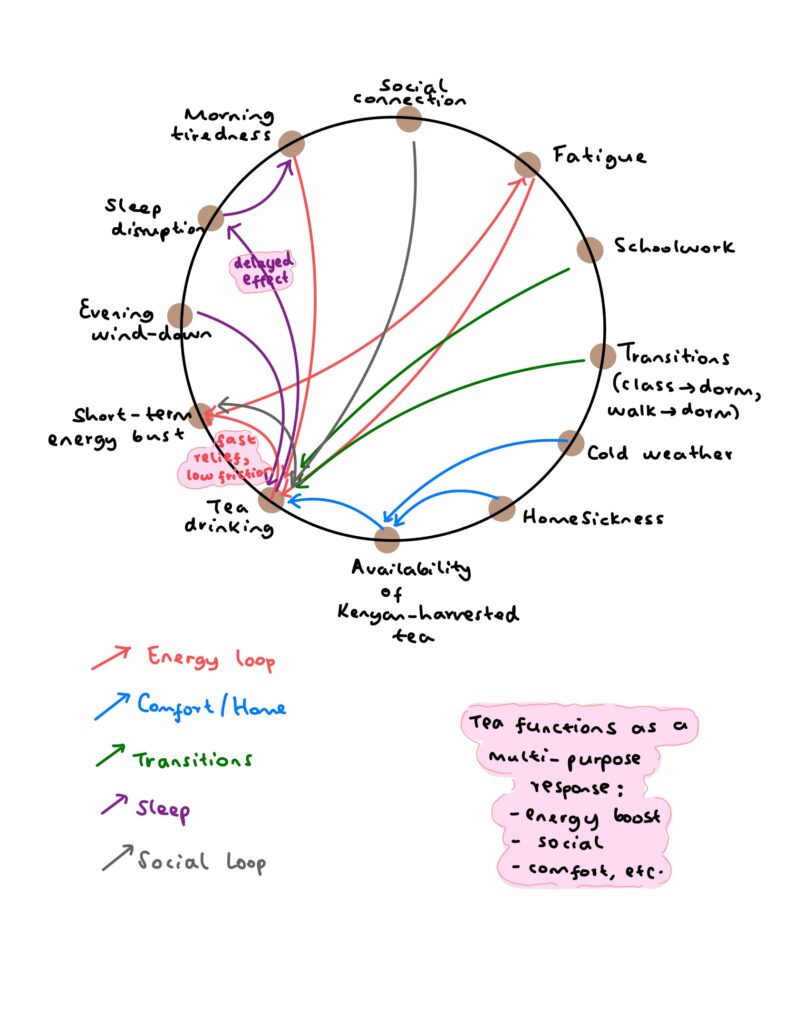
The connection circle shows how tea sits at the center of multiple reinforcing loops related to energy regulation, emotional comfort, transitions, sleep, and social connection. These loops reinforce one another, making tea a highly stable habit rather than a conscious choice for me. One key insight from this model is that tea is not triggered by a single cue. Instead, it functions as a universal response across many situations, which explains why it feels invisible and difficult to interrupt.
- Causal Model
The causal model frames mental energy as a stock influenced by both slow and fast inflows. Tea acts as a fast, low-friction substitute for slower energy sources such as sleep, food, and movement. While tea provides immediate relief, it also introduces delayed negative effects by disrupting sleep, ultimately lowering mental energy and reinforcing the need for tea the next day. This model highlights how short-term solutions can crowd out healthier behaviors while still maintaining the system.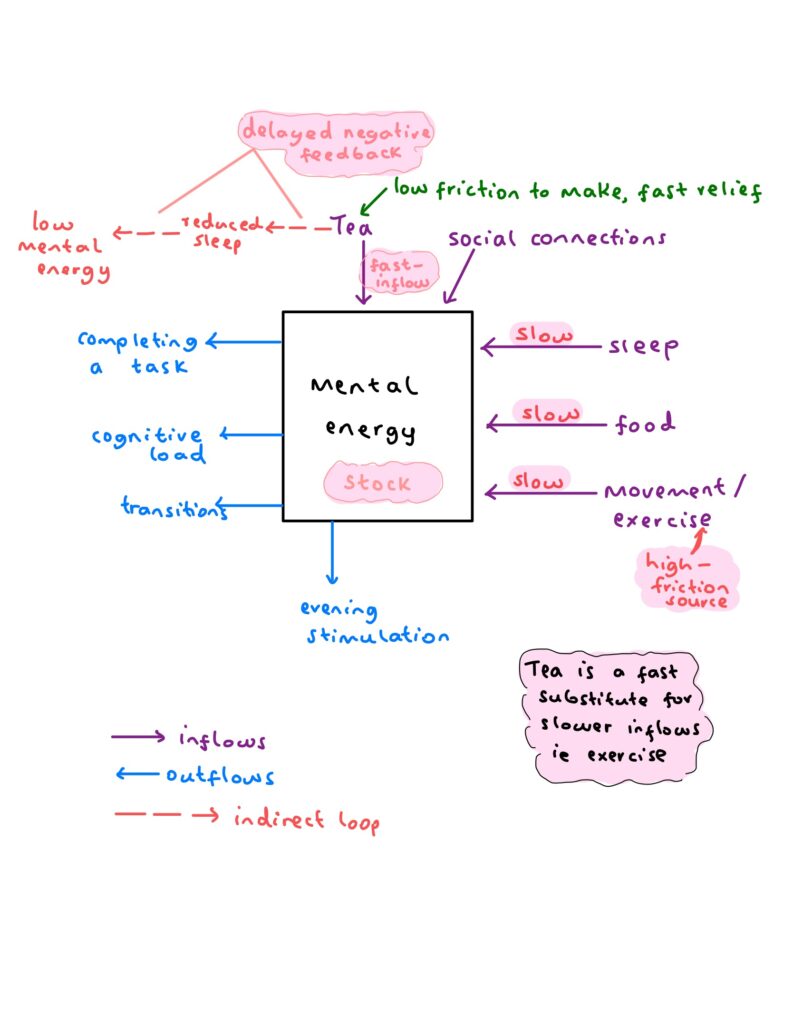
Final Reflection
Looking back, I realize that drinking tea is not the problem. Instead, tea helps me manage friction, anticipate fatigue, and regulate comfort in an environment that demands constant transitions and cognitive effort. Framing this behaviour as a failure does not work for me because tea is deeply tied into my identity, culture, and sense of home.I have made the conclusion that if I want to change my tea consumption, I need to change the situations that make tea the easiest response. Because I am in school and have back-to-back classes and constant movement, this creates an environment that rewards fast relief. I can imagine that after graduating, when my days are less fragmented, the need for tea will naturally decrease.
Moving forward, I want to drink tea more intentionally. Rather than reacting automatically, I want to decide ahead of rime when tea will fit into my day, which will allow it to remain meaningful rather than becoming my default response to stress and/or fatigue.



