
Behavior tracked:
Whenever I spend time with my family, they always call out how much dessert I have and how I’m going to get diabetes someday. I personally don’t really notice or pay attention to how much sweet/ultra-processed food I consume on a daily basis and thought it would be interesting to track any unhealthy food (dessert, fast food, junk food etc.) consumptions I have and investigate what contributes to it.
Methods:
I tracked when and what I ate whenever I considered the food as unhealthy from last Wednesday to this Monday. I also made notes about what was going on that day and jot down details about other food/moods/special occasions that may have contributed. I didn’t let this study change my desire for food at any moment.
Result data:
Wednesday: (Normal school day, watched TV for too long at night)
- Late night: the melt burger, garlic farm fries and shake
Thursday: (Normal school day, didn’t have a very satisfying lunch)
- Afternoon: Paris Baguette coffee, donut and tiramisu + chocolate bc it was on my desk
Friday: (On the road day to SoCal, needed quick food options on the way)
- Afternoon/dinner: McDonalds fries, ice cream, ice cream crunch, chicken sandwich and nuggets
Saturday: (Frisbee tournament day on the beach, no time for food really all day, ate leftovers for lunch)
Sunday: (Frisbee tournament day on the beach, no time for food until late afternoon by which point I was starving and would eat anything)
- Afternoon/evening: Chocolate bars
Monday:(On the road day back to school, needed quick food options on the way)
- Lunch: McDonalds nuggets, fries and ice cream
- Post-Dinner: Wilbur ice cream
My 2 models:
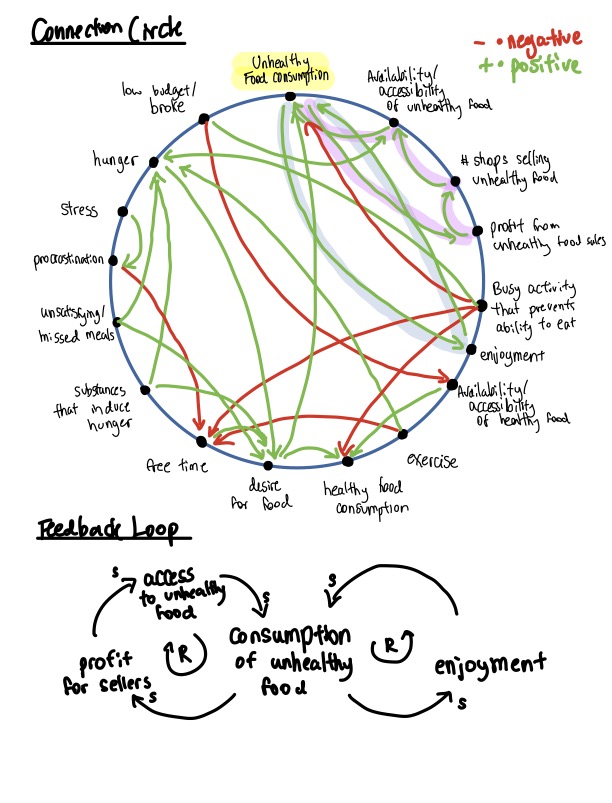
Findings:
There are two loops that are interesting. The first is like the one we saw in class regarding French fries and business—if I eat McDonald’s, it drives the business, allowing for McDonalds to because as popular as it is, which then makes it even more accessible and tempting especially in terms of time and price.
The second is simply that junk food often tastes good and trigger the release of positive chemicals in our brain, leading us to want to consume more. In addition to ease of access, the yum feeling contributes to further consumption as well. It crossed my mind that the feeling of guilt may be able to balance this loop out a little bit, but unfortunately I didn’t feel much guilt especially given I was exercising so much this past weekend or on the road where choices were limited.
Hunger is a double-edged sword because it leads to desire for food, but what I end up choosing to consume normally happens to be a combination of what’s cheap and convenient in the moment. Unhealthy food tastes good and is usually faster to obtain and cheaper, providing lots of incentive to choose it over healthier options. Accessibility is huge because sometimes I’m not even craving chocolate, but if a square falls out my bag and I see it, I’ll probably just eat it. If I’m very hungry, I’ll eat whatever I find first and junk food is easier to find a lot of the time.
In the future:
I would like to track not just the times I actually ate junk food and what I ate, but also the times I craved junk food and chose not to eat any to gain more insights on what prevents bad eating habits. I also think there are some other variables that could be interesting to track and gain more insights on, including tracking all food consumption beyond just unhealthy food, mood, sleep and exercise as I think eating is likely linked to these factors as well but it’s hard to see the connection if we don’t track for a long period of time. Something else I think would be interesting is looking at when I feel justified vs not justified to eat something unhealthy and where that cutoff is as these thoughts were definitely in the back of my head.



