
Measuring Me: Drinking Water
For this assignment, I chose a behavior that sounds simple but keeps slipping for me: drinking enough water consistently throughout the day. My pattern is usually not “I never drink water,” it’s that I go long stretches without it and then try to make up for it late at night. I wanted to understand what was actually driving that.
How I measured it
I measured my hydration for a little over two days. Instead of tracking constantly, I logged at repeatable checkpoints that matched my day: when I woke up, late morning, around lunch, during longer work or class blocks, around dinner, and before bed. At each check-in, I recorded a quick rating (low, medium, high) plus a short note when something important might explain the day, like travel, alcohol, symptoms, a workout, or spending a long time in my room. This approach stayed lightweight enough that I did not abandon it.
What it felt like to log
Two things surprised me. First, logging changed my behavior immediately. The moment I wrote “low,” I became aware of how long it had been, which pushed me to drink sooner. Second, my hydration was not random. It was predictable. Once I saw it written down, the same weak points showed up again and again.
What I learned
The biggest learning was that time of day mattered more than motivation. My second model (the pattern over the day) makes it clear I have recurring dips: a drop mid-morning, a recovery around lunch or afternoon, another dip around dinner, and then a late-night spike that looks like I am trying to catch up. That late-night spike feels productive in the moment, but it is really evidence I fell behind earlier.
The other learning was that hydration sits inside a system. My Connection Circle shows that my water intake connects to sleep quality, alcohol use, diet, travel, exercise, time spent in my room (which reduces cues to drink or refill), meditation, and symptoms like headaches or colitis-related issues. Even the act of measuring is part of the ecosystem because it increases awareness and changes behavior.
Model 1: Connection Circle
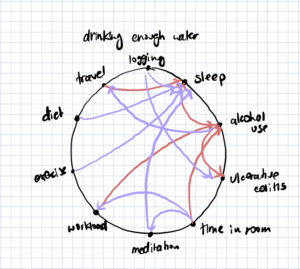
This model helped me stop treating hydration like a standalone willpower problem. The most useful leverage points are not “try harder,” they are things like better cues, easier access to refills, and protecting sleep because those affect multiple parts of the loop.
Model 2: Pattern over the day
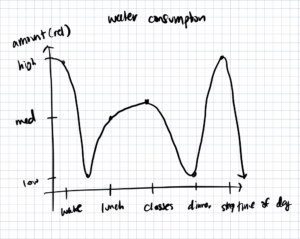
This model highlights that my worst moments happen when I am cognitively busy (work blocks, classes) or physically stationary (staying in my room). That suggests the fix is structural: I need reminders, cues, and placement that work even when my attention is elsewhere.
What I would do differently next time
Next time, I would track a rough quantity (ounces, bottle count, or refills) instead of only low, medium, high. I would also add 1 to 2 quick context tags per entry (class, work, room, travel, alcohol, exercise, symptoms) so I can spot correlations faster. I would add a consistent early afternoon checkpoint because I suspect there is another dip there that my current logging missed. Finally, I would start a small intervention while measuring rather than waiting until after the study.
A simple experiment I would run
If I were turning this into a one-week behavior change test, I would keep it simple: finish one bottle by lunch and one by dinner. I would make the environment do the work by keeping water visible on my desk and forcing a refill at lunch. I would also tie drinking to an automatic cue like opening my laptop in the morning or arriving at my first class. The goal would be to flatten the dips and eliminate the late-night catch-up spike.



