
The behavior that I wanted to observe was tardiness. From Saturday to Monday, I tracked when I arrived to the events I had planned for that day (practice, meetings, dinner plans, etc). I wanted to better understand what types of events, contexts, and environments would make me more likely to show up late. While doing this assignment, I focused on simply measuring what I did rather than trying to change any behaviors, thus only taking note of when I had to leave for an event rather than measuring in rigid time intervals.
Experience
During the three days, I observed that I inevitably showed up late to some events, but I also managed to show up on time or even early to other events. I noticed that it was easier for me to show up to events on time when it was an event that I perceived needed me to be there in order to get started. I think this is attributed to the fact that those events were typically more high-demanding, rare, and exciting such as going off campus or getting dinner with a friend I haven’t seen in months. On the other hand, I found that I kept showing up late to events that were recurring, events that I felt didn’t need me there to get started, and events that took place when I was feeling tired/low on energy.
Models
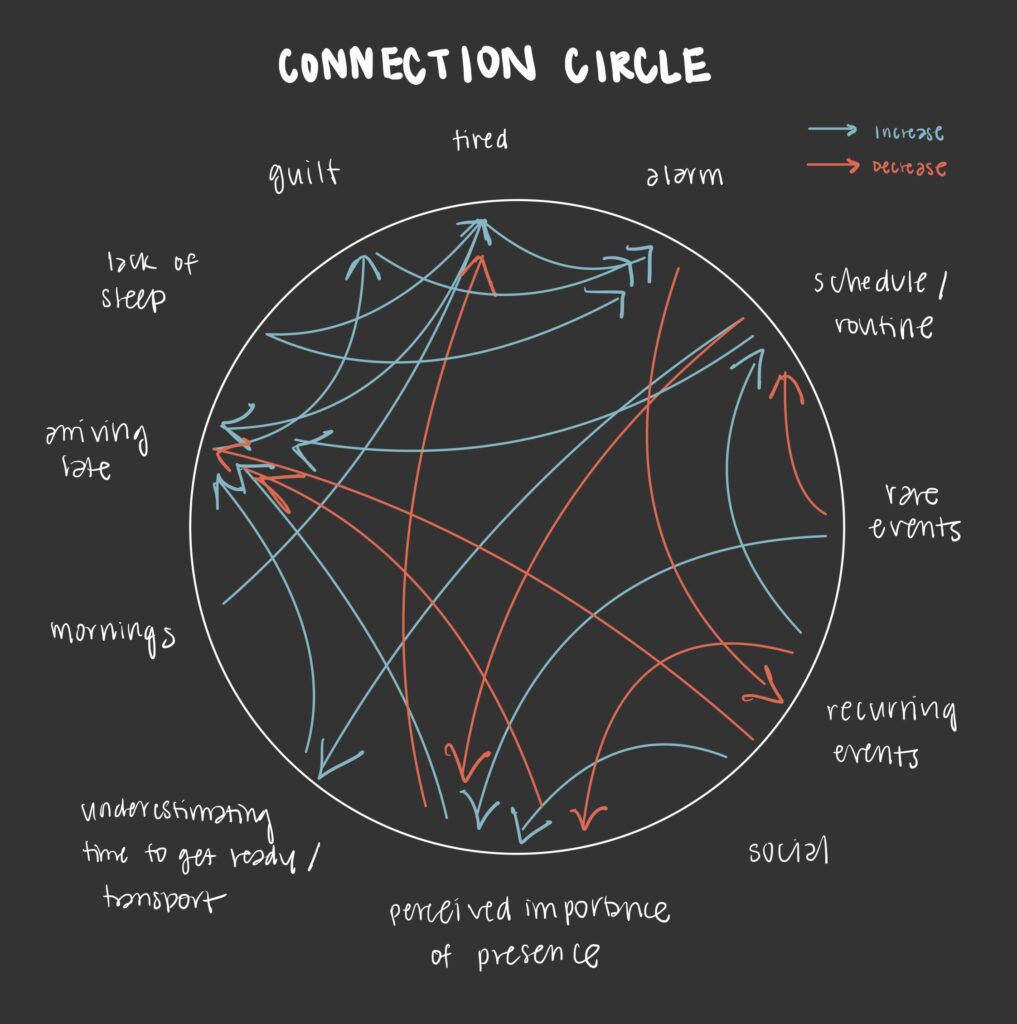
By creating a connection circle, I was able to visualize the different factors that contribute to me being late and the respective consequences. For instance, I don’t need an alarm for recurring events because they are so integrated into my schedule already, but because I’m so used to going to those events, I underestimate the time it takes to get ready/get there and have a lower perceived importance of presence, thus arriving late. I find that I show up on time when I feel that my presence is absolutely necessary for the event to proceed.
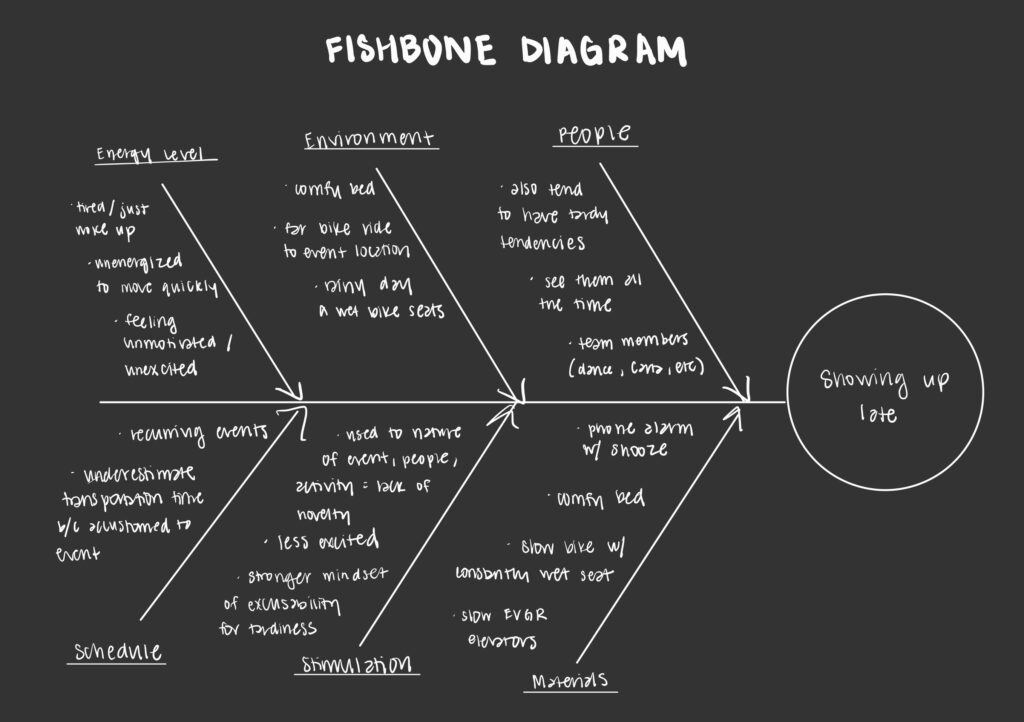
By creating a fishbone diagram, I was able to gain more insight into how the state of my environment and the materials I have to interact with contribute to my tardiness. For instance, having to wait for the elevator and transport to a location on a slow bike are variables that are beyond my control but do contribute to me underestimating the time it takes to transport. Additionally the amount of stimulation I get from thinking about the event plays a role in my motivation and energy level to move.
What I’d Do Differently
Next time, I’d be interested in tracking what my behavior would like in the case where tardiness involves some sort of consequence. I would like to understand deeper whether this would be enough to break a habit of perpetual lateness or if a different method would need to be employed to change this habit.



