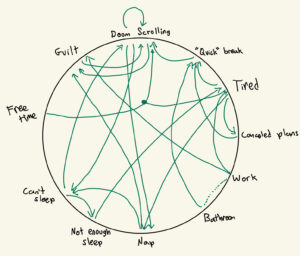
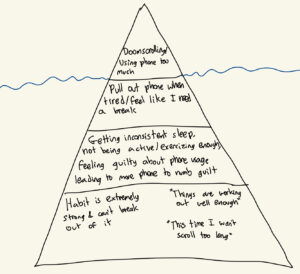
I wasn’t sure which habit I should focus on for this assignment. I was torn between focusing on my screen usage (specifically with doomscrolling) and my bad sleep. I chose doomscrolling, but the most concrete thing this exercise has shown me is that my poor phone habits are inextricably linked to my poor sleep habits. Often times when I pulled out my phone, it was because I felt tired and needed a “quick break” to reset, which often easily turned into using my phone for far longer than I intended.
Another frequent trigger was going to the bathroom. I’ll habitually poll out my phone when I’m on the toilet and I’ll easily get sucked in to TikTok or YouTube. When I leave the restroom, I’ll still be listening to whatever video I was last on, and when I get back to my desk where I was previously getting some work done, I’ll pull out my phone and finish watching the video. Then I’ll move on to the next video, and pretty soon I’m deep into the scroll. Soon enough, I’ll find myself not at my desk but laying on my bed, work long forgotten, scrolling and watching for over an hour. On occasion this turns into an unintentional nap, freeing me up to stay up extra late scrolling that night.
While analyzing my own behavior in this way was revealing and helpful, I think connecting these habits to the podcast on the science of habits reveals a much clearer picture of what’s really going on. Pulling out my phone and going on TikTok or YouTube or Reddit is such an engrained habit with so little friction that it’s really not surprising that I keep doing it, even if I feel like I shouldn’t or if I feel guilty about it. Especially because that guilt leads to stress, and as we learned in the podcast, stress causes you to fall back on the habits more than ever.
To actually make a real change, I need to find a way to add friction between me and the habits I want to break. One change that I can make is to stop working in my room so I don’t have the option to mindlessly scroll in bed when I’m trying to be productive. I’ll find libraries or cafes to increase some social pressure and accountability so I don’t feel like I can scroll forever.
The trickier challenge is to add friction between me and using my phone in the ways I know I need to stop. One option would be to ditch my phone when I’m doing work. For example, I could leave it in my room and do work in a lounge or computer cluster. My only worry here is that I’ll just find ways to waste time on my computer, but I think this might be some mental gymnastics to justify keeping my phone with me.
I’ve tried screen time limitation tools in the past, and they honestly really don’t work, at least not in the long term. It’s too easy and too habitual to ignore the messages when they come up. One idea I recently had that I will try to execute is to turn my phone’s color black and white after this message pops up. This can function as a constant reminder that I’m over my alotted screen usage and will make using my phone less appealing. Ideally this would happen automatically, and even gradually over time (ie, getting increasingly monochrome as I use an app too much) but the best implementation I’ve found is to use the back-tap feature to make my phone monochrome when the message pops up. This is the most frictionless way I have found to introduce this friction.