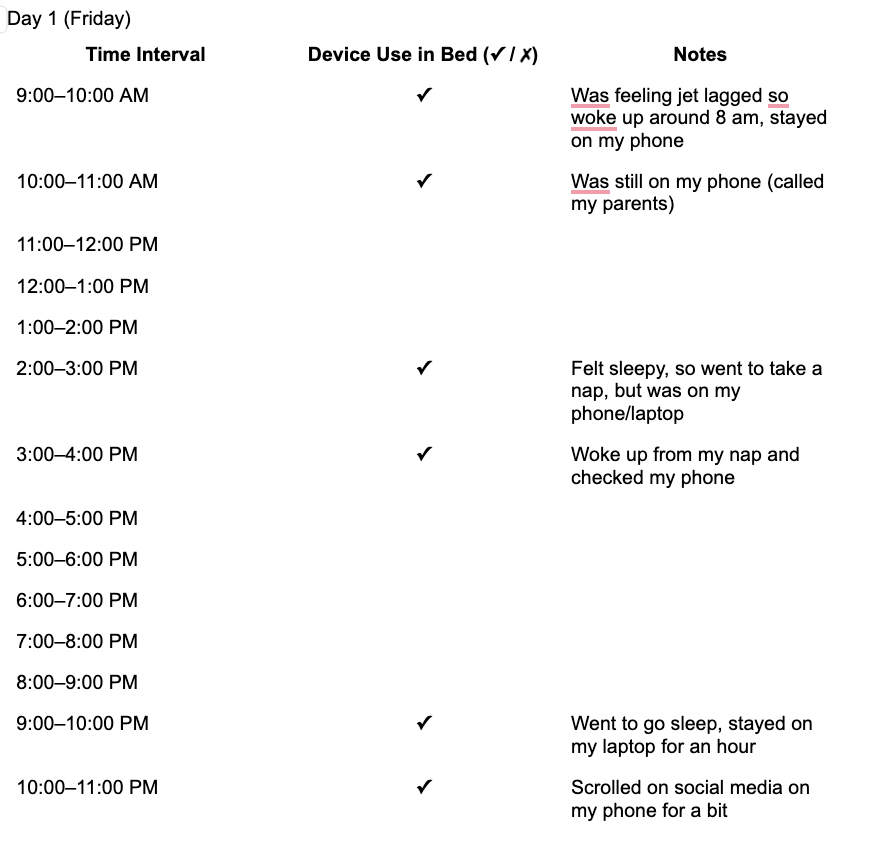
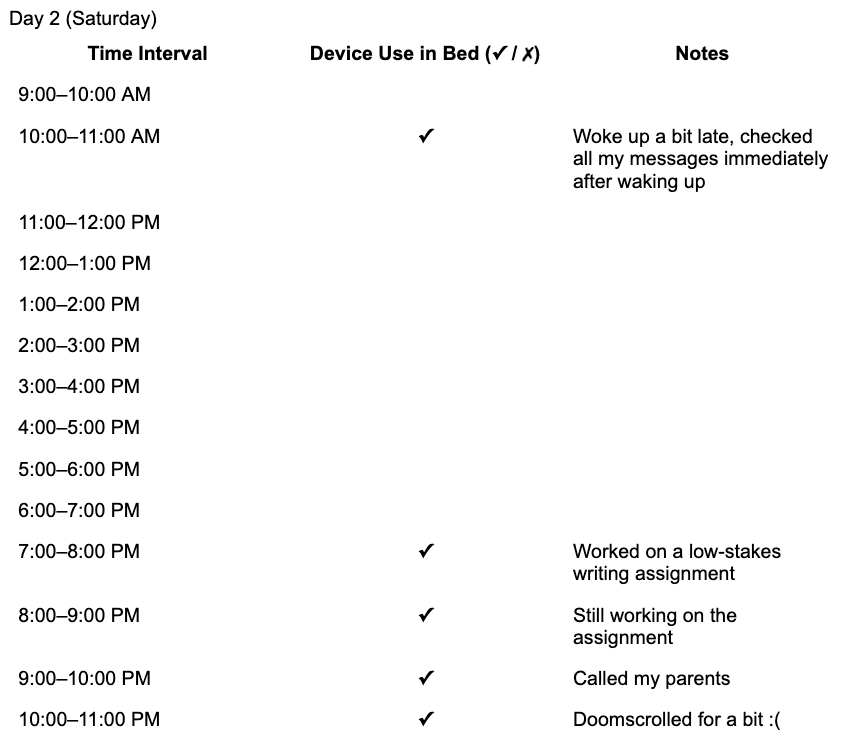
The behaviour I would like to change is device usage in bed. For this project, I defined it as using my phone/laptop either before or after sleep, or during the day. The reason why I chose this behaviour was that I’ve read a couple of studies that show that device usage before and after sleep negatively affects sleep quality, is bad for your eyes, and, honestly, can be quite a time sink. Additionally, posture and distance to the device aren’t maintained when using them in bed. Thus, I decided to track this behaviour over the course of three days (this past weekend).
To understand this behaviour, I tracked my device use in bed, using hour-long intervals from 9 am to 11 pm, and for each interval, I marked whether I had used the device in bed and added brief notes to try to get some explanation/context.
I have linked the tracking log at the bottom of this post.
Tracking this behaviour confirmed that I do use devices before and after sleep every day. The habit was most consistent in the two windows of right before going to bed and right after waking up. It also showed up during naps/moments of low energy during the day.
I noticed device use was almost automatic at night and during the day, whether it was scrolling, calling family/friends, or checking messages. Setting alarms at night was the only thing that seemed necessary to do in that moment. At night, the behaviour was more linked to “downtime” and needing more mental stimulation before going ot bed.
Fig 1:

The model above shows the causes and connections. There was one loop that stood out to me, which was the one of needing mental stimulation (maybe at night) -> using a device in bed -> leading to bad sleep quality -> meaning that I’m tired the next day -> needing mental stimulation again (possibly in the morning, to properly wake up). I did read that using a phone right when waking up and right before going to bed does lead to overall more fatigue, which strengthens this loop. This map shows that beyond being habitual, it is also reinforced by environmental and physiological factors.
Fig 2. 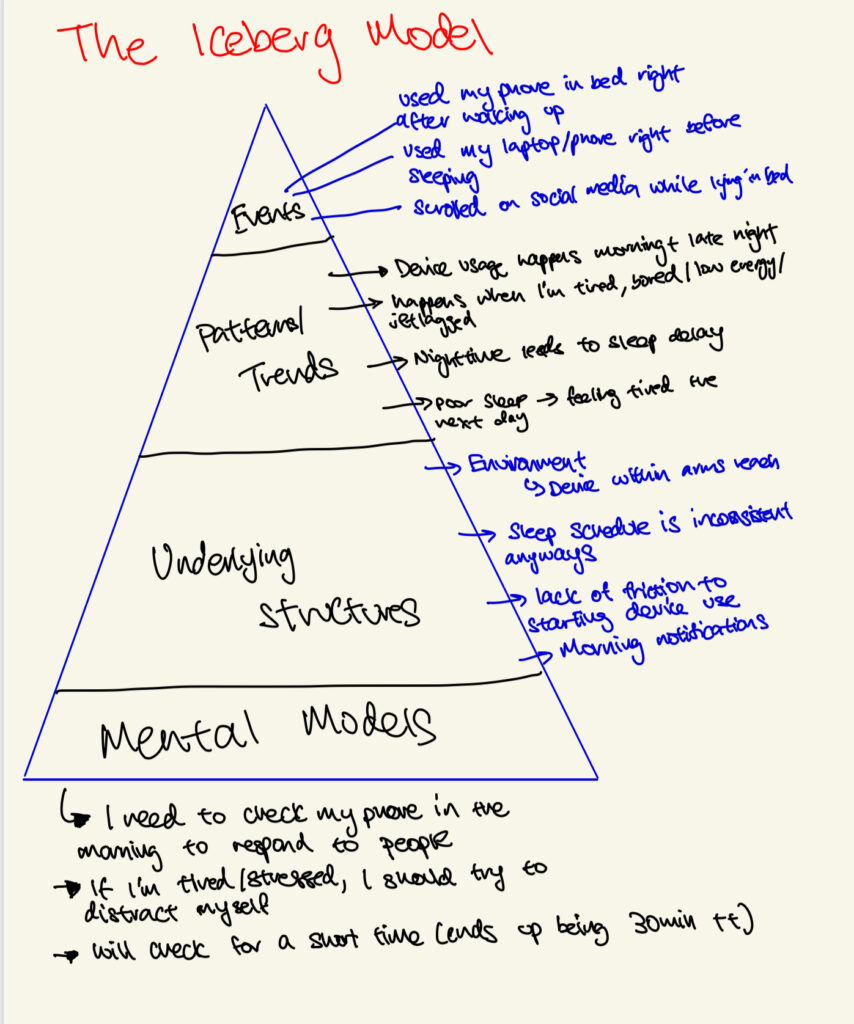
I really liked having to think about the mental models that allow this habit to exist, and thinking about the underlying structures. It showed that this habit is a result of how what I might see as necessary (e.g, fast responses, keeping up-to-date) is actually feeding into this issue.
What I would do differently next time:
So this time, I created a table that had three columns (the time, a yes/no check, and then notes). I think that treating the different device use equally flattened the important difference between the two. Maybe next time, introducing categories could help with understanding and dissecting the habit. I would separate phone use and laptop use into different columns, and track what I was doing on the different devices in bed.
In terms of the tracking period, I think it would be more helpful to track the approximate duration rather than checking it at the end of the hour (because there is a large difference between using a device for 2 minutes rather than 40 minutes). I also think that extending the tracking period can help capture variation across different types of days, such as weekends and weekdays. I could track it by noting when I was picking up the device and when I was putting it down instead.
Overall, this exercise helped frame this habit in the context of other factors and a larger system that involves sleep, energy, how easy it is to access the device, and an overall need for stimulation.
Tracking Log: