I wanted to track my habit of working for more than one consecutive hour. I find that I’m often much more productive when I work for a period of longer than one hour since I get into a sort of “flow state” without distractions and become a lot more focused and high energy. However, every time I sit down and try to do work I am faced with a barrage of different distractions, whether that be from my phone, my computer, my friends, or just from other habits and patterns of behavior I am trying to follow. As a result of this, I tracked my behavior for three days (1/10, 1/11, and 1/12) in 30 minute intervals. I felt like the 15-minute intervals from the first measuring me exercise were too intrusive, but 30 minute intervals were much more doable. I also often do pomodoro sessions, which are completed in cycles of 30 min. During the course of the tracking period I tried to not make the tracking affect my behavior—I made sure I acted only on what my intentions would’ve been regardless of the study rather than trying to change my behavior to appear more favorable on my tracking sheet.
I was helped a little bit by the fact that the period was over a weekend so I could act more freely and observe the types of things I did without the responsibility of required classes and discussion sections. This also enhanced my ability to track my time more accurately and promptly, which helped me more clearly see the causes and effects that led to me being distracted. Overall I thought that logging my behavior in 30 minute intervals (twice an hour) was not bad at all and was useful when seeing the things that popped up and how frequently they popped up as distractions.
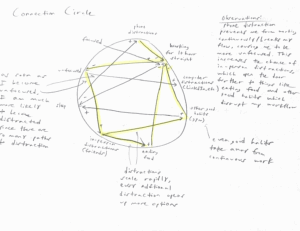
My main takeaways from the experiment were how every time I experienced one distraction, it would open a can of worms of all types of different distractions from all different sources. There were two “mental states” of sorts that I focused on, one in which I was unfocused and more receptive to distractions and one in which I was focused on actively doing work. I found that prior to the 1-hour period, it was very very easy for me to switch out of the focused state into the unfocused state, but that once I was in the unfocused state it was very difficult to switch back to the focused state. However, as I expected, during work periods longer than 1-hour, the barrier to switch out of the focused state increased, and distractions that would have otherwise made me unfocused did not bother me as much.
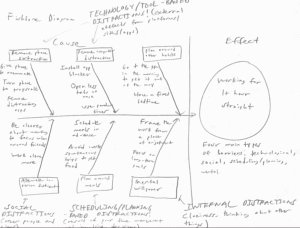
When it comes to the different types of distractions that affected me, I narrowed it down to four types: technological, social, scheduling/planning-related, and mental. Technological distractions were the most pressing, from notifications on my phone to dozens of tempting tabs on my computer. My solution to this would be to keep as clean a slate as possible: only one tab on my computer and turning my phone to silent so it would not bother me. Social distractions involved my friends and people around me talking to me or asking me to do things with them. I found that in-person distractions were often the most dangerous since they could easily lead to things like eating food and other good habits (gym) that would further take away from my work. They were the distraction that most frequently led to other distractions and longer periods of being unfocused. Then there were the scheduling/planning distractions, where it would be things like meals and other habits that popped up and interrupted my working sessions. The main way to reduce these would be to plan my day and manage my time better. The last type of distractions was mental distractions, which were internal thoughts (laziness, thinking about other things) that would frequently lead me to other things besides working. For these, the primary solution in my mind would be to think more long term and reframe the work from a place of enjoyment.
If I were to do this another time I would focus more on logging the actual moment/impetus that led me to go into a distraction rather than just the distraction itself. I feel like that would help me get a better sense of the causes of the distractions, not just the nature of them. I also think it would be useful to gain an idea of the exact moment I get distracted because that is exactly the moment where a well designed product could come in and solve my problem.