
Introduction
I have always been very conscious about social media usage. My siblings’, my cousins’, my own. Even in middle school, after having TikTok for a couple of months and learning Charlie D’Amelio’s dances with my friends, I realized what an incredible business idea and awful time sink the endless feed was. Once I had this realization, I deleted TikTok and kept only Instagram. That worked fairly well for a while, especially since Instagram felt necessary for staying connected with friends and clubs on campus. However, once Instagram introduced Reels, I found myself getting pulled back into the same patterns I had tried to avoid. Even when I opened the app with a specific purpose, the increasingly tailored algorithm made it easy to get sucked into scrolling longer than I intended.
For me, intention is the most important part of social media use. On Wikipedia, doomscrolling is defined as “the act of spending an excessive amount of time watching short-form content.” The key word here is excessive. Like most things, social media exists on a spectrum, and in moderation it can be genuinely useful. I use it to stay connected with friends, keep up with current events, and even reach customers for my family’s small business as well as grow my personal brand. The problem is when intention starts to blur or disappear altogether. When I open an app without a clear purpose, time becomes harder to track and usage becomes less conscious. In those moments, social media shifts from being a tool I am actively using to something that is passively consuming my attention. This is why I focused on tracking extended periods of social media use which I defined to be longer than 5 minutes.
Measurement
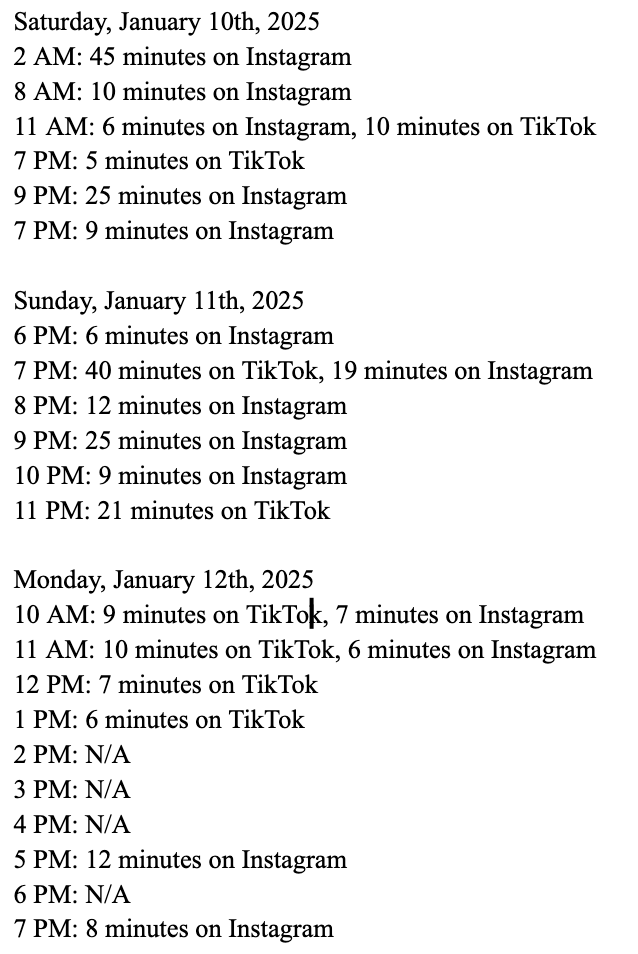
I used data from my Screen Time app to measure my social media usage down to the exact minute for both Instagram and TikTok. This allowed me to be as accurate as possible without relying solely on memory or manual logging. Periods when I was completely off my phone are reflected as gaps in the data, and during times with consistent usage, I checked and recorded my activity hourly. This approach felt both sustainable and representative of my actual behavior. I measured my usage across Saturday, Sunday, and Monday – 3 days.
Observations
I was honestly surprised by how short most of my social media sessions were. My longest sessions were 59 minutes and 45 minutes, and almost everything else was under 25 minutes. Even though it often feels like I spend a lot of time scrolling, the data showed that it is more fragmented than I expected. That said, when all of those shorter sessions are added together, they easily turn into an extra one to two hours a day. Looking back, I cannot really recall anything meaningful I learned or gained from most of that time.
One exception was one of the longer sessions, which happened while I was putting together a post about my Yosemite trip. That kind of usage feels intentional to me. I enjoy reflecting on experiences, curating photos, and posting on my spam account for close friends so I can look back on those moments later. In this case, the time spent felt purposeful rather than mindless, which reinforced how important intention is in defining whether social media use feels excessive or not.
It is also worth noting that this weekend was not typical. I was in Yosemite from Saturday morning to Sunday night with about fifty of my residents, which meant I was busy managing them, hiking, socializing a lot, and without service for large portions of the trip. This definitely changed how and when I used my phone. One thing that helped reduce unintentional usage was rearranging my apps. I would often open my phone out of muscle memory, realize I was about to mindlessly scroll, and then lock it again unless I had a clear reason to be there.
Models


Final Reflection
Tracking my social media usage helped me realize that the biggest factor is not total time, but context. Extended usage tends to happen when I am tired, bored, or have unstructured time, not when I am busy or intentionally using social media. This week, I did not have much time to procrastinate, which clearly showed up in the data.
If I were to repeat this exercise, I would track a more regular weekend and compare it to periods when I have work I am actively procrastinating. Going forward, I want to keep focusing on small design changes that make my usage more intentional rather than trying to cut it out completely.



