
I’ve realized I have the habit of mindlessly eating, especially when there is food in front of me or when I am bored. Sometimes I don’t even notice I am eating or how much I am eating until after, when I wonder why I did it. For the purpose of this observation (and my reflections on this habit in general), I have tried to distinguish mindless or impulsive eating from emotional eating, which is something I also struggle with. There is definitely overlap between the two, especially where boredom comes into play, but I’ve tried to specifically target instances and situations where I am not really aware of the behavior until afterwards. I chose this behavior because I have been trying to bring more mindfulness into my life and reconnect with my physical experience of the world. My focus is on paying attention to the things I do and how they make me feel rather than restricting myself or trying to chase a specific metric.
To measure this behavior I used two strategies over the course of three days. I tracked the behavior when it occurred, noting what I ate, approximately how much, and in what context. I also did check-ins at 3-4 hour intervals throughout the day, thinking back on what I had eaten to catch any instances that were so thoughtless that I had forgotten to track them. Additionally, I tracked a few instances where I had been about to eat something but decided not to. It’s pretty unusual for me to “catch” myself at this stage, so I attribute my heightened awareness in part to the tracking. In general, however, I tried my best not to let my observation affect my behavior.
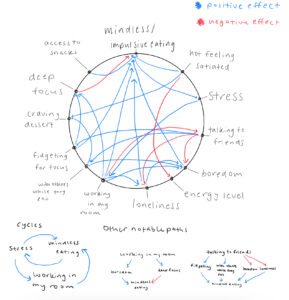
From my connection circle I noticed that a variety of factors prompted me to eat mindlessly, including ease of access to food/snacks, cravings and not feeling satiated, being with others, being alone, wanting to fidget, etc. I noticed that talking with friends decreased my boredom and loneliness, which were both triggers for mindless eating, whereas working in my room increased my loneliness and by extension mindless eating. Stress was a major factor in the reinforcing feedback loops that emerged from the connection circle, as it contributed both directly to mindless eating but also to me doing work in my room, which in turn increased mindless eating. Interestingly, working in my room led both to loneliness and deep focus, which increased and decreased mindless eating respectively, suggesting that working in my room might have a mixed effect. Talking with friends conversely decreased boredom and loneliness but increased the desire to fidget, also leading to mixed effects on mindless eating.
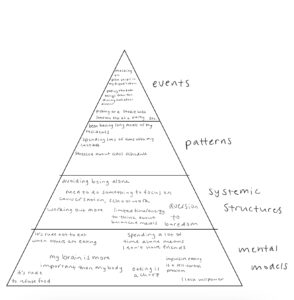
In my iceberg model I noticed some deeper contributing factors to this behavior. High stress and my frequent involvement in social situations that center around or provide access to food were two key patterns. On a structural level, I identified a need to focus, both in conversations and while doing schoolwork, which led me to engage in mindless behaviors. While I focused on mindless eating here I have also noticed that I tend to engage in tactile fidgeting in similar situations. I also noted an aversion to being alone and being bored, and a lack of energy needed to plan a balanced diet. I noted several assumptions and deep seating beliefs, several of which revolved around politeness and social norms and others of which stemmed from my beliefs about habits, behaviors, and willpower. I was surprised to realize that I believe that it’s rude to not eat while others are eating, which could lead me to subconsciously mirror others when they are eating. I also noticed an implicit assumption that my brain and intellect are more important than my body, leading me to neglect my physical health and have a weak mind-body connection. I realized that I feel a lot of guilt about this behavior, believing that it stems from a lack of discipline and willpower.
Next time I would observe this behavior over a longer period of time; since I only had three days for observation, I exclusively tracked days on which I did not have class, which may have skewed my results as I did more socializing and had less work/commitments. I would also want to observe later in the quarter, when I am much more stressed and most of my “bad” habits become more salient.
Tyler Abernethy, January 12, 2026. Measuring Me Take 2.



