
I chose to go after an elusive but detrimental habit of mine: mindless phone pick ups. Apple tracks this data quantitively via the ScreenTime app. They call it “Pickups”.
I do not know what Apple defines as a “Pickup” exactly, but for the purpose of this qualitative, observational study a mindless phone pick up was anytime I reached and grabbed my phone to check my text notifications when I was 1) already on Do Not Disturb (this is a default mode I put my phone in when I’m in class or meant to be focused on something) and 2) did not have a direct reason to be checking my phone (i.e. there was no clear intention or task I was aiming for when I reached to take my phone, thus making it mindless).
These mindless phone pick up are extremely reflexive for me. They occur throughout the day often and without thought. It is a significant behavior I am super interested in curbing and therefore I chose to observe it first in this assignment. Mindless phone pick ups are a symptom of a larger addiction to screens and technology but I think in particular because of how often I put my phone on Do Not Disturb, phone pick ups to check my notifications by swiping down on the notification pull down have become a way to get a hit of dopamine.
To give more context on myself, aside from this assignment, I have previously and actively try various methods and techniques to reduce my screen time and pick ups overall. The most successful thus far has been my Brick which allows me to block my messages app and therefore no messages or notifications go through when my phone is activated with it.
I observed myself across two days, Sunday and Monday. I kept a log on the notes app of my phone. I generally checked with 3 hour intervals throughout the day but overall, my goal in which I was quite diligent was to log the behavior right after it had occurred no matter if it was at 3 hour check in mark or in the middle of that interval. I logged the date, time, and my reasoning / thought process. I used these logs as an opportunity to actively journal about why I had mindlessly reached for my phone, what I had been doing prior to that, and what had perhaps led to that behavior.
Here is a summarized version of my log. The journal notes were summarized by ChatGPT in order to maintain my privacy because they were logged raw honest thoughts about my whereabouts and social navigations which are personal to me. Below this log are my own written reflections on the overall process of logging including an excerpt taken directly from my log itself.
1/11
- 9:30 AM — Checked phone for messages from ride; later kept phone on DND and did not use it during church
- 3:11 PM — Repeatedly checked WhatsApp, toggling between phone and laptop while working
- 3:28 PM — Checked WhatsApp on laptop during work lulls to coordinate plans
- 3:33 PM — Checked phone after receiving a message while away from desk
- 3:37 PM — Closed WhatsApp on laptop; phone placed on DND, screen down
- 3:42 PM — Urge to check phone after seeing others nearby on their phones
- 4:15 PM — Checked phone without a specific reason; reviewed messages
- 8:43 PM — Checked phone in car during a quiet moment; no new messages, responded to old ones
1/12
- 9:15 AM — Checked notifications immediately after waking
- 12:13 PM — Checked texts while waiting after class
- 2:13 PM — Checked phone during class while waiting for a group response
- 7:23 PM — Checked notifications while waiting after dinner
It was really difficult to be objective when logging this behavior. It is a behavior I want to change and the very notion that I had to log it and be conscious of the number of times I was repeating it was significant enough to influence me. It made me more self conscious and gave me a desire to avoid the behavior, even if subconsciously. At one point I even wrote in my log that “It’s very hard to try and not change my behavior during the challenge. Like because I’m observing it, I want to stop and do it less. Like I feel so compelled. Too hyperaware.”
My main learning from observing the behavior itself is that mindlessly picking up my phone occurs most in moments of boredom. When I am bored, there is a lull in my attention, or I have nothing to do, I pick up my phone and check my notifications as a way to entertain myself and give myself “something to do”. It was clear that the moments in which I sought out my notification center for no reason were moments in between things that had actually effectively captured my attention. There was also another phenomena in which I would check my phone because of the open question in my mind of ‘what if someone had texted me’ and I didn’t know? I should respond to them! It was the potential of there being a dopamine reward waiting for me if I picked up my phone that drew me in and compelled me to do the behavior.
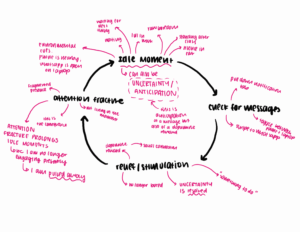
I chose to explore this study via the Connection Circle and Feedback Loop models. The Connection Circle was particularly illuminating because I started to see connections and similarities between different node elements. Like having WhatsApp open and having a phone nearby are both related to accessibility. It was also clear via the connections that boredom, procrastination, and free time although different experiences with different motivations all lead to the same outcome of checking the notification center when combined with ease of accessibility. In contrast, the feedback loop is a lot cleaner of a model featuring 4 steps. The annotations in pink are there to bring more color into that loop and convey how many different ways each step can be manifested and appear even though they also boil down to these broad categories written in black.
Figure 1. Connection Circle
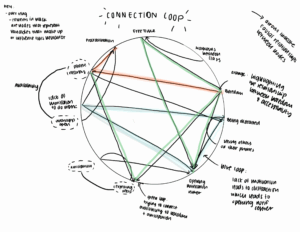
Figure 2. Feedback Loop
If I were to redesign the observational study I think I would have rather gone about my entire day and then somehow used a tracker in post, possibly a screen recorder for the day. Even if that’s not realistic, I find myself asking what I could do differently so the study did not feel as intrusive or influential on the behavior itself with the goal of being as objective as possible. Another thing I would do differently if I were to repeat it is have a much easier way to log it. I wouldn’t do a journal entry with my thoughts every time, possibly just a button that I can click and indicate that I did the behavior. I have a strong hunch that it’s active journaling and reflection with each entry that caused me to be too critical of my own behavior and gave me that desire to reduce the behavior while I was still meant to be non-judgmentally observing myself.



