
From Saturday evening through Monday I chose to track a habit that I often feel conflicted about: how frequently I pick up my phone. Rather than focusing on screen time totals, I was interested in the moments I reached for my phone, which included intentional uses (such as opening maps or paying for something) as well as habitual or unconscious ones (checking the time, unlocking and scrolling).
I noted each pickup as close to the moment as possible, which sometimes meant interrupting my routine to record the behavior. While this sometimes felt tedious, it also forced me to become aware of how automatic the action often was. Other times, I simply went back some time later to reflect and remember each time I’d picked up my phone in the last hour. I chose this habit because I think if I want to address my screen-time usage, it could be useful to understand what is happening at the beginning that causes me to reach for my phone in the first place.
What stood out was how often I picked up my phone without a clear intention. There were many moments where logging felt almost embarrassing, because I hadn’t realized how frequently the behavior occurred until I was forced to acknowledge it explicitly. At times this made me want to change my behavior, which is why I decided not to immediately log all these moments.
One of the most surprising findings came from comparing the weekend to Monday. On Saturday and Sunday, I picked up my phone far less frequently—even though I technically had more free time. This is because I was spending time with friends. For example, going out for drinks and exploring San Francisco. I mainly picked up my phone to use it for GPS, looking up information, and to make payments.
On Monday, my phone pickups increased dramatically. I checked my screen time in my phone’s settings and saw that the number of times I picked up my phone on Monday was more than Saturday and Sunday combined. The biggest difference wasn’t workload, but being alone. When I was alone, I felt bored more often, and boredom triggered phone use as a source of easy stimulation or dopamine.
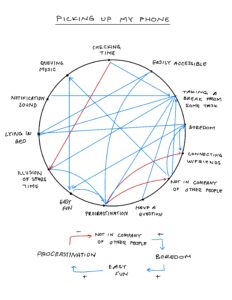
Using a connection circle model forced me to face a loop I already knew.
Being alone made me bored
Boredom led me to pick up my phone
Phone use led to procrastination
Procrastination pushed work later into the day
This reduced time available to connect with others
In other words, the behavior I used to cope with being alone often reinforced the very condition that caused it.
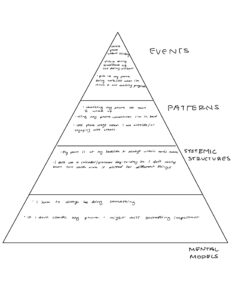 My iceberg model helped surface deeper structures influencing this behavior. I almost always keep my phone within arm’s reach: in my pocket, at my desk, or at my bedside. It’s the first thing I check every morning, or when I wake up in the middle of the night! Another factor is how I structure my time. I don’t consistently use a daily planner or assign time blocks to tasks. Without internal deadlines, time feels open-ended, and only externally imposed deadlines (like assignments or meetings) significantly shape my behavior. In the absence of those, my phone easily fills the gaps.
Some underlying mental models also became clear: I feel like I always need to be doing something, even if that something isn’t meaningful to my long term goals or productive. Also, I believe that if I don’t check my phone, I might miss something important—even though most things could wait hours without consequence.
If I were to do this study again, there are a few things I would change. I would add more contextual data, such as noting my environment, emotional state, or what I was transitioning between when I picked up my phone. This would help distinguish between boredom-driven use and intentional use more clearly. I would also consider tracking for a longer period, such as an entire week, to see whether the weekday pattern holds consistently or if Monday was an outlier.
This study reinforced the learnings from the reading on the science of habits: that habits are deeply contextual. They happen in the same places, at the same times, under the same conditions. It is obvious and logical then, that I used my phone far less on weekends. I’m not moving mechanically through the day, defaulting to my phone at any transition: between classes, between sets at the gym, or while getting ready for class. I’m least tempted by my phone when my life feels full and I am socially engaged. I am most drawn to it when time feels unstructured and isolating.



