For this habit tracking task, I wanted to focus on my slow, unproductive mornings. I feel guilty every time I sleep in and lose time for productivity, and it sometimes gives me headaches, setting me up for a terrible day. Since 2026 started, I have been wanting to get out of bed earlier, and that is reflected in my first Measuring Me log from Wednesday, a day that had no classes and no obligations. I managed to get out of bed at 8 am, which is a major improvement for me since I usually stay in bed until 11 am or noon on days like this.
However, by tracking what I actually did with my morning time, I realized I was still unproductive, as I did not start working until 11 am. As shown in my Day 1 schedule, I spent 3 hours on a slow, laid-back morning routine (sit around and chill, take my time doing makeup, enjoy coffee, phone time). This is a reasonable routine for when I’m on break, but now that I’m back at school I have to lock in. I logged these activities easily (not needing a timer/reminder) since I didn’t have anything else going on; I logged the activities in my Notes app.
Wednesday:
- 7:45- wake up, watch youtube video
- 8:00- out of bed, wash face brush teeth
- 8:15 skincare, phone
- 8:30 get dressed
- 8:45 sit around and chill
- 9:00 makeup
- 9:15 makeup
- 9:30 make coffee, breakfast
- 9:45 breakfast
- 10:00 chill/phone
- 10:15 phone
- 10:30 prepare to leave
- 10:45 walk
- 11:00 find place to sit, plan what to work on
- 11:15 start homework
- …
I realize the issue with my New Year’s resolution to simply “get out of bed earlier”. Waking up early is useless if I don’t have a plan for what I’m going to do with the additional morning hours. This is easier said than done, though. I am a night owl and have a hard time following through with self-defined morning plans because I have low energy. As a result, my mornings are unproductive and I spend the evening/night catching up on my tasks.
The other days I tracked are Saturday and Monday, measuring hourly. Both of these are days with no obligations, so I wish I had time to measure on Tuesday (a class day) to have more data. On Saturday I had a particularly “bad” morning: I didn’t get out of bed at 8 – I went back to my old habits of sleeping in until noon. My schedule from Saturday reflects the habit: a slow/late morning and compensating at night (9-11 pm Leetcode).
Saturday:
- 11:00 wake up
- 12:00 youtube, social media in bed
- 1:00 out of bed, eat something, get ready
- …
- 9:00 pm leetcode
- 10:00 leetcode
- 11:00 leetcode
- 12:00 unwind, get ready for bed, shower
- 1:00 instagram, lights out
By Monday, I had already started writing this blog post so I was more aware of my slow mornings. That is reflected in my schedule as well, since I had a slight improvement from Day 1: my morning routine took 2 hours rather than 3. Plus, I immediately got to work on Leetcode instead of saying “I’ll do it later”, because this time I made a plan for what topic I was going to do. In the future, I want to get my “out of bed” to “out of the house” elapsed time down to 1 hour.
Monday:
- 7:00 sleeping
- 8:00 out of bed, get ready, makeup
- 9:00 makeup, breakfast, pack bag
- 10:00 walk, plan
- 11:00 leetcode
- 12:00 leetcode, review data structures
- …
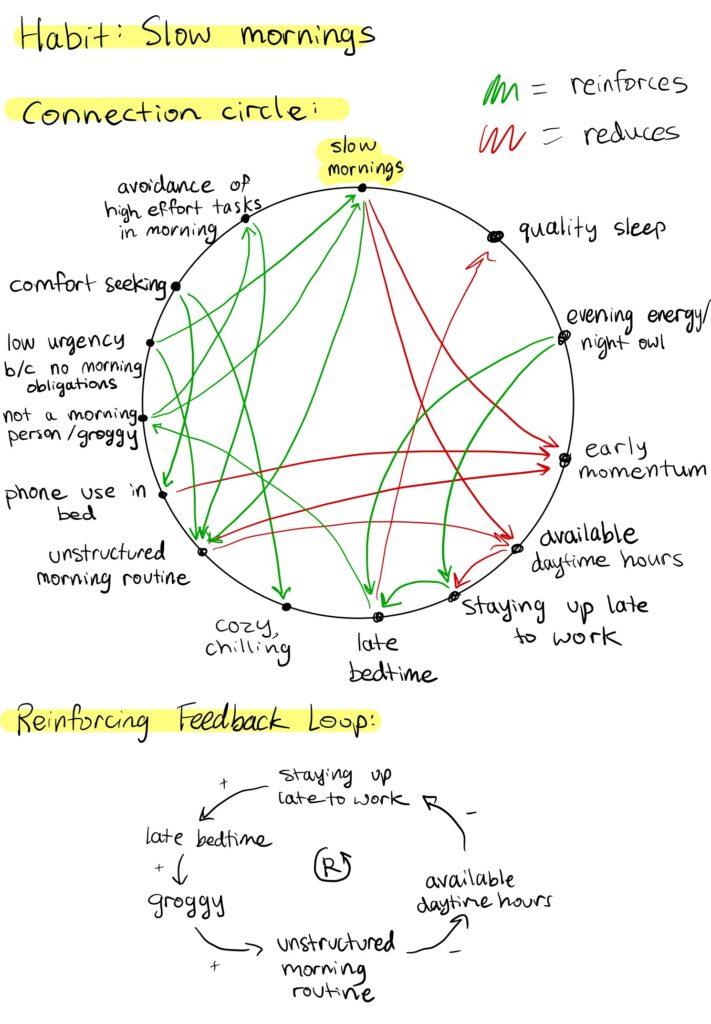
Although my days look different, they reflect the same underlying habit of “slow day activation”. On Wednesday, I got out of bed at 8 am but still spent several hours in a low-effort, unstructured routine before starting work. On Saturday, with it being a weekend, that habit was more pronounced: I stayed in bed longer and missed the morning entirely, with my day not starting until 1 pm. Both days show delayed task initiation when there are no morning obligations, just at different intensities. I created two models to get insight on why this habit occurs. I drew a connection circle, helping me realize the main contributors are my low energy in the mornings, my avoidance of high-effort tasks in the mornings, and low urgency due to having no morning obligations. I also drew a feedback loop to see which behaviors reinforce my habit.