
Selected Behavior and Motivation
For a while, I’ve struggled with unintentionally checking or opening my phone, and I wanted to learn from myself why I was doing that. Specifically, I wanted to learn from moments when I picked up my phone without a clear reason (e.g., not responding to a message, making a call, or completing a planned task).
I chose this behavior because I noticed how frequent it was, but also how invisible it was to me. While I was aware that I used my phone a lot, I rarely processed why I reached for it in the moment. I was interested in understanding what conditions made this more likely and why it kept happening even though I thought I actively tried not to look at my phone unintentionally.
Collecting Data
Duration and Frequency:
- Tracking period: 3 consecutive days (Friday 1/9 – Sunday 1/11)
- Logging method: whenever I caught myself on my phone without a clear reason
- Data recorded:
- What I was doing immediately beforehand
- Context (location, task, social setting)
- Emotional or cognitive state
I wanted to track this for more than 2 days because I was really interested in seeing if the data would show variation. Also, I wanted to log data immediately after catching myself so I could accurately describe the details, especially the emotional and cognitive state, since that can be viewed differently in the future vs. in the moment.
At first, logging was challenging, and I noticed how much of this habit was truly a reflex. This was especially true in short, uncertain pauses or when I was nervous or anxious about something.
Logging, by the third day, increased my awareness. I often noticed the urge to check my phone before acting on it, but not 100% of the time. This shift of after-the-fact awareness to in-the-moment awareness was a great personal outcome for me.
Key Learnings
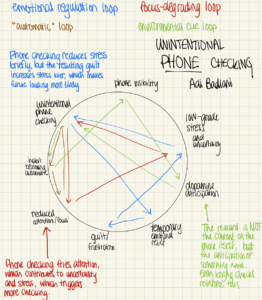
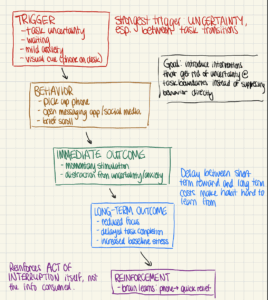
- Uncertainty, not boredom or anxiety, was the biggest trigger: phone checking happened most when I was figuring out what to do next and in moments of ambiguity.
- Environmental cues play a massive role: simply having my phone visible or within reach significantly increased the likelihood of checking, even when I felt motivated to focus; it might be helpful to hide my phone in the future when working.
- Short-term relief made long-term costs less obvious: the emotional relief caused by phone checking in the short term caused reduced focus and more frustration, which compounded with time and made future checking more likely.
What I Would Do Differently
- Add more quantitative data: I would track the number of checks per hour to compare different contexts and different times of the day.
- Log all resisted urges: Capturing moments even when I feel the impulse to go on my phone, but choose not to, would help me think about friction points.
- Introduce controlled changes: I would alter one variable at a time (e.g., phone visibility) to think about how the system responds, rather than waiting until after the experiment.



