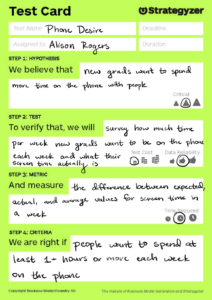
Test #1: Phone Desirability
Alison Results:
We reached out to six college recent graduates through text and snowball recruiting due to their proximity to our target demographic. While not all of them have moved out in the last year, many of them have moved out in the last two years. Those who had moved out over a year ago were all non-Stanford graduates, which we wanted to ensure we included in our sampling. Our participants reported the following:
| Participant | Amount of time spent on the phone/texting friends (per week) | Amount of time wished (per week) | Desired change (per week) |
| 1 | 4 hours | 6 hours | +2 hours |
| 2 | 7.5 hours | 6.5 hours | -1 hour |
| 3 | 10 hours | 10 hours | +0 hours |
| 4 | 4 hours | 4 hours | +0 hours |
| 5 | 3 hours | 3 hours | +0 hours |
| 6 | 5 hours | 5 hours | +0 hours |
Some participants also replied with qualitative data about their time spent: “I just started a long-distance friendship, and it’s going very well” and “I relatively meet my goal for communication time. If anything I want to spend more in person time with friends.”
Our assumption here was incorrect, as our mean desired change was 10 minutes and our median response was no change. This will shift our focus away from increasing time spent and more towards increasing quality of digital interactions.

Test #2: Reminder Feasibility
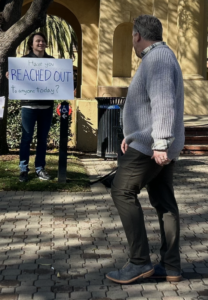
To assess whether reminders are an effective method to encourage people to reach out to their friends, I created a sign that said “Have you reached out to anyone today?” And held walking around white plaza and Tressider, areas populated by many Stanford students. If I noticed someone college aged looking at the sign on foot and without headphones in, I directly engaged them and asked if they had reached out to anyone. These participants were picked because they most closely resembled our target audience of recent graduates while being reachable and (at least presumably) open to interaction.
Regardless of their answer, I encouraged them to immediately reach out to more friends and loved ones. Here are the raw responses:
- “I’m good thank you”
- “I have…I will”
- “I have”
- “I have….I will”
- “Not yet”
- “I’ll text my mom right now” (immediate action)
- “I’ll text them right now too” (immediate action)
- “Texting my sister now” (immediate action)
- “Okay”
- “Not yet”
- “I should…I will”
- “I have”
- “No I haven’t but that’s a good idea…I will”
- Ignored with eye contact
- “I have…no”
- “I have…no thanks”
- “I haven’t…yeah yeah I’m going to”
- “I have…sure I will again” (did it immediately)
- “Nah not yet…sure I’ll do it”
In general, the vast majority of people did not take action, although most said that they had already reached out and many promised to take action. However, there’s no way for us to know whether they actually took action and the unique social situation of being accosted by a stranger with a sign is likely to impact their promises.


Test #3: Maintaining College Friendships
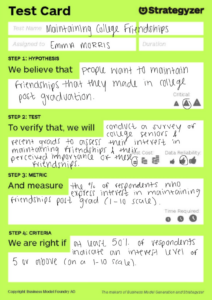
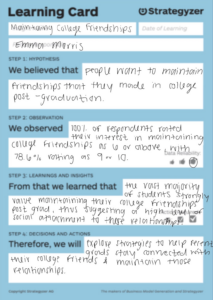
To explore the importance of maintaining college friendships post-graduation, I conducted a survey with 14 recent graduates, asking them to rate their interest in staying connected on a scale of 1-10. I recruited participants through direct outreach and social media, targeting individuals at a transitional stage where friendships may be impacted by career shifts and distance. The results showed that 100% of respondents rated their interest as 6 or above, with 78.6% rating it at 9 or 10, confirming that maintaining friendships is a high priority for most graduates. This suggests a strong emotional and social attachment to college friendships, highlighting the need for tools or strategies to help facilitate ongoing connections. A follow-up study could explore the specific challenges graduates face in staying connected and identify the most effective ways to maintain these relationships.

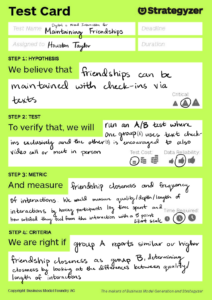
Test #4: Digital vs Mixed Interaction for Maintaining Friendships
I had two people in Group A and two in Group B
- Group A: Clemson new grad from South Carolina working as an engineer and co-term from Washington studying economics
- Clemson grad was chosen because he is a new grad who is experiencing long-distance friendships due to relocation. He has a mix of new friends from work and old friends from school and his best friend lives in Colorado, giving insight into how text-based check-ins work for distant friendships.
- Co-term was chosen because she is about to transition into post-grad life and has friends who already have, so she is somewhat familiar with long-distance friendships.
- Group B: Stanford senior from Los Angeles studying psychology and Stanford graduate from Florida who studied human biology
- Stanford senior was chosen because she is highly comfortable with texting and maintaining digital friendships, so it would be interesting to see if FaceTiming and such adds value.
- Stanford grad was chosen because she has the opposite behavior to the senior and tends to be passive about digital communication. I thought it would be interesting to see if asking them to reach out changed the behavior of someone who normally does not.
I called each of them or asked them to participate in person and explained their role, having them reach out to a friend in the designated manner and text me how they felt after their day’s interactions, answering the following short questions for each:
- How much time did you spend interacting with this person?
- (For text only) Was this time consecutive?
- How satisfied did the interaction make you feel (1-5)?