
Overview
The Mockingbird study focused on the socialization patterns of those who have recently left the undergraduate college environment. All members of our target demographic are facing a stage in their life where executive functioning skills are required and tested in new ways; for many people in our target demographic (except those attending graduate school), this is their first time in an environment not dominated by school social dynamics, where classes, school clubs, and dorm environments dominate many of the socialization habits. In addition to that, many people who have just left the college environment live further away from their friends than they are used to, whether that is because they moved or because their friends did. The key question we were aiming to answer were:
- How do people who have just left undergraduate college keep in touch with their friends from before that transition?
- What role does digital communication play in the socialization pattern of our target demographic?
- How do members of our target demographic meet and form friendships with people in new environments?
- How does socialization fit into the lives of people who have been granted more independence as a young adult than they have ever had before?
The purpose of this baseline study was to establish the existing habits of this user population as it pertains to both in-person and digital socialization to discover the key needs and pain points.
Participant Recruitment
Our participants were recruited via text message, Instagram DMs, and snowball recruiting from other participants. Participants were asked to fill out a pre-screen survey that filtered out those who had moved out over 12 months ago, those with particularly strong social connections, and those who still live in dorms or with family.
Study Methodology
Our study consisted of three stages: 1) pre-study interviews 2) a diary study and 3) post-study interviews. The stages are described below.
1) Pre-Study Interviews: During this phase, participants met with members of the Mockingbird research team for 20-30 minute interviews. During these interviews, participants were asked to describe their current socialization patterns, any existing tools used, and their current pain points. The pre-study interviews allowed us to gather key qualitative data about how our target demographic feels about their social habits, when they feel successful, and what being unsuccessful looks and feels like for them.
2) Diary Study: The diary study took place over four days (January 20 – 23 for some participants and January 21 – 24 for the remaining participants). During the diary study, participants were asked to fill out a diary twice a day – once in the morning and once at night. There was an optional mid-day diary entry that participants could also fill out, and participants would receive pings by 10am and 8pm in their respective time zones if they had not filled out either the morning or evening diary entries. The morning diary entry would describe socialization plans for the day, and the evening diary entry would reflect on what happened that day. The diary-study gave us quantitative data about the perceived quality of interactions on a 1-10 scale, as well as the method of these interactions. The diary entry also gave us qualitative data about how socialization patterns affected the overall well being of our participants.
3) Post-Study Interviews: In the final phase of our study, participants who completed the diary met with a member of the Mockingbird team a second time for a 20-30 minute conversation on their experience. Similar to the pre-study interviews, we gathered qualitative data about our participant’s thoughts and feelings about the study: any new patterns discovered, what tracking interactions felt like for them, and a reflection on successes and failures over the past few days.
Raw Data ⇾ Grounded Theory
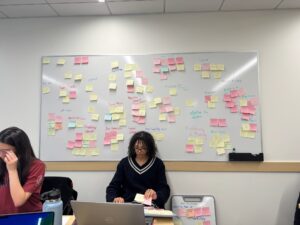
This section presents a grounded theory synthesis based on interviews with 11 post graduates. To view our raw data and synthesis process in more detail, please see this FigJam. Data for each of the participants is color-coded and sorted on the left.
Grounded Theory 1: Post-grads want to maintain friendships, but reaching out takes effort
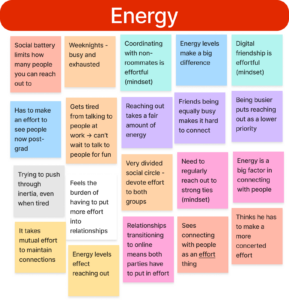
Many participants want to keep their friendships strong but find that reaching out requires more effort than they expect. Without the convenience of shared spaces and casual encounters, keeping up with friends requires more effort, intentionality, and planning.
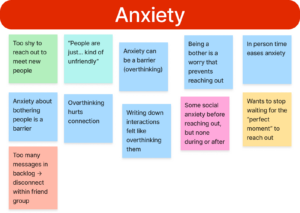
Subtheory: The emotional and cognitive burden of initiating contact discourages people from reaching out.
- Example: Wants to stop waiting for the ‘perfect moment’ to reach out.
- Example: “Reaching out is stressful but worth it.”
- Example: “Reaching out takes a fair amount of energy.”
- Example: Thinks he has to make a more concerted effort.
Question: What social tools can reduce the cognitive burden of initiating interactions?
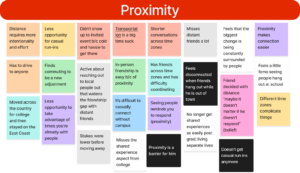
Subtheory: Proximity made friendship easy in college, but distance now requires active effort.
- Example: “In-person friendship is easy because of proximity. Now, distance requires more intentionality.
- Example: “Has to make an effort to see people now post-grad.”
- Example: “Distance requires more intentionality and effort.”
- Example: “No longer get shared experiences as easily post-grad; living separate lives.”
Question: How can post-grads adapt to the absence of casual run-ins? What mechanisms can help maintain connection in their absence?
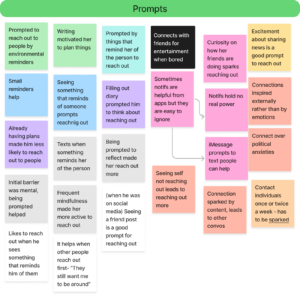
Subtheory: External reminders serve as prompts for reaching out.
- Example: “Prompted by things that remind her of the person to reach out.”
- Example: “Seeing people reminds you to respond (proximity).”
- Example: “Flips through memories in downtime and reaches out to people she thinks about.”
- Example: “Likes to reach out when he sees something that reminds him of them.”
- Example: “Texts when something reminds her of the person.”
Question: Can external cues be designed to support social maintenance?
Grounded Theory 2: The shift from structured to self-managed socialization is difficult
In college, social life is embedded in daily routines (school, clubs, extracurriculars,etc.), but after graduation, maintaining connections requires deliberate planning.

Subtheory: Post-grad life lacks the automatic social opportunities of college.
- Example: “Less opportunity to take advantage of times you’re already with people.”
- Example: “No longer get shared experiences as easily post-grad; living separate lives.”
- Example: “Days are much less regimented now.”
- Example: “College didn’t feel like maintaining friendships.”
Question: How can post-grads recreate structured social opportunities?
Subtheory: Without built-in routines, friendships require intentional scheduling.
- Example: “Planned interactions are better in the long run; spontaneous interactions are spikes.”
- Example: “Scheduling calls can take weeks to happen because it will be long – commitment.”
- Example: “Took a risk to graduate early—now has to put more effort into relationships.”
Question: What tools or habits help post-grads maintain social consistency?
Subtheory: The transition from spontaneity to planning is a challenge.
- Example: “Spontaneous is good but hard to get.”
- Example: “Planning hangouts makes it more difficult.”
- Example: “Used when2meet to schedule a call – no one answered (embarrassed).”
Question: What are effective ways to make social planning feel more natural?
Grounded Theory 3: Digital interactions create both connection and disconnection

Post-grads rely on digital communication to maintain friendships, but it does not always feel satisfying.
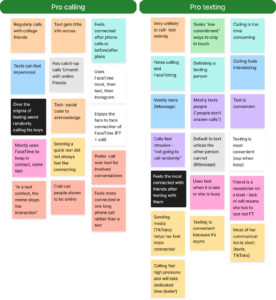
Subtheory: Texting is the default mode but lacks emotional depth.

- Example: “Text gets little info across.”
- Example: “Sending a quick text did not always feel like connecting.”
Question: How can digital communication tools be adapted to better support emotional connection?
Subtheory: Video calls feel high-pressure and time-consuming.
- Example: “Calling feels high pressure and will take dedicated time (belief).”
- Example: “Calling is too time-consuming.”
Question: What design solutions could make video calls feel less burdensome?
Subtheory: Passive digital interactions (e.g., sharing media) help maintain connection.
- Example: “Uses IG ‘close friends’ story – wants more delineation options (like Snapchat).”
- Example: “Sending media (TikToks) helps her feel more connected.”
Question: What role do passive digital interactions play in friendship maintenance?
Grounded Theory 4: New life responsibilities make social maintenance harder
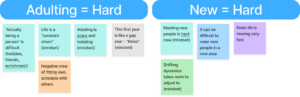
Work, errands, and personal obligations compete with social priorities.
Subtheory: Work and exhaustion make reaching out feel like another task.
- Example: “Work and busy life makes reaching out take more effort.”
- Example: “Weeknights – busy and exhausted.”
Question: How can people integrate social connection into busy schedules?
Subtheory: Time differences and unpredictable schedules create barriers.
- Example: “Time difference is a barrier to connection.”
- Example: “Works 3 jobs -> inconsistent/non-traditional schedule.”
Question: What solutions can help long-distance friends stay connected despite conflicting schedules?
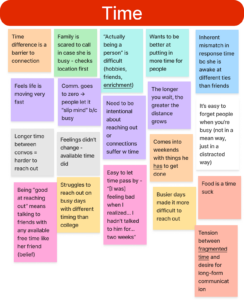
Subtheory: People want to prioritize friendships but struggle to act.
- Example: “Wants to be better at putting in more time for people.”
- Example: “Recognized grind culture at work is getting in the way of social connections.”
Question: How can post-grads reframe socializing as a necessity rather than an optional task?
Grounded Theory 5: New friendships form in structured environments post-grad
Participants rely on structured social settings to meet new people.
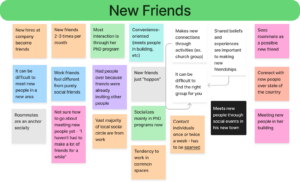
Subtheory: The workplace becomes a primary social space.
- Example: “New hires at company become friends.”
- Example: “Vast majority of local social circle are from work.”
Question: How can workplaces better facilitate friendships?
Subtheory: New social groups form through organized activities.
- Example: “Meets new people through social events in his new town.”
- Example: “Makes new connections through activities (ex. church group).”
Question: What structured activities best support meaningful social connections?
Subtheory: Post-grads struggle to make friends outside structured settings.
- Example: “Not sure how to go about meeting new people yet – ‘I haven’t had to make a lot of friends for a while.’”
- Example: “Meeting new people is hard now (mindset).”
Question: How can post-grads form organic friendships outside of structured settings?
Grounded Theory 6: Social expectations and anxieties influence reaching out
Fears of rejection, social norms, and anxiety affect how and when people connect.
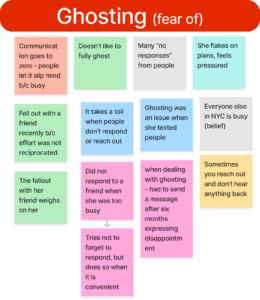
Subtheory: Fear of being a bother prevents many from reaching out.
- Example: “Being a bother is a worry that prevents reaching out.”
- Example: “Sometimes you reach out and don’t hear anything back.”
Question: How can people be reassured that their friends want to hear from them?
Subtheory: Overthinking interactions leads to inaction.
- Example: “Anxiety can be a barrier (overthinking).”
- Example: “Overthinking hurts connection.”
Question: What strategies can help people reach out without overanalyzing the situation?
Subtheory: Social norms discourage spontaneous communication.
- Example: “Calls feel intrusive – ‘not going to call randomly.’”
- Example: “Social expectation that people don’t want to be called – burden on others.”
Question: How do shifting social norms impact communication habits?
Grounded Theory 7: Friendships change post-grad, requiring new strategies for connection
Friendships evolve after college, requiring active effort and adaptation. (See Energy under Grounded Theory 1.)
Subtheory: Post-grad friendships require intentional effort to maintain.
- Example: “Need to regularly reach out to strong ties (mindset).”
- Example: “Relationships transitioning to online means both parties have to put in effort.”
Question: How do post-grad friendships redefine what it means to be ‘close’?
Subtheory: Some friendships fade due to lack of shared experiences.
- Example: “Misses the shared experience aspect from college.”
- Example: “Felt a little fomo seeing people hang out at school.”
Question: What can help maintain friendships when shared experiences decrease?
Subtheory: Maintaining friendships requires balancing effort and flexibility.
- Example: “Okay with fading in/out of contact.”
- Example: “Longer time between convos = harder to reach out.”
Question: How can post-grads create friendships that are both flexible and meaningful?
System Models
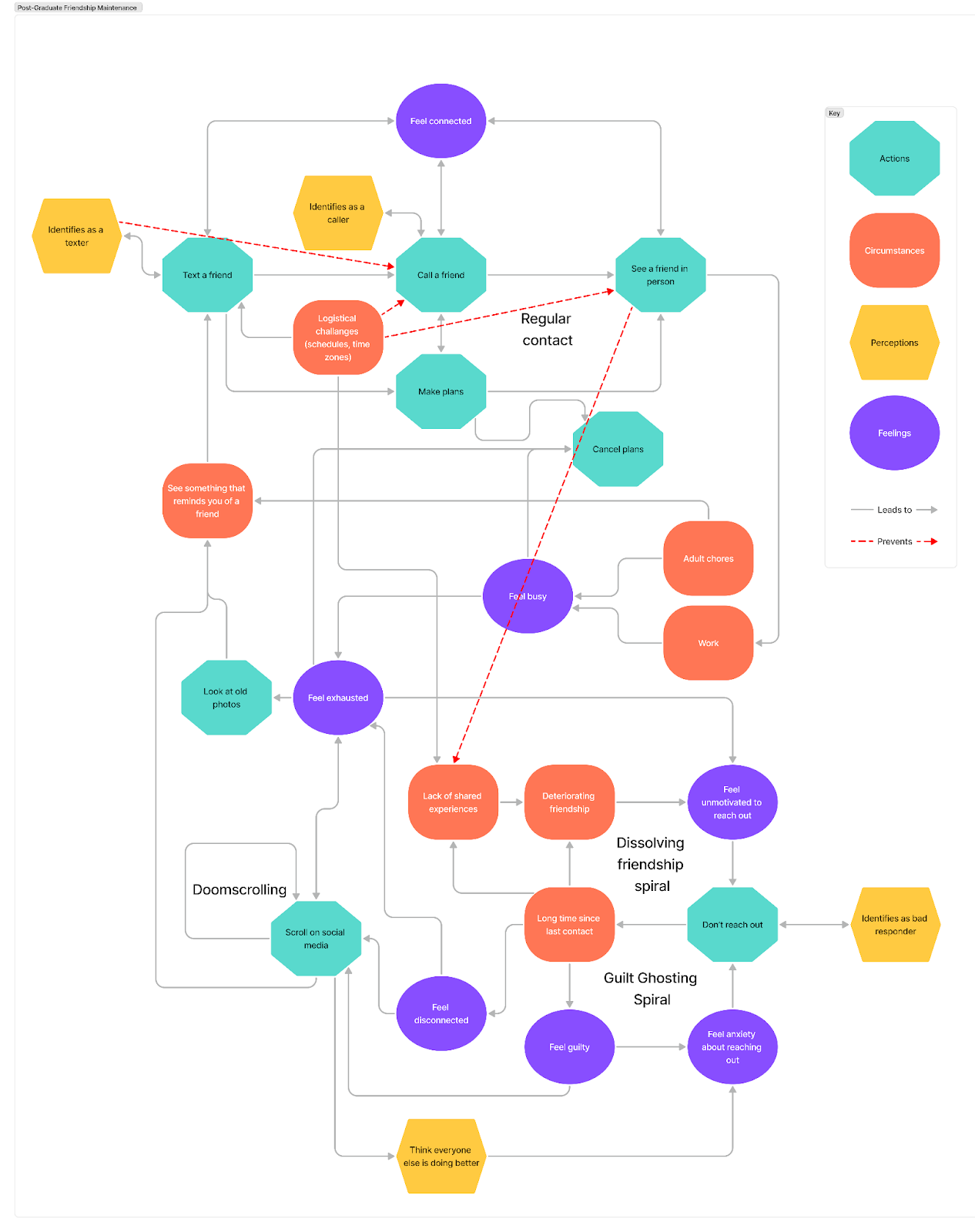
Our system maps are both listed below. If you would like to explore our maps, please feel free to view this FigJam.
System Model 1: Feedback Loops
This first model captures a detailed look at the causes, effects and emergent loops of our participants’ behavior. The feedback loops make it clear that both communicating and the lack of communication are self-sustaining. The failure to reach out is promoted by either guilt or lack of motivation/perception of higher effort necessary to reach out. One especially revealing piece of this model is the importance of seeing something that reminds you of a friend, which seems to be one of the few ways to make the leap from the down-ward, no connection spiral to being connected.
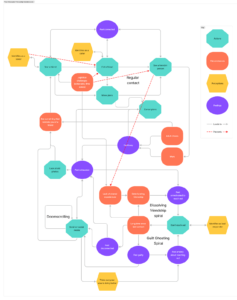
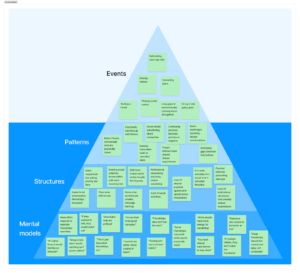
System Model 2: Iceberg
This iceberg model re-emphasizes how actions of texting or not give way to cycles of connection and disconnection. The structural level exposes how the shift from college’s built-in community to dispersed adult life fundamentally changes how friendship maintenance works. Perhaps most telling are the mental models, which show a web of conflicting beliefs about friendship—that it should be effortless yet requires work, that everyone else is doing better while believing they too are struggling, that real connection requires energy while exhaustion is normalized. These underlying assumptions create a gap between how recent graduates believe friendship “should” work and the realistic demands of maintaining connection after college.
Secondary Research
Literature Review: Post-Grads Connecting with Friends
One of the biggest challenges post graduates face is staying connected with friends after leaving the structured social environment of college. Without dorms, dining halls, and spontaneous run-ins, friendships require more effort to maintain. Research shows that 73% of graduates rely mostly on digital communication to keep in touch, but maintaining strong relationships can still be difficult (Rice et al., 2017). Our analysis of existing studies and social connection apps reveals key trends in how post-grads stay connected, the struggles they face, and potential solutions.
Key Research Findings
How Communication Changes After College
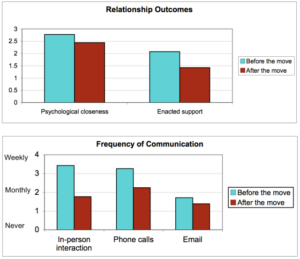
Keeping in Touch by Technology, 2008 – Figure 1: Changes over time for pre-move friendships
- Moving away reduces how often friends talk by 50%, yet many still feel emotionally close to their friendships (Keeping in Touch by Technology, 2008).
- Most post-grads juggle 4-5 different apps to stay in touch, which can be overwhelming (Digital Intimacy, 2023).
- Only about one-third of post-grads continue communicating as much as they did in college after six months (Transition to Adulthood, 2014).
These findings suggest that while friendships can remain strong, the frequency of communication drops significantly due to new responsibilities, different time zones, and fewer shared experiences.
What Actually Works for Staying in Touch
- Quick check-ins work better than long scheduled calls, with 89% of people preferring this approach (Smart Contact Reminder, 2025).
- Reminders increase outreach by 42%, showing that small nudges help people keep in touch.
- Apps that focus on shared activities, like Strava (fitness tracking) or Meetup (events), see 40% better engagement than those that rely solely on messaging.
This suggests that casual, low-effort ways to stay connected are more effective than trying to schedule long conversations.
Comparative Analysis: What Existing Platforms Offer
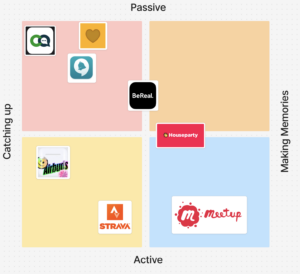
Passive vs. Active Communication
- Apps like Airbuds and BeReal make staying in touch effortless by allowing users to passively share updates without the pressure of responding.
- In contrast, apps like Smart Contact Reminder and CommuniqAI send structured reminders to encourage people to reach out (Comparative Analysis, 2025).
- The ideal solution would combine both passive and active communication. Thus, allowing for easy, ongoing connection without making it feel like another task.
Asynchronous vs. Synchronous Interaction
- 67% of post-grads prefer messaging whenever they have time instead of scheduling calls (Distant Friends Study, 2014).
- Apps like Ping and SocialPing tried to solve this by allowing users to signal availability instead of demanding immediate responses.
- Meanwhile, real-time apps like Houseparty struggled because they required everyone to be online at the same time, which isn’t practical for post-grads with busy schedules.
The Role of Shared Activities
- Some apps, like Strava, show that sharing experiences can be more engaging than just messaging.
- Users are 65% more likely to stay active on an app that offers multiple ways to connect through messaging, shared activities, and passive updates.
Implications for Ideation
What People Want in a Friendship Tool
- Casual updates are used 2x more than formal check-ins.
- Apps that integrate into existing habits (rather than forcing new behaviors) perform 3x better in long-term engagement.
- People want both planned and random ways to check in (structured reminders increase communication by 47% but shouldn’t feel robotic).
What This Means for Designing a Solution
- Mix automatic reminders with real connection: lightweight nudges help, but users should have control.
- Offer multiple ways to stay in touch: messaging, shared experiences, and passive updates.
- Let people respond when they have time: asynchronous features make it easier for post-grads with busy schedules.
- Make staying in touch feel effortless: low-pressure updates (like BeReal or Airbuds) keep friendships alive without forcing constant messaging.
Conclusion
The research clearly shows that post-grads want low-effort, natural ways to stay connected without making friendships feel like another obligation. By combining passive social updates, structured reminders, and shared activities, a tool designed for post-grads can help them maintain meaningful friendships even as their lives become busier and more spread out.
Proto-Personas and Journey Maps
In the last section of our synthesis, we’ve aggregated proto-personas and journey maps based on our findings from our interviews and baseline studies. These aggregations will form the foundation of our future work as we shift towards developing an intervention study geared directly towards our users’ key needs.
Busy Beatrice
We developed the Busy Beatrice (or Bea) persona based on the many participants we found who viewed their new adult lives as too hectic and busy to reach out to friends. Our participants shared details about how their work schedules don’t align with their friends’, how the constant churn of chores gets in the way, and how highly time-intensive mediums such as phone calls are overwhelming. This was a core painpoint in multiple interviews, so creating Bea was especially important for us.
Bea is 22 years old, a recent graduate, and just starting her career. She values her friendships but often finds that entire days go by without her realizing she hasn’t spoken to anyone outside of work. It’s not that she doesn’t care—it’s that time keeps slipping away, and her friends are also navigating similar post-graduation challenges. In our research, we heard multiple times that new professionals don’t intentionally ignore their friends— instead, maintaining friendships becomes difficult when everyone is juggling work, life, and adjusting to new routines. Bea is one of those people, and her journey reveals key pain points in how people keep up with friendships in their busiest seasons.
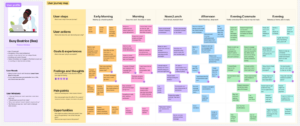
Key Takeaways from Bea’s Journey
- It’s not about forgetting, it’s about time slipping away. Bea intends to text back but is constantly sidetracked by work, social media, and exhaustion.
- Low-effort social engagement fills the gap, but not completely. Bea likes posts, watches stories, and reacts to messages, but those interactions don’t replace real conversations.
- Friendships require effort, but the effort feels like another task. At the end of a long day, even sending a text can feel like work, making it easy to delay interactions.
Proximity Paul
Another common theme in our interviews was the increased distance that post-grads experienced with their friends after moving away. As many of our participants are living alone or with only a handful of roommates, the shift from a dorm environment to a young adult lifestyle has been jarring. We noticed increased feelings if isolation across these participants, and thought creating this persona was key to understanding the needs of our users.
Proximity Paul is a recent college graduate struggling to maintain the deep friendships he built in school now that he lives far away from his friends. In college, social interactions were effortless—running into friends at the dining hall, walking to class together, or studying in the same spaces. However, after graduation, those spontaneous moments have disappeared, and staying in touch requires intentional effort. Paul wants to stay connected but often feels uncertain about reaching out. He wonders if his friends are just as busy or if they even think about him the way he thinks about them.

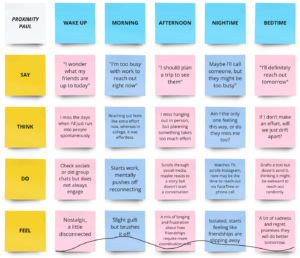
Key Takeaways from Paul’s Journey:
- Paul needs a system or habit that helps him maintain strong connections without it feeling like work. When a social interaction does occur, Paul is instantly reminded of how much these relationships mean to him, but he will still put off texting and calling for days, always with the promise that he’ll do better tomorrow (which he rarely does).
- Digital interactions, like liking posts or reacting to stories, feel passive and unfulfilling.
- Paul’s biggest pain points include the loss of spontaneity, the fear of one-sided effort, and the difficulty of scheduling meaningful interactions across different time zones and life commitments.
Anxious Allie
Our last proto-persona is based on the running theme we noticed of those who felt anxiety surrounding reaching out. This pattern emerged in our interviews, particularly exemplified by quotes like “I always second-guess myself, like, ‘Am I bothering them?’” and “The longer we don’t talk, the bigger that whole thing becomes.” Despite multiple participants asserting that “everyone wants to do better”, we found tension in the fact that our participants seemed worried they’d be wrong for doing better themselves. We decided that this needed to be expanded on to learn more.
Anxious Allie is a 23-year-old software engineer whose main activated role is that she is a friend and family member. She misses her college friends and feels lonely, but she has not reached out to them because in the absence of something specific to talk to them about, she worries that she’ll be seen as a bother. She browses social media at times, but rarely instigates any conversation or interactions on those platforms, and her daily routine is particularly mundane: get up, go to work, go to the gym, come home, doomscroll, sleep.
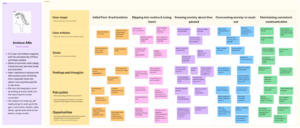
Key Insights from Allie’s Journey:
- Physical disconnection feeds into anxiety about reaching out, making it harder to break out of isolated routines.
- Anxiety about reaching out creates a cycle – the longer it goes, the harder it is to break. Users need help finding the immense energy and will to do so.
- Even once a habit of reaching out is established, there is still anxiety over the work that maintaining that relationship requires that needs to be addressed. The work of a solution should not stop at simply reaching out.
Future directions
Having completed our baseline study, we plan to develop an intervention study that touches on the key pain points we uncovered: conflicting schedules, anxiety, and the difference between maintaining friendships versus simply being friends. Our intervention study will help us uncover effective ways to change the habits of our target demographic as we move toward our ultimate goal of designing an app that will make longlasting, positive changes in the social lives of our new graduates.



