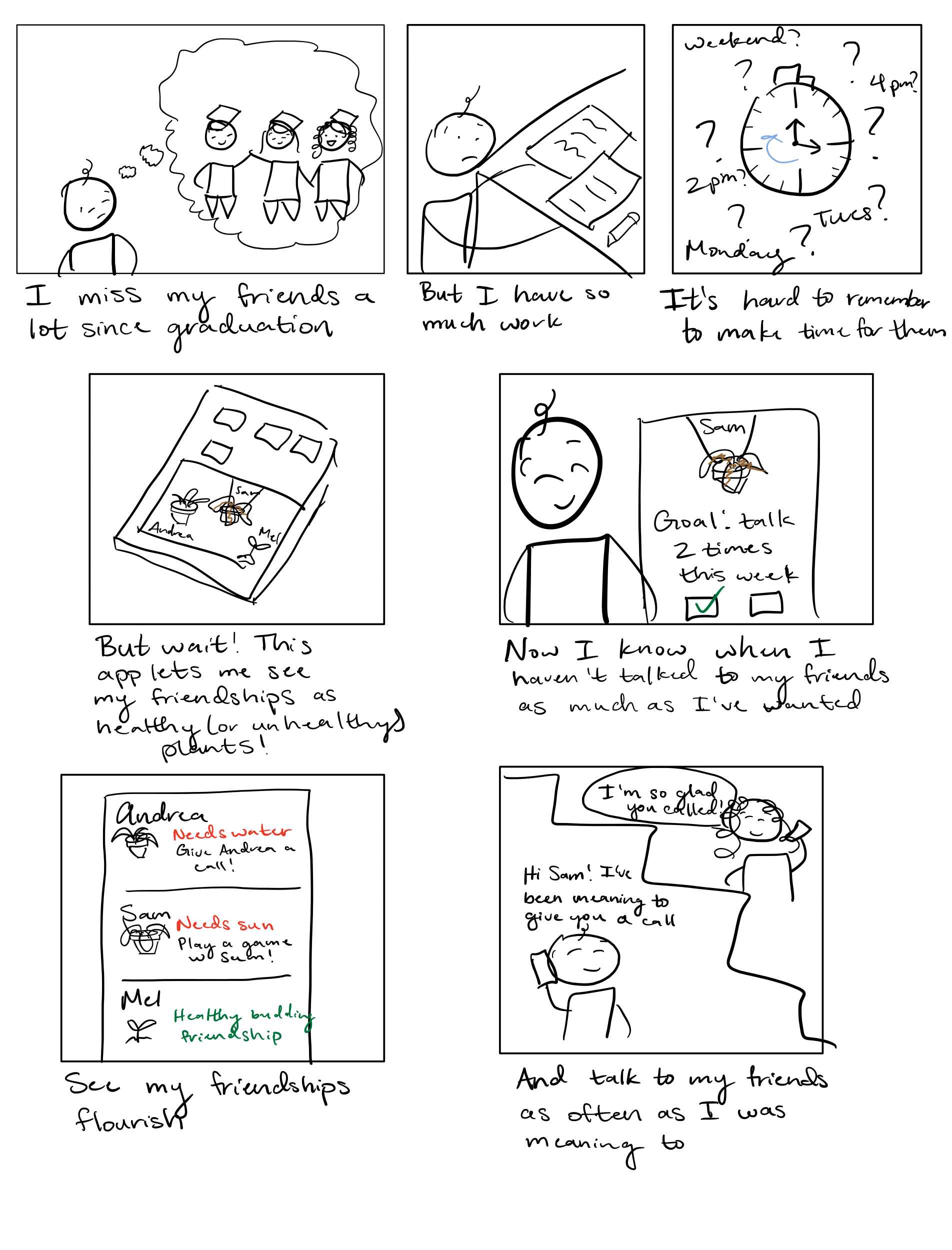
Top 3 Ideas
Chosen intervention: Passive depiction of friendship through plants
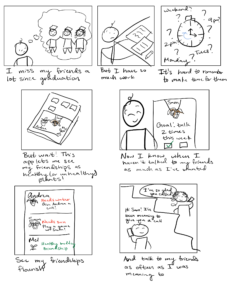
This solution seeks to represent friendships through plant-based visualizations on a phone’s home screen widget. Users select plants to represent specific friends, with each plant’s watering needs corresponding to their desired frequency of connection with that friend. The widget passively displays how long it’s been since the last interaction. Plants begin to wilt and dry up when too much time has passed without contact, while recent connections make the plant appear healthy and vibrant.
The core interaction happens through the widget rather than requiring users to actively open the app. This creates ambient awareness during natural phone usage moments when users have the capacity to reach out. The system integrates reminders to maintain friendships into existing phone-checking behaviors rather than demanding dedicated attention.
| Pros |
Cons |
- Aesthetic reminder of the importance of their connections
- Unobtrusive
- Feasible and implementable
- As a widget on the phone, very visible especially when they have time to be on their phone anyway
- Only requires one party to participate–don’t have to deal with cold start problem
- Plants as a metaphor naturally communicate the need for consistent care rather than sporadic intense attention
- The visual nature provides immediate understanding of relationship status without needing to parse text or numbers
- Different plants can reflect different types of friendships naturally (like how some plants need daily water, others weekly/monthly)
- Creates accountability without being punitive – wilting plants (hopefully) evoke concern rather than guilt
- Minimal cognitive overhead – doesn’t require learning new interaction patterns
|
- Doesn’t provide an anchor for the forthcoming conversation (ie, something to talk about when they reach out)
- Could potentially involve gamification, thereby minimizing the intrinsic value of the friendships
- Passive reminders may be easy to ignore
- May create anxiety or guilt when seeing multiple “wilting” relationships at once
- Could oversimplify complex relationships by reducing them to a binary healthy/unhealthy state
- Might encourage superficial check-ins just to “water the plant” rather than meaningful connection
- No way to account for quality of interactions, only frequency
- Doesn’t account for natural ebbs and flows in friendships (some friends you might naturally talk to less during certain periods)
|
Daily puzzles for distant friends
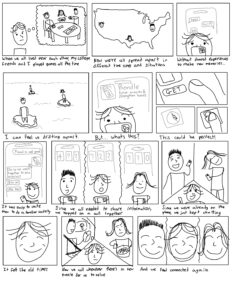
This idea is to have a game that requires multiple parties with different sets of information to work together to solve puzzles. Friends who are potentially falling out of contact can take up this habit and work together on these puzzles, which may require them to work/do things at the same time, requiring them to call. The motivation to play the game gets them into the habit of consistent communication. Could be built to scale for different numbers of people to help groups of friends thrive.
| Pros |
Cons |
- Ground connection in specific activity, moving connection towards memory making rather than catching up
- Splitting information needed to do game encourages calling, which can expand beyond original purpose of solving puzzle
- If the game is fun enough there’s more motivation to continue to play and reach out
- Game format creates natural “checkpoints” to resume from when schedules align
- Puzzle-solving creates a sense of shared accomplishment that texting/calling alone doesn’t provide
- Could help establish regular recurring meetup times in a natural way
- Success in solving puzzles together could build confidence in reaching out for other things
|
- Requirement of synchronicity may be too hard to overcome for time-zone separated friends
- Invitation to play daily game may be too big of an ask when trying to reconnect
- Game may start feeling like an obligation and become less fun over time
- Harder to implement as it requires designing puzzles with split information daily
- Friends with different puzzle-solving abilities might feel frustrated or left out
- Could be hard to balance difficulty to keep all parties engaged
- Risk of focusing too much on puzzle mechanics rather than using them as conversation starters
- May appeal more to certain personality types, limiting its broader applicability
- Could be challenging to provide enough variety in puzzles to maintain long-term interest
- Development complexity of creating multiplayer game infrastructure in addition to puzzle content
|
Ping Alert Reminder


This idea involves a customizable alert system that detects prolonged scrolling on social media and pings the user with a reminder to call or message a friend instead. The goal is to help post-graduates maintain connections by nudging them toward meaningful interactions rather than passive online consumption. The system integrates seamlessly into existing phone habits, triggering during periods of excessive scrolling to encourage users to redirect their online time toward social engagement.
| Pros |
Cons |
- Encourages intentional communication rather than passive social media usage
- Helps post-grads maintain friendships without needing to schedule calls in advance
- Customizable reminders allows users to set their own preferred frequency and timing
- Integrates naturally into phone habits rather than requiring extra effort to check an app
- Can reduce “doom scrolling” and promote healthier social media consumption
- Might provide emotional benefits, helping users feel more connected and less isolated
- Lightweight intervention that doesn’t demand significant behavior change
|
- Users might ignore or dismiss reminders if they are too frequent or intrusive
- Could create guilt or pressure rather than genuine motivation to connect
- Might not work for friendships that require deeper, more organic conversations rather than just a quick call
- Could be seen as nagging rather than helpful if not a good balance \
- Some users may not want to associate social media use with responsibility, preferring is more of as an brain escape
- No built in way to track or ensure quality of interaction, just frequency
|
Intervention Study Plan
Our core question is: Does the passive representation of friendships as plants help new grads be conscientious of how often they’re connecting with friends and does that translate to action of reaching out more and feeling more connected?
In order to run the study, we will do the following:
- Before study, send survey asking for three people they would like to stay in contact with over the course of the study and how often they want to be in contact with each of them.
- Make sure they have a specific spot in the diary to mark whether they made contact with these friends in particular
- Every day, send them an image of a shelf with three plants, each labeled with one of those friends’ names
- If they haven’t contacted a friend as frequently as they wanted to, the plant in that slot will be wilting
- If they recently contacted that friend, the plant in that spot will be thriving
- Measure how often they connected along with their thoughts and feelings regarding the plant representations of their friendships.
Our study materials can be found here.