MINDLESS PHONE CHECKING
Saturday, January 10
9:11 AM
10:15 AM
8:20 PM
8:22 PM
8:25 PM
10:30 PM
10:55 PM
Sunday, January 11:
7:05 AM
9:42 AM
9:45 AM
10:25 AM
3:32 PM
5:05 PM
7:02 PM
7:13 PM
7:15 PM
Duration: Saturday, January 10 – Sunday, January 11
Frequency: logged whenever I caught myself checking my phone mindlessly
The convenience of and dependency on my phone scares me. How many times do I get sidetracked because it’s within arms reach? Why do I turn to the screen as a physical reflex? How much real life have I missed out on in exchange for screen time?
I decided to put this to the test this past weekend, but with a twist. I went on a dorm trip to Yosemite, and wanted to see how much time in nature I’d sacrifice to look at my phone with no purpose. Would my reflex stay the same? Or would I be sufficiently engrossed in other activities to stop checking my phone?
The times I logged were the times I picked up my phone without realizing (times where I needed to use my phone were not the issue). I noticed I did have long stretches of time where my phone was completely away/I didn’t check for notifications. In the periods of time where I was resting, and in the morning during wakeup and evening before sleeping, I was most susceptible to mindless phone grabs. Sometimes these phone grabs were important though—I would have missed some important texts and missed calls (I am an RA so I need to be responding), so this habit is not always useless. Maybe this habit was even formed from a sense of responsibility that involved needing to be reachable.
This supports the Wendy Wood’s idea of habits being formed from immediate reward; in the past, checking my phone resulted in the ability to be responsive to important messages, leading me to do it more often. However, it also manifested a bad sense of always needing to be “online”.
Next time, I’d conduct this same study on myself but during an “average” day at school, seeing if there is a significant change to the habit when my environment or daily activities change. Having this comparison can be useful to determining the triggers of the habit, allowing more insight to how I might change it.
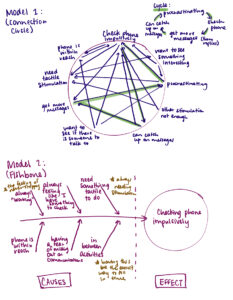
Below are the two models I drew to better understand this habit: