Intervention Study: Synthesis & Intervention
Part 1: Synthesis
Baseline Study Synthesis: Baseline study -> Raw data -> Grounded Theory Discuss any interesting trends, insights, and key theories from your baseline
Baseline Study
To begin our study, we sent out a pre-screener that yielded n=23 respondents. Of those 23, we selected n=10 participants for our full study. The screener asked the following questions:
- How much do you exercise per week, on average?
- How satisfied are you with your current workout routine? [scale of 1-10]
- Please elaborate upon this number
- What does growth/improvement mean to you?
- What are your motivations for wanting to exercise?
- Are there any limiting factors preventing you from exercising more?
We selected the n=10 full study participants by choosing a representative sample of workout routine satisfaction ratings. Headed into the study, we wanted to focus on as broad an audience as possible among exercises. Only focusing on very unsatisfied people initially would limit our ability to learn what makes currently satisfied people feel the way they feel. Only focusing on very satisfied people would limit the potential for our eventual solution to provide significant net improvements in satisfaction.
Moreover, we wanted to capture a wide range of reported motivations, ranging from quantifiable goals like a specific time in a planned future marathon to more aspirational goals like returning to past form and recapturing a feeling from a successful athletic experience that occurred some years ago.
In our pre-study interviews, we once again focused on the broad topic of exercise habit improvement, with an ideal participant of people who already exercise and want to increase time/intensity/frequency of exercise. We asked the following questions, with each interview differing slightly depending on interviewee responses and areas of interest:
General
- How do you define exercise?
- What is your preferred method of exercise?
- Why?
- How do you choose what kind of exercise to do on a given day?
-
- How does working out make you feel?
-
- Past routine
- When did you start exercising? What was the motivation behind that?
-
-
-
- How does this compare to their current motivation
- Have your workout habits changed over time? If so, how has it evolved?
- Tell us about your first time [doing their preferred method of exercise].
-
- Current Routine
- Walk me through your current workout routine.
- Tell us about your most recent workout.
-
- How do you feel about your current routine? What would you change about it?
-
-
- How do you fit workouts into your schedule?
- How social is working out for you?
-
- Do you use any exercise tracking tools? If so, what type and would you be willing to track and share your workouts with us?
- Potential Grand Tour: Can you show me how you logged your last workout?
-
-
- What methods do you use to track your progress?
- Ideal routine
- You mentioned that you are ____ satisfied with your current exercise routine. I’d love to hear more about this.
-
- Tell me about your best workout experience
Motivation
- You mentioned that your main motivation to workout was ____, can you talk more about that?
- What motivates you to workout?
- Do you usually work out alone or in a group?
-
-
- Are there any workout influencers that you follow?
- When was the last time you skipped a workout due to lack of motivation?
-
- How effective is motivation as a driving force to exercise? / How much do you rely on motivation compared to other driving forces
Goals
- What does fitness progress look like for you?
-
-
- Do you have any specific health goals?
-
- What are your top exercise goals right now? Has that evolved overtime?
Barriers/obstacles
- Tell me about the last time you had a disappointing workout.
- When you don’t work out, what are the main obstacles that stop you?
- Describe a time you decided not to exercise because of a barrier.
-
-
- What are your concerns moving forward in your fitness journey?
-
- Tell me about a time you were able to overcome barriers to exercise?
- Get them to elaborate on that experience?
Wrap-Up
- Comment invitingly about contradictions or insights
- Look through notes and note what you still have questions about
- Any last thoughts? Feedback?
- Thank the interviewee for their time and insights.
- Inform them about the next steps and how the information will be used.
Highlighted questions are those that we prioritized within our interviews. Our pre-study interview allowed us to learn more qualitative information surrounding habits and motivations, and also to establish a precedence of how people think their routine looks versus how it actually looks during the true baseline study.
For our baseline study, we had participants respond to a form every night for five days, populating results within a spreadsheet. Among our n=10 participants, to achieve a perfect response rate, we would hope for 50 total form responses. We received 43 total responses, for a success rate of 43/50, or 86%. Going with n=10 participants initially gave us a valuable buffer that allowed some people to miss a day of recording and us to still receive useful data.
In our post-study interview, we wanted to assess how people felt about having recorded their workouts for five days straight, and also how the reflection aspects of our form influenced their emotions and motivation. We asked the following questions in our post-study interviews, slightly tailoring each question to respondents’ pre-study interview responses and their baseline study results:
- General [only ask what is relevant]
-
-
- How would you describe your overall experience with participating in the study?
- What surprised you through this weeklong experience?
- How did participating in this study affect your exercise behavior?
- How similar would you say a normal week in your life is compared with this past week?
- How would you compare this past week to a routine week in your life?
- Aka regular week
- What did you learn about yourself/your exercise habits through this study?
- E.g. how motivated did they feel, which types of exercise did they most enjoy
- Before the study, you mentioned that your _____ [mental and/or physical] health is a main motivation. How do you feel in that regard after this study?
- What changes, if any, could you see yourself making to your exercise routine after this experience?
- [if relevant] How did working out with friends/groups over the week affect how you feel about the experience?
-
- Contradictions: Differences between pre-interview and study results
-
-
- During your prestudy interview, you mentioned that you [x], but we noticed that you [y].
- Things to consider: workout frequency, length, etc.
- During your prestudy interview, you mentioned that you [x], but we noticed that you [y].
-
- Surprises: Anything shocking?
-
- We noticed that you said/mentioned [z]… could you elaborate more on that?
- Note any surprisingly low/high numbers on scales, or interesting short answers
- We noticed that you said/mentioned [z]… could you elaborate more on that?
Raw Data
We analyzed the raw data results of our pre-study interviews, our baseline study, and our post-study interviews on our Nighthawks team Miro board. Findings from our raw data are in our Grounded Theory, below.
Grounded Theory
Team Nighthawks believes the following theories might help us understand the inner workings of working out. We categorized the theories into 6 broad buckets, some with sub-theories and each with specific examples listed.
Evidence for each of these theories comes from our pre-study interview, our baseline study results, and our post-study interview.
- Philosophical Foundation
The foundation of sustained workout routines is a deep-rooted personal philosophy and intrinsic motivation. When individuals exercise for reasons that are personally meaningful and internally rewarding, rather than for external validation or superficial goals, they are more likely to maintain consistency in their workouts. Individuals lacking a deep-seated philosophy or personal reason for working out are often the first to abandon their fitness routines. A strong, intrinsic motivation is crucial for long-term adherence.
- RB says “I don’t like planning out my workouts, I’m more of an intuitive runner”. Despite planning to run one of the days, she abandoned the plan due to light rain.
- CS, on the other hand, schedules consistent workouts in her Google calendar and sees it as a promise to her future self. She is less likely to abandon her plans because she sees not following through as an active decision to disservice to her future self.
- LW said “There is this narrative in my mind like, why not? Just go and do it. And then it’s done”, which emphasizes a philosophical foundation of getting things done, and that she will always be more satisfied after having done a workout than beforehand.
- Everyone we interviewed acknowledged the physical and mental benefits of working out. While this is not enough to maintain frequency, it is an essential philosophy to getting started.
- Social Accountability and Group Dynamics
The presence of social support, whether through group exercises or accountability partners, significantly enhances workout consistency. This social element provides a framework for regularity and shared objectives, making individuals less likely to skip workouts due to the added layer of responsibility and communal encouragement. Working out in groups or with a partner provides a layer of accountability, structured scheduling, and shared goals, significantly reducing the likelihood of skipping sessions. This social support system can enhance motivation through the desire not to let others down.
- “With my team, [working out] is just mandatory motivation” – JK
- “Working out alone, I wouldn’t have worked as hard” – JK. Exercising with a group can create social conformity dynamics, which positively influence workout habits to a certain degree.
- SB schedules workout 3 times a week with his friends, and sees it as the best way to hold himself accountable since he doesn’t want to let his friends down.
- The only time CS workout without planning to that day was when her friends dragged her along.
- Goal Setting and Progress Measurement
Setting specific, measurable, and realistic goals helps in maintaining focus and direction in workout routines. Tracking progress against these goals provides a tangible sense of achievement and motivation. The importance of perceiving the value of workouts, in comparison to other activities, influences an individual’s decision to prioritize exercise.
-
- Measurable Goals: Setting measurable goals can lead to a more tangible sense of achievement and progress, making individuals more likely to continue their routines. Conversely, goals based solely on emotional outcomes might not provide the same level of satisfaction or clear indicators of progress.
- TB often reminisces about what he deems successful (namely, what TB referred to as “good splits”) workouts of the past, and his main goal is to feel those feelings again because those runs are “pretty awesome”.
- SB enjoys lifting because lifting heavier and heavier weights with more reps, as well as seeing body weight numbers go up with workout, are very quantitative, tangible and easy to track metrics. This then gives him a sense of drive to achieve those goals and when he does, he feels good about himself and wants more.
- MB on the other hand has less quantitative and measurable goals such as “feeling better” and “getting deeper in my stretches”, and therefore does not have a solid routine or reliable way to measure progress.
- “My friend and I are doing a half marathon every month for 6 months” – ES
- “Having a longer term goal helps me keep up my weekly regimen” – ES
- LW is following a very defined marathon training plan that dictates her routine down to exact pacing on each run. She has been extremely consistent in her exercise routines.
- CS expressed that she would like to get a pull-up, a pistol squat and someday run a marathon, and therefore, along with her health-consciousness mentioned in the philosophical foundations section, is more invested in building a good routine that helps her improve and reach her goals.
- Measurable Goals: Setting measurable goals can lead to a more tangible sense of achievement and progress, making individuals more likely to continue their routines. Conversely, goals based solely on emotional outcomes might not provide the same level of satisfaction or clear indicators of progress.
- Intrinsic vs extrinsic: The distinction between intrinsic motivation (doing something for its own sake) and extrinsic motivation (doing something for an external reward) plays a significant role in the sustainability of workout habits.
-
- KA has attempted multiple times to build a routine in the gym, but would always fail after a few weeks when focusing on the external reward of changing physical appearance. He was finally able to build a more consistent routine this summer when he was more motivated by personal growth.
- AM began going to the gym in high school, when she was motivated by needing to track workouts for her PE class. She did not build a sustainable routine until going to college, when she was able to go to the gym by choice.
- Perceived Value of Workout: The value assigned to workout sessions compared to other activities influences the decision to exercise. Increasing the perceived importance of exercise can make individuals more likely to prioritize it over other tasks.
- For example, we noticed that those who were very productive (CS, SB) and got a lot of other tasks/activities done but did not exercise on a certain day were more at peace with their decision to not workout that day because the other activities were seen as valued higher (if exercise is task A and homework is task B, then someone feels okay that they did B instead of A if B has a higher value to them in that moment). This means that if we can increase the perceived importance/value of exercise in general as well as specific workout sessions, then people could be more convinced to choose exercise over something else.
- Routine Removes Daily Challenge to Workout and Instead Creates Daily Challenge to Not Miss a Workout
The establishment of a consistent workout routine is crucial. Over time, the routine becomes a driving force, where the discomfort of breaking it outweighs the effort required to follow it. This routine-based approach ensures discipline even on days of low motivation, fostering a habit that withstands fluctuations in mood or potentially negative factors.
-
- The Importance of Routine: Discipline and routine go hand-in-hand, and with discipline, it is easier to stick to a plan even when external factors kick in.
- TB says, “if I feel sluggish, I usually just slow down and deal with that”, but he still completes the workout because it is a part of his routine.
- LW says, “It feels good to go in and do workouts when your recovery is low”. This emphasizes that sticking to a routine is a greater satisfaction than even the individual benefit of the workout itself. Even though the workout may not be perfect, LW is satisfied on the basis of having completed a workout.
- CS, similarly has a defined routine and says that even if her workout was not as satisfying as she wanted, she recognizes that any exercise is better than no exercise in her opinion.
- Activation Energy and Mental Blocks: Beginning exercisers need to overcome initial mental and physical barriers to establish a routine. There is a threshold of routine that makes sustaining workout frequency less of a challenge.
- “My ideal routine is more more consistency little bit every day rather than a lot of energy all at once” – anonymous
- “When I feel tired I usually just succumb to it” – JK. There are two sides to the coin; sometimes people can’t get over the threshold of routine and, thus, exercise less often.
- “Once I get to the gym, I know I will l finish my workout, but it’s about the activation energy of getting there”- SB
- The Importance of Routine: Discipline and routine go hand-in-hand, and with discipline, it is easier to stick to a plan even when external factors kick in.
- Brain Chemistry and Routine: The pain and drop in serotonin levels of missing a workout when you have a routine outweighs the dopamine rush of a one-off workout with non-obvious immediate rewards.
-
- JK says, “Giving me a schedule to stick to really made me feel less anxious during COVID”. The pure existence of a routine is something that humans find satisfying and comforting. Sticking to it further reinforces that feeling.
- Psychological and Behavioral Factors
Initial barriers to exercise, both mental and physical, must be overcome to establish a sustainable routine. This involves building a certain level of comfort and knowledge about exercise, and recognizing that mental resilience is often more critical than physical capability in maintaining workout habits.
- Threshold of Comfort and Knowledge: Before individuals can set meaningful, quantitative goals, they need to reach a certain level of comfort and understanding with their workout routine. Without understanding realistic improvements, prematurely setting ambitious numeric goals can lead to discouragement. In addition, without knowing what progress looks like, individuals may not know what progress consists of.
- Our participants with more experience had more tangible goals, such as running marathons, whereas our participants who recently (within six months) began their exercise routine had qualitative goals, such as getting stronger and building endurance. These participants mentioned that knowing more about the body and how to work out would help them to improve their workout routines.
- For example, MB is just starting to get into a yoga every morning routine and her goals are to get deeper in stretches. After her 30 day program following youtube, she has since been able to increase intensity by tailoring an extra 15 minutes routine that she feels good about, progressing towards a stage where she can have more tangible goals.
- Mental vs. Physical Barriers: Overcoming mental barriers is often more challenging than physical ones. Mental resilience is key to pushing through days of low motivation.
- JK says, “If I’m not feeling it then there’s not much that will get me to push through”. Mentally, if he is not locked in, then he has trouble overcoming the magnitude of the task.
- Additional Theories (Expansion)
- Cognitive Evaluation Theory: This theory suggests that external rewards can sometimes diminish intrinsic motivation. Applying this to workout habits, finding intrinsic pleasure in exercise itself, rather than exercising solely for external validation (like appearance), can lead to more sustainable habits.
- JK said one of his core motivations is when he feels like he has “power” during a lift. This is entirely internal. One does not look in a mirror and see power, it is something that you feel within.
- SB finds joy in progress which drives more goal setting and progress.
- Self-Determination Theory: This framework posits that fulfilling the needs for autonomy, competence, and relatedness can enhance intrinsic motivation towards an activity. In the context of exercise, creating an environment where individuals feel in control of their workouts, competent in their abilities, and connected to a community can significantly improve adherence.
- LW said “I’m faster than the old me and that gives me a lot of satisfaction”. She has had a hyper focus on running for a year or two, and at this point, she feels immense confidence and is quite competent when it comes to planning workouts.
By understanding these theories, individuals can tailor their approach to fitness in a way that aligns with their motivations, lifestyle, and psychological needs, increasing the likelihood of long-term adherence to workout routines. Exercise means something different to everyone, and making it more satisfying will improve routines and, by extension, lives.
Everyone acknowledges the benefits of working out and increasing frequency, however, college students are very good at making excuses for missing a workout. To increase frequency, students need to schedule their workouts, compete with friends, visualize metrics, and maintain a frequency that establishes a routine such that missing becomes more tangible.
System Models: Map your process using various models and explain your insights from these as well.
Insights:
- There are 2 loops that we can see in the connection circle
- 1) Exercise->progress->feel good->motivation->exercise more
- 2) Energy->exercise motivation->exercise->more energy
- The first one is not surprising. Progress itself is a positive feedback loop that encourages more motivation for progress. Seeing progress in our fitness journeys makes us feel good and motivated to reach the next high. What this means is that with goal(s) and progress, once the ball gets rolling, the momentum for exercise motivation increases. We need to focus on what progress means for different people and think about how to help them visualize and feel the progress to bring in more motivation. Also note how exercise is not directly connected to feel good. While people may feel good afterwards, many do mention the pain in the moment, so we did not directly connect the two. We may also want to consider exploring how to take the pain away a little or adding other aspects like fun to balance out pain during exercise to make the activation energy lower for exercising. Note motivation seems to directly drive exercise and it often stems from a feeling (abstract).
- The second one is more surprising. Although exercise may lead to fatigue, it may also lead to more energy as many interview participants have brought up. For example, MB uses yoga to get herself out of bed and get energized for the day. CS often mentions in her diary study that exercise brought her more energy and helped her be more productive during the day outside of exercising. We think more about raising awareness for the positive side effects of exercise, as well as investigate what makes some exercise sessions draining versus energizing so that we could help people feel good after exercising.
- Another point we want to touch on is the idea of confidence as shown in feedback loops. It seems like those who have a good idea of what to do are more likely to go do it and have measurable goals (and know how to get there) that they can then be proud of, further boosting their confidence.
Secondary Research: Discuss key findings from your literature review and comparator analysis.
Literature Review Findings
To better understand the fitness landscape and how we can effectively encourage users to increase and improve exercise habits, we took a deep dive into existing research studies that provide us with knowledge and inspiration. We focused on studies involving motivation and determination theory as well as studies involving digital tools being used to influence exercise habits.
When it came to motivation, several strategies for increasing were explored in studies, some more successfully than others. “Get thee to the gym! A field experiment on improving exercise habits” studies exercise incentives by putting people in teams of various levels of emotional connection. It found that putting exercisers into teams with any level of background knowledge about each other successfully increased motivation levels. “The Effect of Social Support on Athlete Burnout in Weightlifters: The Mediation Effect of Mental Toughness and Sports Motivation” found that social support reduces burnout in weightlifters, and that positive encouragement and competition were positively correlated with building a successful and consistent workout routine. These studies inspired us to consider several social motivation solutions.
On the subject of determination and adherence to routine, “Creating Exercise Habits Using Incentives: The Trade-off Between Flexibility and Routinization”, people with established routines are likely to maintain the same activity level regardless of outside factors, but with proper incentives, people will stray from routine as long as the incentives persist. When the incentives disappeared, participants returned to routine. In “Intrinsic Motivation and Exercise Adherence”, for people to adhere to a routine of physical activity, motives like enjoyment and competence are necessary. Finally, “Exercise, physical activity, and self-determination theory: A systematic review” found that regulation of routine is a stronger motivator of the initial adoption of exercise than pure enjoyment is. We found the importance of a routine to be interesting, but also that gamifying exercise too much, as in making adherence too incentive-based, is also unsuccessful. There is a line we need to tow to make our behavior-changing tool successful.
As far as digital tools go for improving workout habits, “Contextual Influences on the Use and Non-Use of Digital Technology While Exercising at the Gym” established two outcomes of exercise technology usage: distraction from exercise and disruption from exercise. Participants would use their exercise technology to distract themselves from exercise-induced pain and exhaustion, but also sometimes that would go too far and they would use technology for non-exercise related reasons, which would disrupt their workout flow. Finally, “A Theory-Based Exercise App to Enhance Exercise Adherence: A Pilot Study” experimented with using cognitive nudges like personalized goals and interaction within an exercise app. These nudges were effective when done intentionally and sparingly, but there were definite diminishing returns when done too often. Technology, when used effectively, can be a great motivator, but much like non-technological incentives, too much technology usage in motivating exercisers can actually take away from a routine.
Comparator analysis findings
Through our comparative analysis, we noticed a wide array of health tool focuses, which we boiled down to two axes: source of motivation and specificity of activity. Our competitors use a wide range of extrinsic and intrinsic motivators, including money (highly extrinsic), social affirmation (somewhat extrinsic), life improvement (somewhat intrinsic), and personal development (highly intrinsic). We aim to primarily build on users’ intrinsic motivations, while still including social affirmation so that users will remain motivated even despite possible changes in goals. Our competitors also had a range of specificity, from focused on a specific area of fitness (activity performance based) to general well-being (holistic health based). Most of our competitors were toward the ends of the scale, being either extremely general, with no specific definition of exercise, or extremely focused, with a clear definition of exercise. Since our project aims to cater toward students with different goals and fitness levels, we aim to be in the center, improving fitness through whatever means our audience prefers.
Among these competitors, we noticed that many employed different ways to make working out fun. Regardless of the type of motivation, each solution appealed to users’ desires to enjoy physical activity. Common solutions included gamification, appealing to the nostalgia of team sports, celebrating milestones, and building a fitness-based social network. Each solution uses techniques that cater to their intended audience. For our solution, we want a progress-based and somewhat unplugged approach, so we will likely use nostalgia, celebrations, and a social network to encourage users to have fun when exercising.
Several of the solutions exhibited weaknesses through their scope. Of the competitors with a limited scope, many were overly specific and focused on niche goals and exercise types, which would limit the audience or allow users to outgrow their product as their goals changed. Others would focus on only a specific phase of a fitness journey, such as helping to build a new routine but not helping to maintain or improve existing ones. Of the competitors with an excessive scope, the largest weakness was overwhelming users; products often include many features that are only applicable to certain fitness levels, making users feel that the product is oversaturated with unnecessary features.
Of our eight competitors, the value propositions are a combination of five main categories: encouraging exploration and fun, social networking, health tracking, extrinsically rewarding behavior, and building up new routines. While our solution will not include providing rewards, we hope to balance all of these values by allowing users to track their progress, try new exercise, improve their routines, and share with their friends.
Proto-personas: Discuss and include the 2-3 proto-personas that your group narrowed down.
Persona 1: Stubborn Sally
We identified a persona we named “Stubborn Sally”. Sally is an “intuitive exerciser”, meaning she has general, qualitative, goals and listens to her body and heart when decided when to work out and what to do. She feels she “knows better” than most workout content online, trusting herself over everything.

| Name | Stubborn Sally |
| Activated Role | Intuitive exerciser and heart-follower, and excuse-teller as a result |
| Goal | Improve general health, aesthetics, strength, and endurance |
| Motivation | Have the strength, energy, and health to live the life she wants
Wants to feel good in her body |
| Conflict | Will avoid or not follow workouts and justify by saying “it’s not what my body wants”
Will feel guilty about missing workouts but doesn’t schedule rest |
| Attempts to Solve | Listens to her body to guide workouts, diet, etc, but that can be misaligned with her goals (less cardio/strength depending on mood)
Has tried workout challenges and apps but won’t continue if she feels that she knows better than something virtual |
| Setting/ Environment | Lives on a college campus, where gyms + running/hiking trails are nearby |
| Tools | Apps, access to workout locations, accountability partners (sometimes) |
| Skills | Knowledge of different exercise techniques
Exercise time scheduled into her day |
| Routine/Habits | Will avoid doing certain workouts in male-dominated spaces
Will avoid the gym during her period |
Persona 2: Feel-Good Franklin
We identified a persona we named “Feel-Good Franklin”. Franklin is a student who engages in workouts on a whim but aspires to elevate his frequency to multiple sessions per week. The considerable disparity between his current workout frequency and the desired ideal has led Franklin to consider whether his goals reflect genuine commitment or are merely socially adapted responses.

| Name | Feel-Good Franklin |
| Activated Role | Spontaneous exerciser who feels good to exercise rather than exercising to feel good |
| Goal | Improve frequency of working out to more than once a week. |
| Motivation | Wants to feel better about himself and improve his health. |
| Conflict | Often points to time, sleep, or school being limiting factors to working out. Internally he has a tough time motivating himself to go for a workout even when he knows it is good for him. |
| Attempts to Solve | Tries to plan out his week on what days he will workout.
Tries to find a workout buddy. |
| Setting/ Environment | Lives on a college campus but inside when it rains. |
| Tools | Phone, friends, planner/calendar. |
| Skills | Self-aware and admits when he is failing. |
| Routine/Habits | Waits to feel the need to work out before he actually does (this could happen at any point during the week). Often makes excuses not to go if he’s not feeling like it (it’s raining, the gym will be packed, I need more sleep, etc.) |
Journey Maps: Discuss and include the journey maps that your group created from your proto-personas.
Journey Map 1: Stubborn Sally
Sally has true intentions, but her behavior matches the old adage of bringing a horse to water but not drinking unless it wants to do so. She often has a plan and has the motivation to go to the gym, but the plan unravels once she gets there and anything feels “off”. Moreover, her plan is mostly “intuitive”, in the sense that she does the exercise that feels correct in the moment rather than having a set and specific routine to which she adheres.
| Timeline | Pre-Workout | Workout | Post-Workout |
| Behaviors |
|
|
|
| Pain Points |
|
|
|
| Touchpoints / Insights |
|
|
|
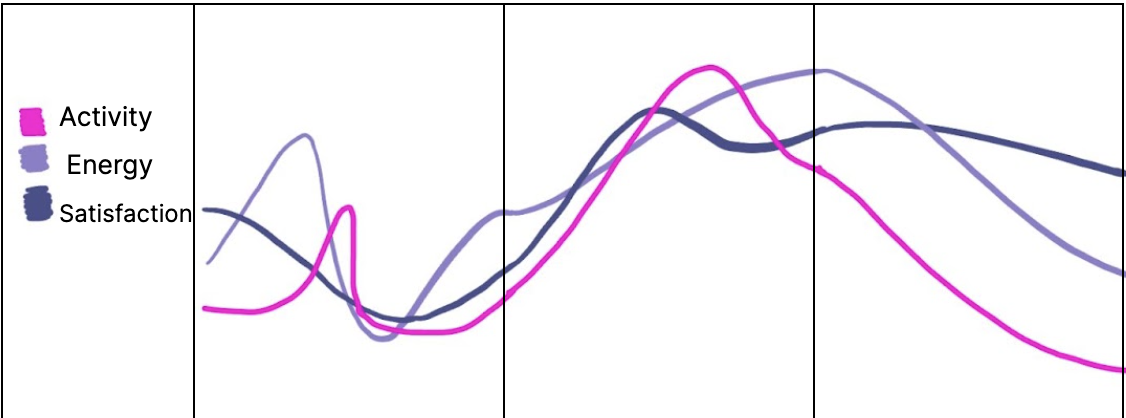
Feel-Good Franklin
Franklin finds himself going through a consistent cycle of an active weekend followed by a low point mid-week where the weight of work and corresponding exhaustion reaches a critical point. Momentum starts to build again and going for a run/working out results in peak self-esteem for the week, but the momentum does not persist. Esteem drops afterward before the promise of an active weekend creates another upward trajectory.
| Mon | Tues | Wed | Thurs | Fri | Weekend | |
| Self Esteem |  |
|||||
| Actions | Coming off a fun weekend, Franklin is looking forward to the week | Large PSET hits. Franklin is swamped | Rains super hard. Franklin does not workout | Finally goes for a much needed run | Sleeps in
due to tiredness. Misses Planned run part 2 |
Franklin
goes out and has Another Active weekend |
| Thoughts / Feelings | Franklin wants to be productive. Is not thinking about workouts | Franklin is burning out and feeling stagnant. Too much time sitting. He plans for a workout tomorrow | Feels even worse about his body | “Runner’s high feels amazing! I should do this more often! (like tomorrow)” | Doesn’t mind missing a run, thinks he “deserves the rest” | Where did the week go? Let’s party. |
| Insights | An active weekend can energize Franklin and remove the need to workout in his mind | Work decreases both self esteem and his time for workouts | People don’t predict or plan for weather | People rarely regret having worked out after the fact | Back to back workouts are still difficult to pull off on a runners high! | The week can easily “run away” from people |
Part 2: Intervention Study
Ideation: Take us through your ideation process.
- Individual sketches
- Team sketches
- List of ideas / HMW statements
-
- HMW get Franklin to work out even when he doesn’t particularly want to feel good?
- HMW get Felix to build a more stable habit?
- Show him that working out would make him feel better
- Building discipline
- External incentives
- Build goals so that he has other reasons
- Find him friend to drag him
- Nudge him with downsides
- Get him addicted to a new sport
- Make him feel bad all the time
- Nudge him with activities that are classified as workouts (pickleball)
- Make exercise games
- FOMO
- Streaks for going to the gym
- HMW we improve gym satisfaction for Sally?
- HMW give Sally the structure she needs to feel good?
- HMW make following a routine accessible for Sally?
- Have alternatives for each exercise that work the same muscle
- Have a dumbbell only, etc workout
- HMW help Sally build tangible goals?
- HMW get sally to use the machines at the gym that she really wants to use
- HMW give sally more specific goals that differ each time she goes to the gym
- HMW offer sally more guidance before she goes to the gym
Intervention Study: Discusses what the intervention is, how the study will be conducted, who will be recruited, and the key question(s) being addressed by the study.
Ideas:
- Data from last time: you worked out X amount less than the average person
- Voice memos
- Pointing out contradictions over text
- Visualizing progress-> how much of mount everest did you climb?
- Listening to the same song before exercising for classic conditioning
- Streak
- Gamble game
- Competition!! Pair people up randomly in pairs, send each other encouraging notes and keep track of exercise amount in the same doc as everyone else so everyone can see whos doing most and WHAT they’re doing for inspiration
- Have people share what they do with one another to inspire workouts
Intervention Study: Team Fitness Challenge
Goals:
For our intervention study, we will be conducting a team fitness challenge. We aim to create a casual yet competitive atmosphere where pairs of study participants work together over the course of the 5 day study period to exercise and share their feelings. We hypothesize that the competitive and social atmosphere will lead to increased motivation and more satisfaction. This hypothesis came from findings from our diary study, comparative analysis, and literature review, with one specific finding being that having other people on similar fitness journeys is motivating and helps keep people accountable. Another specific finding is that some participants felt motivated by the idea of being watched/tracked when they stated they didn’t exercise in our diary study survey and they felt guilt.
Questions we want to address:
Generally, we want to assess how this semi-competitive atmosphere affects frequency, perceived quality, and satisfaction. In the end, our goal is to foster more satisfaction in workout routines by improving them, no matter what improvement means to each individual person. We also want to see where the difference lies between workout habits during the diary study versus workout habits in the intervention study, which will be possible because we are using a subset of our diary study participants for this study. Another question we want to address is what the difference between exercise volume, method, and satisfaction looks like and then exploring how the most satisfied people reach that point.
Participants:
We plan to have n=8 participants for our intervention study. Among these n=8 total, we will structure 4 teams of n=2 people each. We will choose these groups based on similar interests and schedules (not necessarily for exercising together but also for communicating with each other).
Method:
The challenge will last for 5 days and the process will involve each participant logging their workout daily on a Google sheet that is viewable to all participants, organized by teams. We have a group chat and will announce the daily leaders as well as remind everyone to fill out the sheet.
Since our participants will inevitably come from different skill levels, we will normalize the metrics for scoring so that each team is on a level playing field (skill level data will be collected from participants pre-study). Metrics will be based on duration and consistency of working out.
We believe that by allowing participants to see how other teams are doing compared to their own, those who fall behind will feel more motivated to exercise due to competitive instincts. We also believe that people will be more motivated than usual since they are a part of a team and would not want to disappoint their teammates. For those in the lead, we hope that the positive affirmation will help them feel validated and motivated for their efforts.
Script:
Explanation to participants:
Thank you for agreeing to be a part of this study, we really appreciate your help! For the next 5 days, you are on a team with ____(name). You will be competing against 3 other teams to take home a prize! Please note that while this is a competition, we are only here to support one another in our shared fitness goals. We only condone positivity and encouragement, so please be a leader on this front!
Every day, after you workout, we would like you to add the type and duration (try to be as exact as possible!) of the exercise you completed in this Google sheet under the row for your name. We have a wide variety of fitness goals here, so feel free to see what other participants are doing as well. If you did not do any exercises for a given day, feel free to say so or leave it blank. Don’t forget to encourage your teammates along the way if you see them doing something great!
At the end of the week, we will tally up the hours amongst you and your teammate and announce the winner of the challenge. We will also be keeping a separate daily streak that will add bonus points. The rule of the streak is that as long as one person in your team is able to exercise, the streak will remain on. If no one exercises on a given day, however, then any streak will disappear. The team with the longest streak at the end of the week will be rewarded.
Best of luck and may the best team win!