
Team Nile Crocodiles: Adrian Rivas, Anchal Sayar, Andrew Franks, Jennifer Fung, Maggie Skortcheva
Selected Behavior
We are interested in studying couples who are learning their partner’s native language as a means to build a deeper connection with them and their family. We would like to investigate ways to incorporate unscheduled acts of language learning into someone’s day while maintaining consistent practice and improving proficiency in their target language. Oftentimes couples make an active effort to learn their partner’s native language to be able to better communicate with the rest of their partner’s family who may not speak a common language. Moreover, language is frequently tied to other cultural aspects of someone’s identity which can enrich the relationship through shared understanding, empathy, and connection. The time and effort involved in learning a new language is also seen as an act of love itself, exemplifying their dedication to their partner.
Part 1: Synthesis
Baseline Study
User Demographics: Before administering the study, we asked our study candidates to fill out a screener survey to make sure that they were a good fit for our study. We created a Google Form for the screener which can be accessed here. Specifically, we were focused on individuals who were currently/had experienced learning a second, non-native language for a personal reason (beyond academic requirements). The personal motivation behind learning this second language allowed us to avoid participants who were motivated strictly by academic purposes and engaged with the language primarily through classwork, targeted assignments, and minimally engaged with this language outside of requirements. Instead, individuals who were personally motivated (family members, work, moving, etc.) provided us with participants with (1) urgency, (2) a more diverse set of language acquisition strategies, and (3) personal investment in their chosen practices with the language. The behavior that we were trying to change was to increase the daily engagement with this second language, especially outside of any times they were required to engage with this language.
Week-Long Diary Study: For our diary study, we asked our participants to thoughtfully reflect on their engagement with the second language that they were currently learning. Given our orientation on language use and learning, we were primarily concerned with qualitative reflections and feedback from our participants during the study. Specifically, we were primarily concerned with: (1) how participants engaged with their second language each day, (2) what they found rewarding/discouraging, (3) what challenges they encountered, and (4) content created in their second language. However, to supplement this information, we asked participants to report a time range and time of day of their engagement with their second language. By keeping track of their morale (via challenging and rewarding moments) and the corresponding activities in which they were engaging with this language, we hoped to collect a holistic view of which methods of engaging with a second language may be most effective.
Data Collection and Materials: Throughout the study, we collected data through a Google form that our participants completed twice per day during the trial. Due to individual schedules, we prompted the participants to fill it out “once in the early afternoon and once in the evening”. This allowed participants to fill it out on their timelines and provide more granular feedback. The form allowed participants to send us their reflections/entries at the end of each day so we could notice trends for each day. We created a Google form for data collection. They submitted this form at the end of each day, culminating in a total of 5 submissions throughout the study.
Raw Data
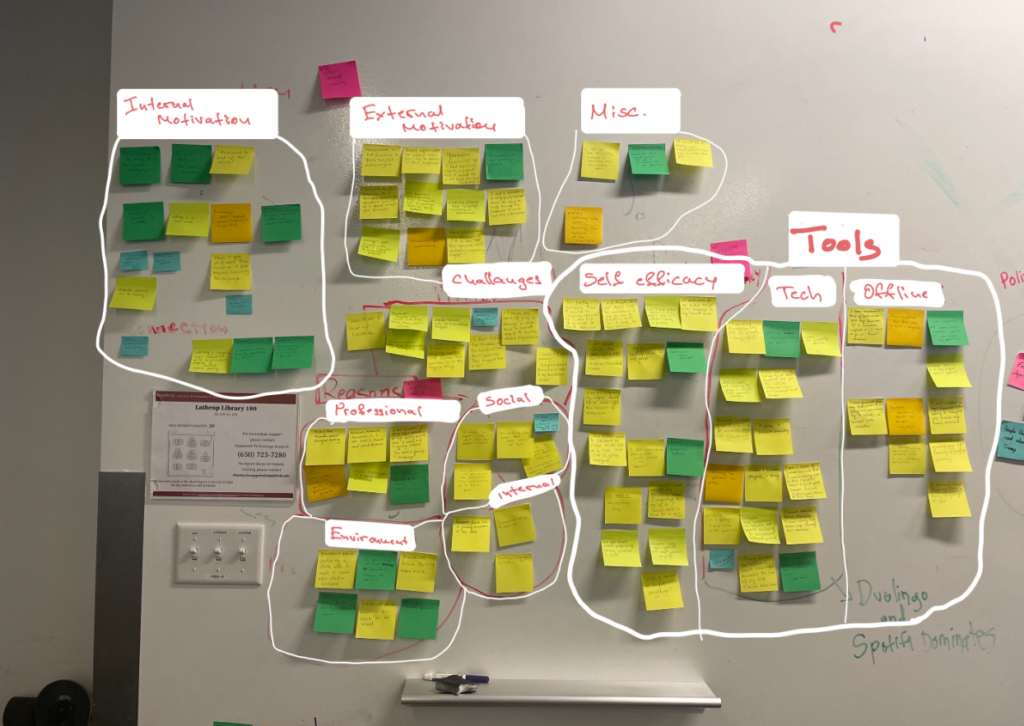
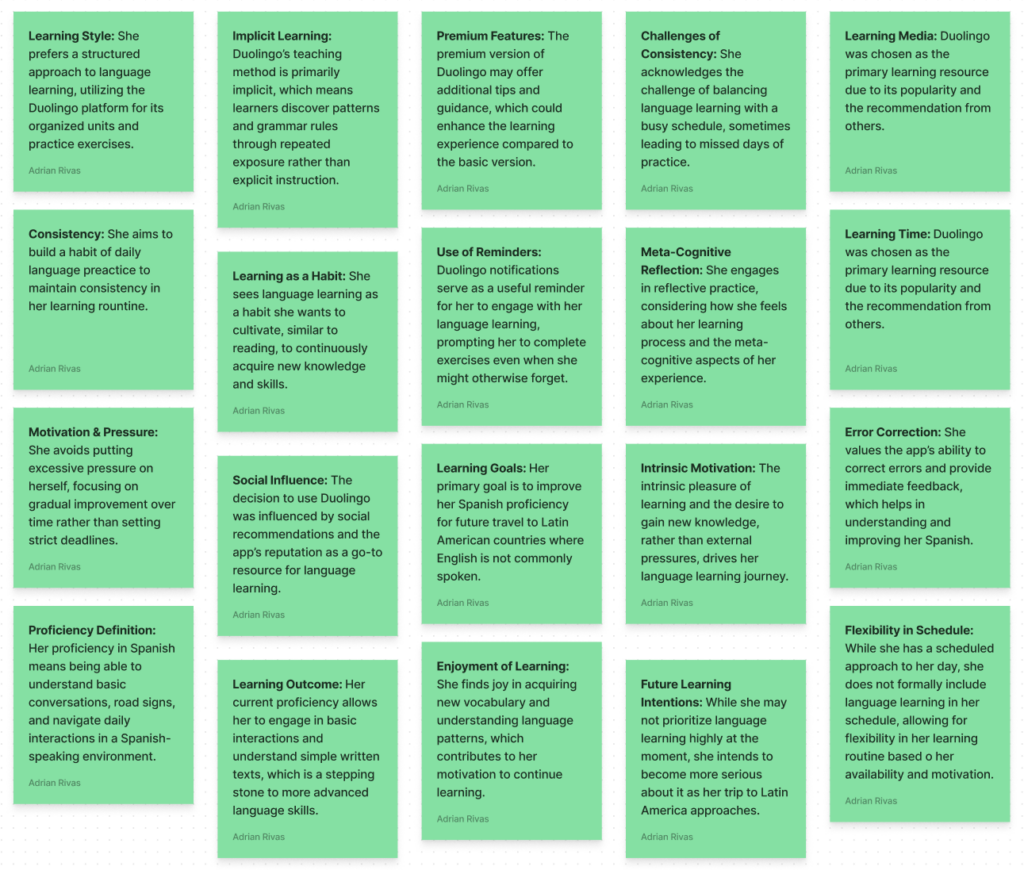
Grounded Theory
From our diary study and corresponding interviews, we developed a series of grounded theories that offer insights about language learning in couples, motivations, and how learners understand success. Among the most important is that: Feelings of success in language learning are not tied to time investment [Theory 1]. Language learners do not frequently carve out large time blocks to study but rather anchor their learning to short, transition periods during their pre-existing routines. Specifically, this may be because learners tend to find moments of learning success in small interactions (recalling vocabulary, remembering phrases, etc.). This explains why media consumption (TV shows, music, podcasts) in a second language functions as a low-barrier immersion experience that can become routine.
However, we also found that Romantic relationships can be strong intrinsic motivators for language learning because learners feel more connected to their partner’s life [Theory 4]. Therefore, we decided to focus our intervention study on our new target audience: couples consisting of a native speaker and a partner learning a second language. We’ve focused our study on how to encourage language learners to engage with their language for short periods of time during the day, specifically keeping in mind that they are primarily motivated by wanting to connect further with their partner through this second language.
System Models
Comparative Matrix
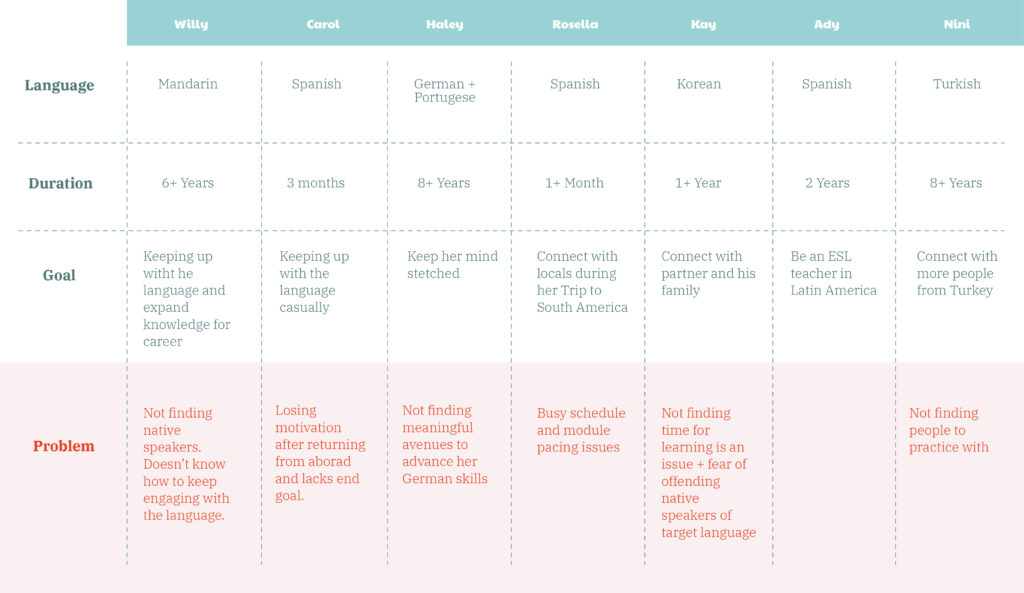
To understand our data better, we summarized what we learned from both the diary study and participant interviews. This helped us create a comparison chart of user profiles. We looked for patterns and differences across these profiles to find the main challenges language learners face. One important thing we found is that learners want to practice regularly with others, but they often feel unsure about connecting with new people. However, those who have partners who speak the language they’re learning find it easier to practice and communicate with them.
Connection Circle
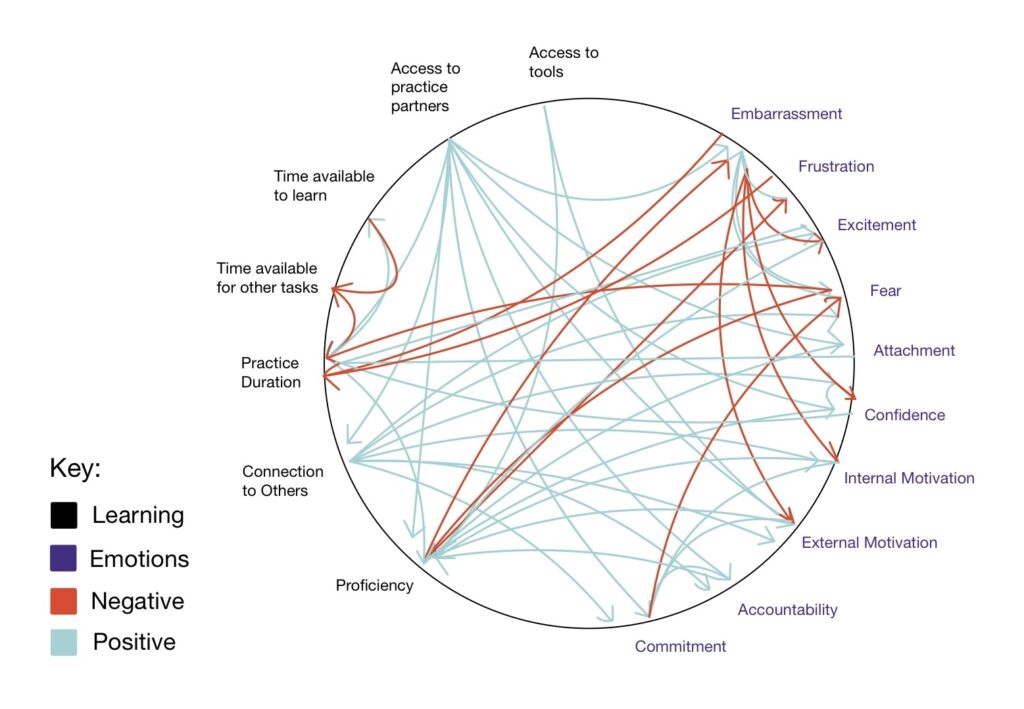
When analyzing this connection circle, the following three patterns emerged:
- Having access to practice partners helps reinforce positive emotions that help language learners stay consistent and take risks, making them more likely to achieve their goals.
- Feelings of embarrassment, fear, and frustration have cascading negative effects on confidence and motivation which can lead to decreased practice and ineffective learning.
- Building a strong connection with others can help bolster positive emotions and keep negative emotions at bay, helping kickstart a positive reinforcing learning environment.
Fishbone Diagram
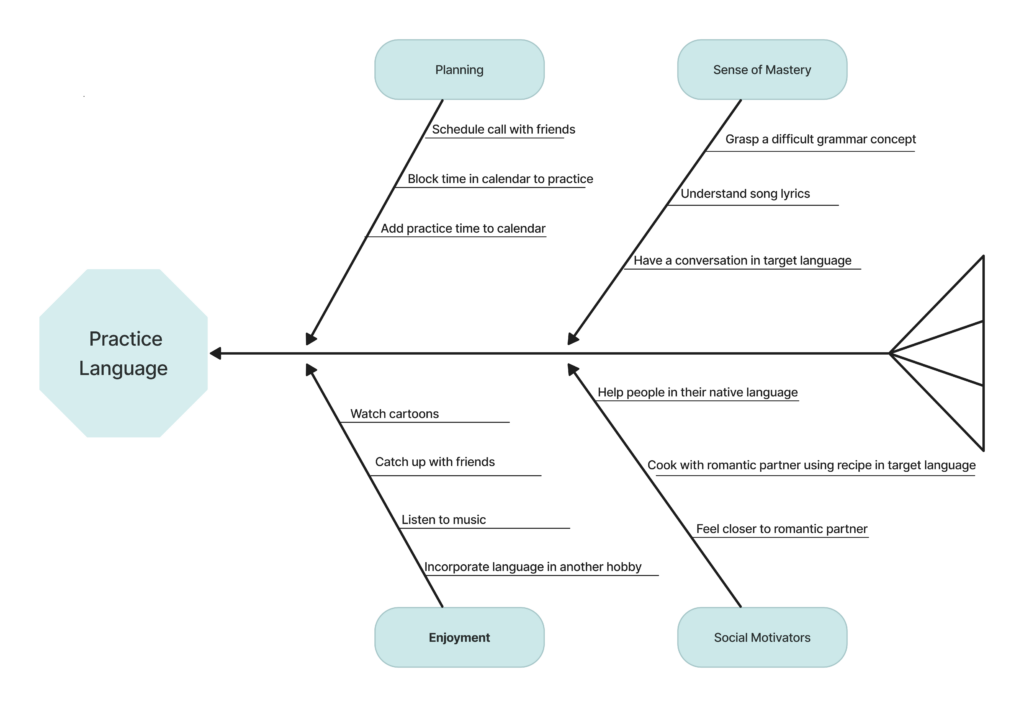
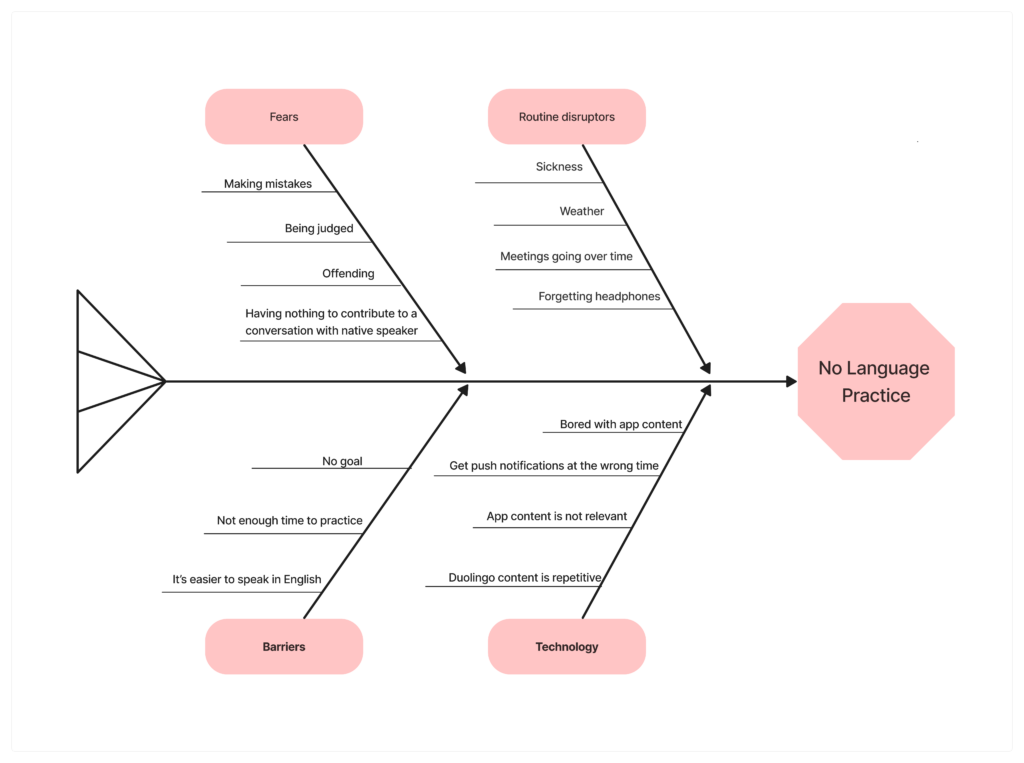
Another tool we used to make sense of the data we collected is Fishbone diagrams.
While sorting through the raw data, we noticed different habits and events leading to our participants either engaging with their target language for the day or not. Creating two fishbone diagrams helped us look at sets of habits that are helpful and ones that get in the way of language practice.
Secondary Research
Dörnyei, Z. (1998) posited the critical role of motivation in second and foreign language (L2) learning, stressing its significance in beginning and maintaining the learning journey. It argues that L2 motivation is intricate and multifaceted, highlighting two key points: firstly, positive motivation escalates with the perceived likelihood of achieving goals and the value of those goals as incentives; secondly, an individual’s self-worth influences their expectations of success. This corroborates our learnings from the diary study as well since language learners’ lack of confidence impedes their ability to connect with people outside their social circles, stemming from their fear of making mistakes or offending native speakers. In a related study by Kastelli,S. , Takács, N, (2023) explored the factors driving user engagement in the language learning app Duolingo. It reveals that tailoring the app to users’ goals enhances engagement, particularly for those seeking flexibility or a simple learning experience compared to those desiring more control. Social learning, notably through features like the leaderboard, is identified as a significant motivator for engagement. Gamification elements, such as streaks and leagues, are generally perceived positively, though the effectiveness of rewards varies among users. Understanding these dynamics can be advantageous for couples attempting to learn a language together. By aligning their goals and preferences with language learning tools, they can tailor their experience to their specific needs, leverage social learning features to motivate each other and navigate potential challenges.
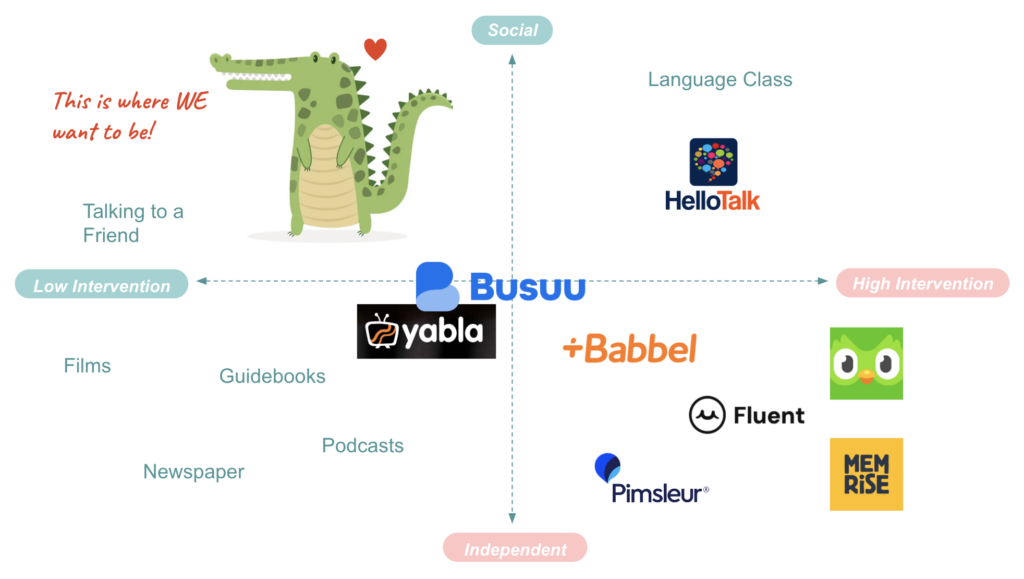
In our exploration of the current language learning market, we discovered that popular language learning applications such as Duolingo, Memrise, and Babbel heavily rely on push notifications and rewards to engage users and maintain their interest. However, these apps primarily cater to independent learning rather than facilitating connections within a community of practice. During our research, some participants expressed concerns about the intrusive nature of push notifications, which they found to be ineffective if they lacked intrinsic motivation to learn. Additionally, we found that many language learners desire the opportunity to practice with someone familiar or to connect with a community of native speakers. In light of these findings, we intend to position our product as a platform that promotes social learning opportunities for language learners with minimal intervention or nudges.
Proto-Personas & Journey Maps
Rosella

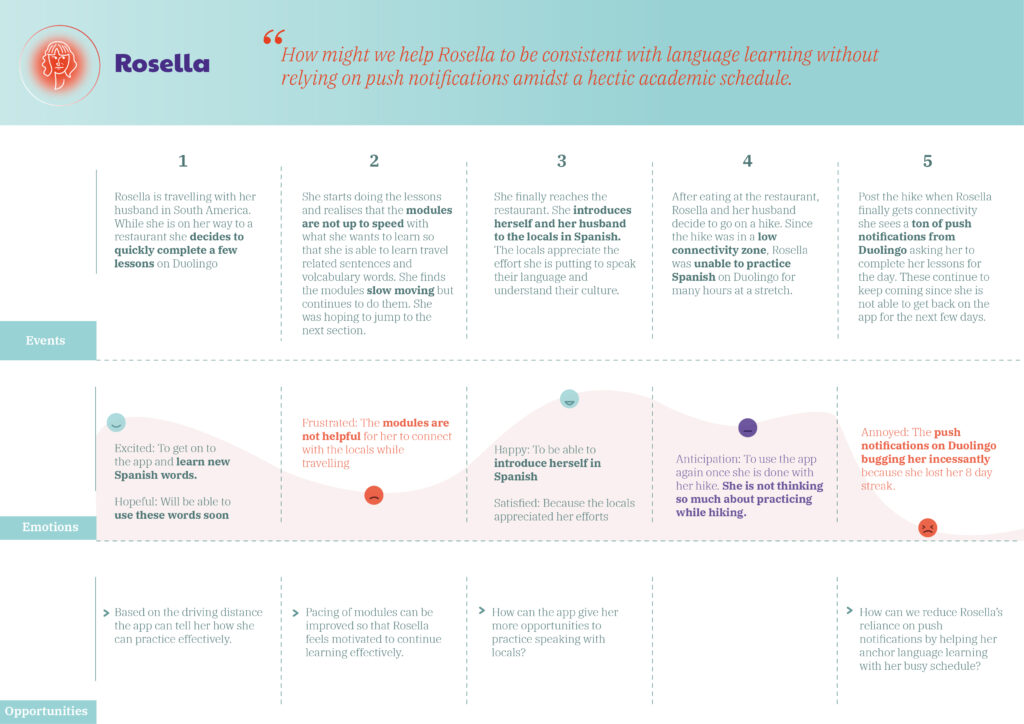
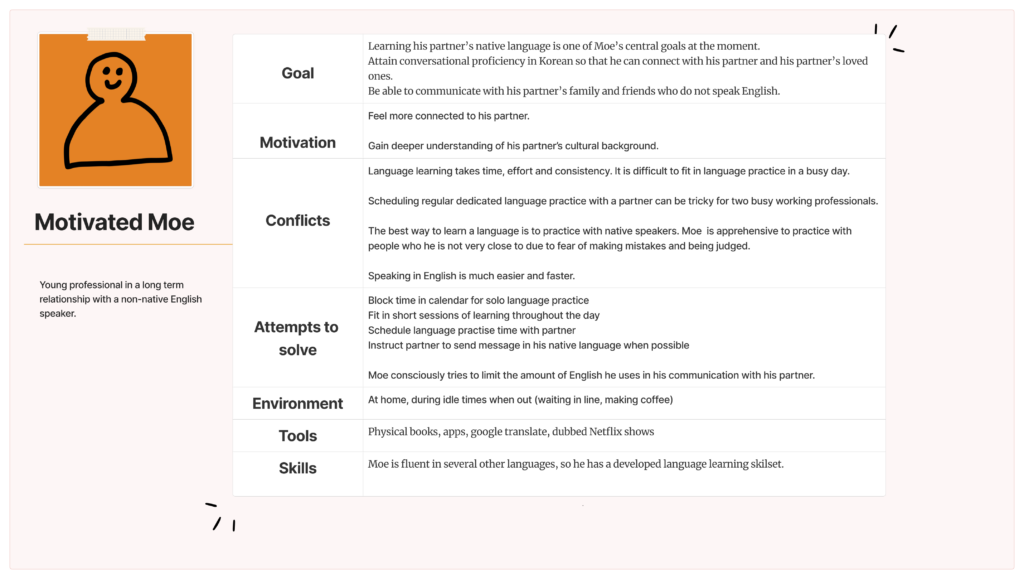
Motivated Moe
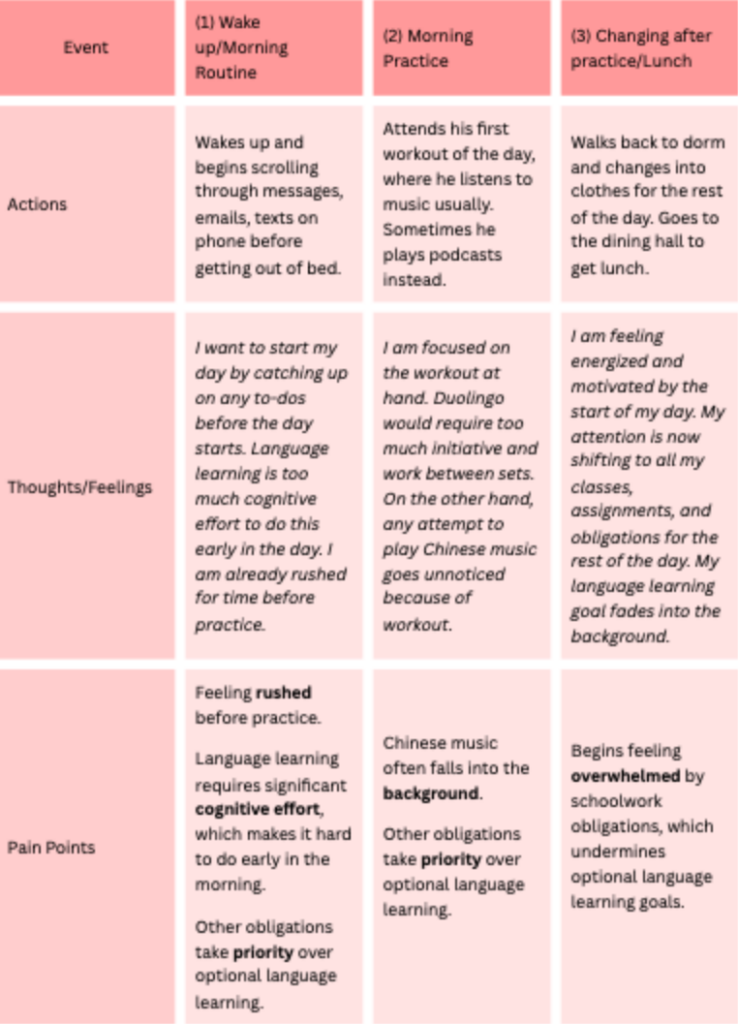
No Direction Nick

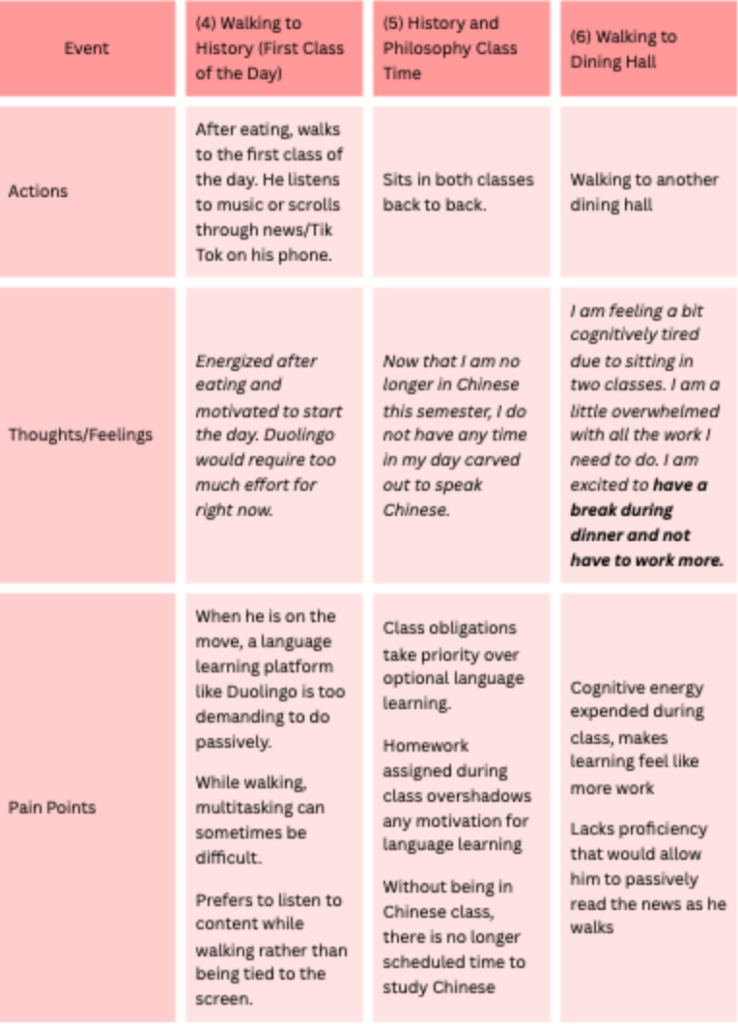
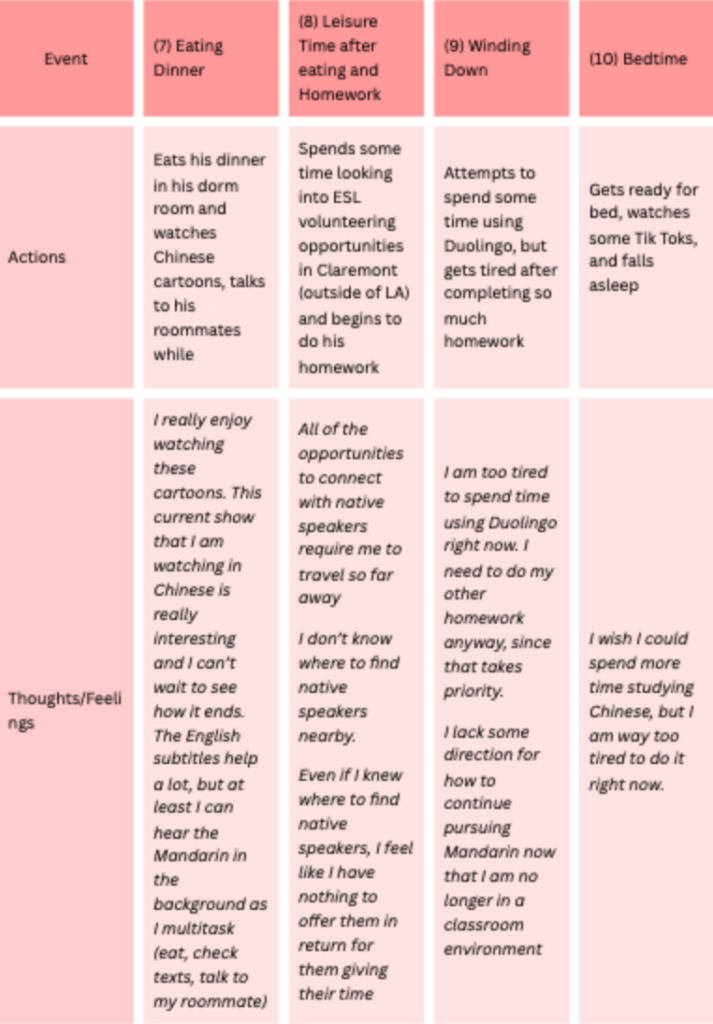
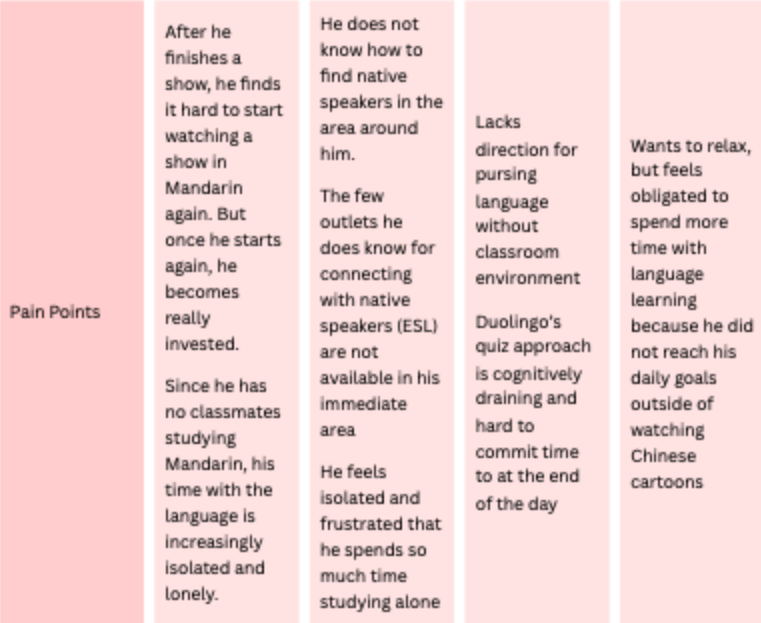
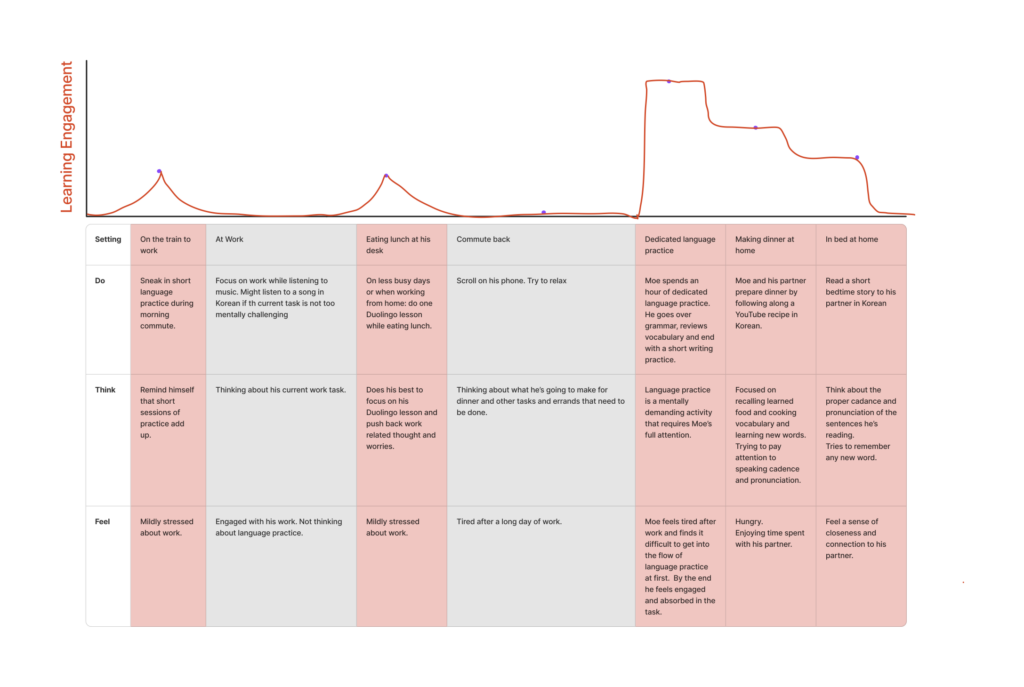
Persona of Interest: Motivated Moe
Motivated Moe is in a serious long-term relationship with a non-native English speaker. Moe is very motivated to learn his partner’s native language so that he can participate in conversations his partner is having with his parents and friends back home.
Moe prioritizes language learning throughout his day. He blocks time off his calendar every day for dedicated language practice and on most days spends the allotted time practicing. He sneaks in a couple of short sessions during his idle time throughout the day and does his best to talk with his partner in Korean.
Part 2: Intervention
Ideation
Idea 1: Love Box
Number of Participants: 3 couples (6 participants total).
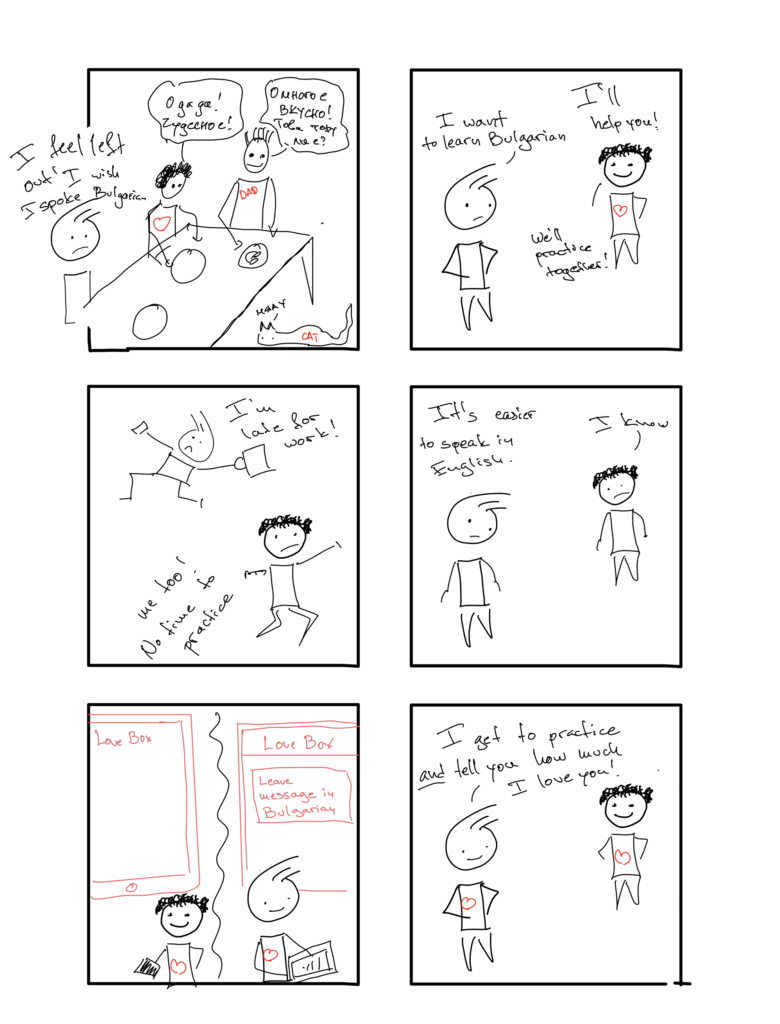
Rationale: Idea: daily love notes that each partner in a couple completes. At the end of the last day, they get to open their box and read all of them. Based on our diary study, we’ve noticed that individuals in couples are strongly motivated to learn their language as a way to express love for their partner. However, we also found that language learners struggle to find ways to integrate language learning into their daily lives. In our intervention study, we aim to investigate how (1) using romantic motivation can help language learners find more daily consistency and (2) how the delayed gratification/reward of waiting until the 5th day to read the love notes motivates language learners to stay consistent until the end of the study.
List of Writing Prompts:
- Write a note about your favorite memory with your partner.
- Write about a time when your partner went out of their way to support you. Express your gratitude for their kindness and generosity.
- Make promises to each other. What commitments do you want to uphold in your relationship? Write them down as affirmations of your love.
- Write a note about your favorite characteristic of your partner
- Share about a song you heard today and really liked.
- Talk about a place you wish to visit during the break with your partner.
Intervention:
Day 1: We will introduce the main concept of the study to the participants. During the day, we will send each partner the first love letter prompt, where they will submit a love letter for their partner. At the end of the day, we will ask whether or not they completed the prompt.
Day 2: During the day, we will send each partner the second love letter prompt, where they will submit a love letter for their partner. At the end of the day, we will ask whether or not they completed the prompt.
Day 3: During the day, we will send each partner the third love letter prompt, where they will submit a love letter for their partner. At the end of the day, we will ask whether or not they completed the prompt.
Day 4: During the day, we will send each partner the fourth love letter prompt, where they will submit a love letter for their partner. At the end of the day, we will ask whether or not they completed the prompt.
Day 5: During the day, we will send each partner the last love letter prompt, where they will submit a love letter for their partner. At the end of the day, we will ask whether or not they completed the prompt and they will get access to all the love notes their partner wrote.
Cons:
- Participants may feel uncomfortable submitting their love notes through a Google form for fear of it being read.
- Participants may not be entirely genuine in their love notes for privacy reasons.
Pros:
- Ties growth in language learning to growth in romantic language.
- Flexibility in daily life.
- Very low-stakes way to engage with love language, with no fear of interacting with strangers.
- Participants will read and write in their target language each day.
- Uses delayed gratification to encourage follow-through.
- Could be completed for long-distance couples.
- Well-timed with Valentine’s Day.
Storyboard:
Idea 2: Cooking Connection
Number of Participants: 6
Rationale: Introduce daily language learning into couples by encouraging the language learners to cook a meal in the cuisine of their target language. We found in our dairy study that (1) individuals motivated to learn a language that their partner speaks fluently/natively are motivated primarily through a desire to better understand their partner’s background, culture, and identity. (2) Individuals struggle to block out long periods of time solely for language learning. Therefore, by linking language learning to a trigger (meals), we can help individuals engage with their target language more frequently.
Intervention:
Day 1: Prompt each member of the couple to select a dish that they wish to cook that day. Follow up and suggest avenues for them to engage with their language while cooking the meal: reading a recipe in their target language, making a shopping list in their target language, etc.
Day 2: Prompt each member of the couple to select a dish that they wish to cook that day. Follow up and suggest avenues for them to engage with their language while cooking the meal: reading a recipe in their target language, making a shopping list in their target language, etc.
Day 3: Prompt each member of the couple to select a dish that they wish to cook that day. Follow up and suggest avenues for them to engage with their language while cooking the meal: reading a recipe in their target language, making a shopping list in their target language, etc.
Day 4: Prompt each member of the couple to select a dish that they wish to cook that day. Follow up and suggest avenues for them to engage with their language while cooking the meal: reading a recipe in their target language, making a shopping list in their target language, etc.
Day 5: Prompt each member of the couple to select a dish that they wish to cook that day. Follow up and suggest avenues for them to engage with their language while cooking the meal: reading a recipe in their target language, making a shopping list in their target language, etc.
Cons:
- The study design does not translate well for long-distance couples.
- It assumes that participants have access to a kitchen.
- High activation energy way to engage with language.
- Financially demanding for participants.
Pros:
- An extensive way to engage with the language.
- Practical integration of target language in daily life.
- Low-stakes way to engage with target language (no interacting with strangers).
- Cultural immersion included.
- Well-timed with Valentine’s Day.
- May be too intense of a workload for regular habit-forming.
Storyboard:

Idea 3: Rose Glasses
Number of Participants: 6
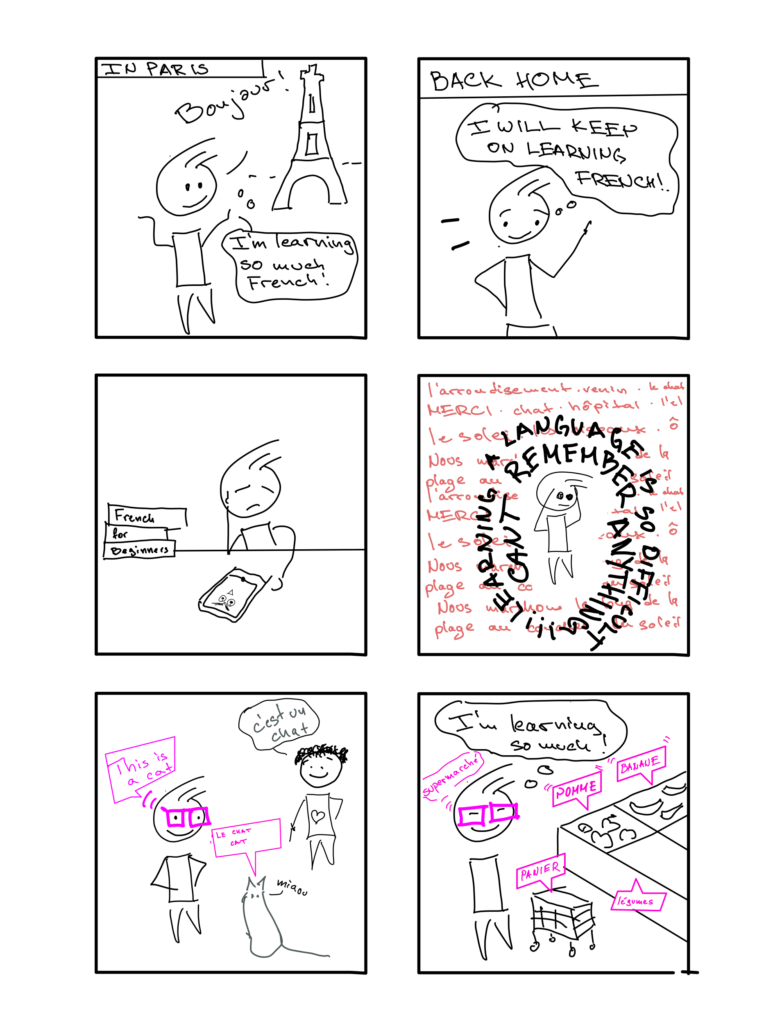
Rationale: For language learners, have an assistant (in theory AR glasses, in execution a person) that translates all the signs around them into their targeted language, also labels objects, and translates conversation clips into their target language. This would be executed through a messaging system. We will reach out to each participant via an unknown number (through Google phone number) and have participants send us photos, objects, and audio clips that they wish to have translated into their new language. We will translate it and then send the response, much like an AI assistant. In our diary study, we found that participants (1) struggle to find large time blocks to integrate language learning into their lives and prefer small milestones of success and (2) immersion experiences tend to keep language learners the most motivated. Therefore, for couples where one partner is learning a second language, by providing more readily available immersion experiences, we may help the language learner stay motivated and excited about the process.
Intervention:
Day 1: Prompt each participant to employ their assistant at one point during the day (i.e. send them a sign to translate into their target language, an object to identify in their target language, an audio clip to translate, etc.). At the end of the day, have the participant reflect on their confidence and motivation level to continue learning their language.
Day 2: Prompt each participant to employ their assistant at one point during the day (i.e. send them a sign to translate into their target language, an object to identify in their target language, an audio clip to translate, etc.). At the end of the day, have the participant reflect on their confidence and motivation level to continue learning their language.
Day 3: Prompt each participant to employ their assistant at one point during the day (i.e. send them a sign to translate into their target language, an object to identify in their target language, an audio clip to translate, etc.). At the end of the day, have the participant reflect on their confidence and motivation level to continue learning their language.
Day 4: Prompt each participant to employ their assistant at one point during the day (i.e. send them a sign to translate into their target language, an object to identify in their target language, an audio clip to translate, etc.). At the end of the day, have the participant reflect on their confidence and motivation level to continue learning their language.
Day 5: Prompt each participant to employ their assistant at one point during the day (i.e. send them a sign to translate into their target language, an object to identify in their target language, an audio clip to translate, etc.). At the end of the day, have the participant reflect on their confidence and motivation level to continue learning their language.
Cons:
- Keeps language learning very isolated, there is very little social interaction.
- Hard to replicate the AI assistant experience seamlessly.
- Requires much more initiative and direction from the participant.
- Hard to replicate the experience of an AR audio/visual experience.
Pros:
- Language immersion is effective in helping participants stay motivated to learn their language.
- Flexible and easily integrated into the daily life of participants.
- Brings the abroad experience into daily life.
Storyboard:
Intervention Study
Love Box: Finding Your Love Language
Description: Each partner in a couple completes daily love notes. At the end of the last day, they get to open their box and read all of them.
Goals: Based on our diary study, we’ve noticed that individuals in couples are strongly motivated to learn their language as a way to express love for their partner. However, we also found that language learners struggle to find ways to integrate language learning into their daily lives. In our intervention study, we aim to investigate how (1) using romantic motivation can help language learners find more daily consistency and (2) how the delayed gratification/reward of waiting until the 5th day to read the love notes motivates language learners to stay consistent until the end of the study. By incorporating elements of romance, learners may feel more engaged and committed through their act of love: language learning. The delayed reveal of the love notes builds anticipation, a sense of achievement, and an air of mystery which makes the learning experience fun and meaningful.
Participants: We plan to have a total of 6 couples (12 individuals) participating in our intervention study. These couples were selected because at least one of the individuals is in the process of learning their partner’s native language to build a deeper connection with them.
Method
Prompting: We will send each couple a love note prompt every day through an automated email message that they will answer for that day. They may choose to write more than just an answer to the prompt as their love note. They may also send multiple love notes in a day if they choose. The prompt is meant as a starting point to which they can add as much or as little as they want.
Writing Prompt Examples:
- Write a note about your favorite memory with your partner.
- Write about a time when your partner went out of their way to support you. Express your gratitude for their kindness and generosity.
- Make promises to each other. What commitments do you want to uphold in your relationship? Write them down as affirmations of your love.
- Write a note about your favorite characteristic of your partner
- Share about a song you heard today and really liked.
- Talk about a place you wish to visit during the break with your partner.
Data Collection: We created a Google Form where participants can upload their love notes.
Data Analysis: Due to the personal nature of these notes, we will be relying heavily on our post-study reflections from our participants about their experiences.
Questions We’d Like to Ask Before The Study:
To both individuals:
- How long have you been together?
- How often do you communicate with each other in your target language?
- What kinds of activities do you do to engage in this language?
- What challenges do you face in trying to communicate with each other in this language?
- How do you express affection for each other?
- How do you think this study will go? What do you hope to gain?
- How do you think building fluency in this language will influence your relationship?
To the Native Speaker:
- How often do you speak your native language? In what settings?
- Do you help your partner practice this language?
- Is intimacy different in English versus your native language?
- What challenges do you think your partner faces in learning this language?
To the Language Learner:
- How long have you been learning this language?
- What are your motivations for learning it?
- How confident do you feel in using this language with your partner? With others?
- Are there any specific ways that you think your partner could support your language-learning efforts?



