
Background
Stanford students are hard-working and often deeply care about their work and about doing well in school. However, many students are often unsatisfied with their productivity and feel guilty about not being able to complete their to-do list.
A couple of weeks ago, we ran a diary study to better understand how Stanford students plan their day and work, what their study breaks look like, and how they feel at the end of the day. As we went over our data, we found a few feedback looks that intrigued us.
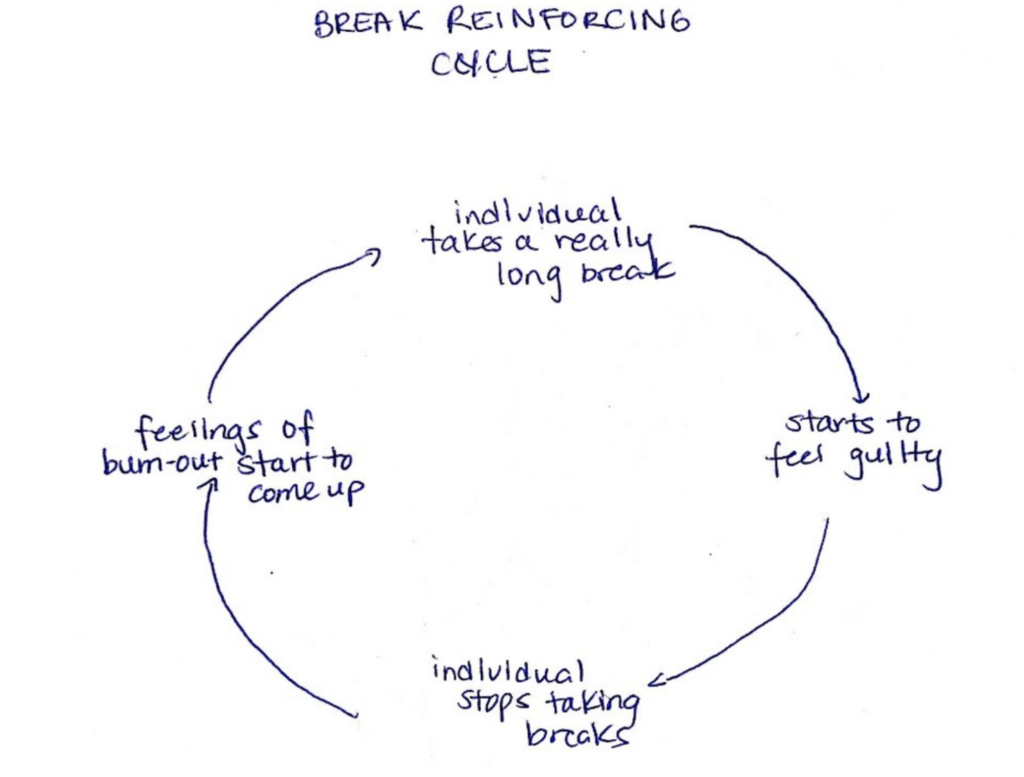
The first loop consists of students taking long breaks, feeling guilty of their breaks, removing all breaks, feeling burnt out, taking long breaks … This loop is shown below.
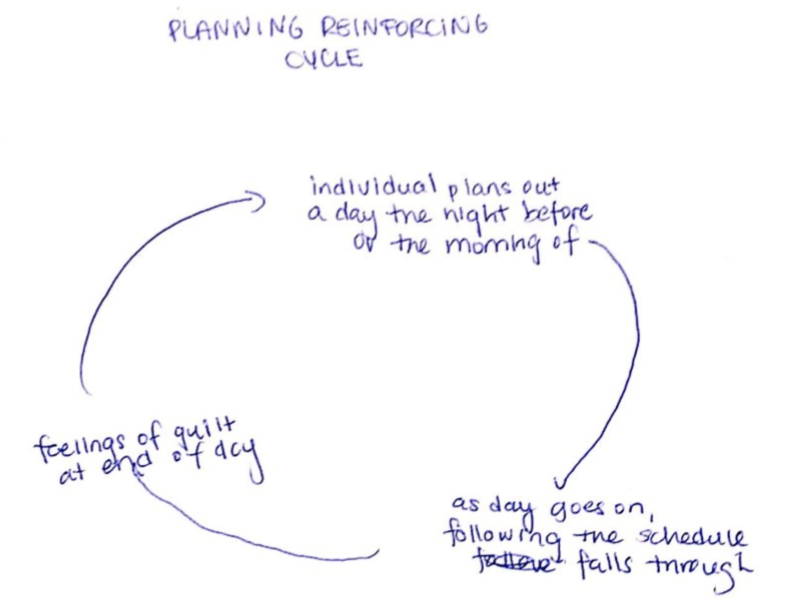
Another feedback loop we identified spans an entire day. More specifically, people tend to do a lot of planning either the morning or the night before. However, as the day progressed, they tended to fall through with their plans. At night they would feel unsatisfied with or guilty about their productivity. This loop is also shown below:
Study Design
We were intrigued by this second feedback loop, as it was one that we had not been aware of before, even from our comparative studies and literature review. Thus, for our intervention study, we wanted to examine why people fail to execute according to their plans, especially as the day progresses. Specifically, we hypothesized that when people do their planning in the morning or the night before, they fail to account for how their energy levels shift during the day and these shifts may impact their productivity and efficiency. For instance, if we’re more tired, it may be harder to concentrate or expect ourselves to accomplish as much as we could earlier in the day.
Our study consisted of two interventions, one that occurred the night before and another that occurred during the day. For a period of 5 days, we had participants
- The night before: Plan out the next day until ~ 3 pm
- ~3 pm the day of: Plan out the rest of their day
We chose 3pm as the time for replanning as we felt that this time was roughly the middle of the day and when people’s energy levels might start to shift.
Findings & Main Takeaways
Our main learnings and conclusions are as follows:
- On average, participants’ energy levels in the mornings, afternoon and evenings were high, medium and low, respectively.
- The 3 o’clock nudge to reassess evening plans according to energy levels felt stressful to some. It prompted people to overplan and add more things to the list.
- The 3 o’clock nudge felt arbitrary and disrupted to some; especially to participants who may experience a drop in energy later in the evening (iei, 5pm)
- This intervention did not hold on weekends, as people may sleep in and have a routine different from their week days.
- People took more and longer breaks in the evening, out of fatigue.
- People tend to procrastinate when the task is difficult and/or not enjoyable.
- One a scale from 1-10, 10 being the most productive, productivity ranged from 5-8
- Napping, walks, social media seem to be welcoming breaks.
- Short social interactions promote accountability.
- Some participants noted that it was helpful to work with someone else since they could keep each other accountable
For our actual product, we originally brainstormed having a planner system that allows individuals to schedule their day until 3 PM and then once more after 3. However, through the intervention study, we see that a lot of our participants’ days were disrupted by replanning at 3 PM.
As an aside, another potential product or intervention that we discussed was a break calculator, which would help individuals schedule their break times and durations based on their tasks and commitments. Through the intervention study, we see that people feel guilty about taking breaks at night since they tend to be longer and feel better when their social breaks are on the shorter end.
We do see that there are quite a few of our intervention and diary study participants who feel like they struggle with planning and sticking to breaks. However, we are hesitant to explore the break calculator idea, because it would be a logistical nightmare to readjust a user’s schedule if they didn’t follow it exactly. We also feel like it may promote unhealthy relationships with breaks (guilt may be multiplied if users don’t follow the premade schedule).
Next Steps
Though our intervention failed to work for several reasons, we are excited by our findings and new potential avenues to take. Some of our participants felt productive when working with friends, who acted as accountability buddies. One participant even explicitly noted that it was really helpful to “work with someone else who kept him accountable for actually working on his psets.” Based on this insight, it might be productive to explore opportunities where we can help find individuals who can keep our users accountable. We plan on interviewing our participants from this study on this idea and concept to better understand their thoughts, what they’ve tried, etc. Moreover, we will use our findings from this study as well as the work we’ve done previously to ideate on several potential solutions. More to come soon!



