
Why I’d Use Airbnb as a Customer, but Work at Spotify as a PM
Every company faces a trade-off between autonomy, efficiency, and coherence. To solve this tension, organizations choose different employee structures, which impacts not only day-to-day employee culture, but the final software users experience.
For example, Airbnb relies on a centralized, top-down model led by design. The CEO, supported by an executive group of 30 to 40 leaders, set a single, unified company roadmap. Decisions trickle down to functional engineering and design teams who bring that vision to life. Instead of deciding what gets built, PMs turn the leadership’s vision into reality. PMs, in other words, ensure that the work of designers and engineers aligns with executive taste and timeline.
In contrast, Spotify uses a decentralized model built around autonomous “Squads.” Small cross-functional teams, including engineers, a designer, a data scientist, and an embedded PM, tackle high-level problem statements (like “get more usage of feature X”) rather than top-down design visions. The PM frames the problem and tests hypotheses, and the rest of the squad experiments with this vision.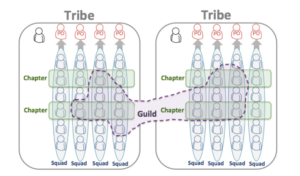
Beyond these two contrasting systems, there are other creative organizational models. For instance, Zappos experimented with Holacracy, with fluid roles nested within self-organizing “circles.” A person might hold a specific role like “Checkout Flow Architect,” giving them absolute decision-making power over that domain, but zero authority beyond it. In this setup, the traditional Product Manager title is sliced into hyper-specific governance accountabilities. Anyone driving product work has autonomy inside their assigned circle, but zero authority across the broader organization.
These systems have clear trade-offs. As a user, I prefer Airbnb’s model since a singular and strong top-down vision leads to a single, cohesive narrative and product. But as a PM, I would rather work at Spotify. Having the autonomy to explore problem spaces, validate hypotheses, and iterate freely makes you feel like the engine driving progress, rather than the operational glue holding a pre-built plan together.
Sources:
Chesky, Brian. “Brian Chesky’s New Playbook.” Interview by Lenny Rachitsky. Lenny’s Podcast, 29 Oct. 2023, www.lennyspodcast.com/brian-cheskys-new-playbook/.
Kniberg, Henrik, and Anders Ivarsson. Scaling Agile @ Spotify with Tribes, Squads, Chapters & Guilds. Crisp, Oct. 2012, blog.crisp.se/wp-content/uploads/2012/11/SpotifyScaling.pdf.
Bernstein, Ethan, et al. “Beyond the Holacracy Hype” Harvard Business Review. 2016



