
Team Members: Anjali, Dorien, Ellington, Ji Hong, Karson
Assumption Recap:
- Risk Money
- Making a $1 bet with someone to hit a target screen time or they have to pay me a dollar and I’ll donate it to the opposite political party
- Step 1: Hypothesis
- We believe that a person will be willing to risk donating money to an opposing political party
- Step 2: Test
- To verify that, we will ask participants to bet a $1 to hit a target screentime goal or we will donate that dollar to the opposing party
- Step 3: Metric
- And measure the amount of participants who are willing to take us on that bet
- Step 4: Criteria
- We are right if we have over 50% of participants agree to our bet
- 2. Emotional Consequences
- Using a participant who lost from the first test and see if they would be interested in playing again
- Step 1: Hypothesis
- We believe that a person would keep working on their screen time even if they lost and had to donate money to the opposing party
- Step 2: Test
- To verify that, we will ask the losing participants from the previous game and ask them if they want to do another bet
- Step 3: Metric
- And measure how many participants are willing to play again
- Step 4: Criteria
- We are right if most if not all are willing to play again
- 3. Political Party Distribution
- Asking participants to list the number of friends they have that don’t share similar political party
- Step 1: Hypothesis
- We believe that people have friends who don’t share the same political interests
- Step 2: Test
- To verify that, we will ask participants to list the friends they have that don’t have the same political affiliation
- Step 3: Metric
- And measure how many friends these participants have that are from a different political party
- Step 4: Criteria
- We are right if they have 2 or more friends from opposing parties
Assumption Testing:
Assumption 1: Risk Money
Person 1: (Recruited by Karson)
- I recruited a senior at Stanford majoring in communications and psychology. This person was recruited because they spend a lot of time on their screen on various social media sites such as tik tok, instagram, and youtube. This participant felt right for the experiment because it would be interesting to see if this person was willing to stay off their screen for a short period of time in order to win the challenge.
- For this specific test, we decided to set the user with a challenge time of 20 minutes. This time was chosen because it seemed like a fair time given the frequency that this user is on their phone. This user successfully completed the challenge although they aren’t much into politics. They didn’t want to lose any money, although it was a small amount, and so they found something else to do in the time period which was reading a book.
Person 2 (Recruited by Dorien):
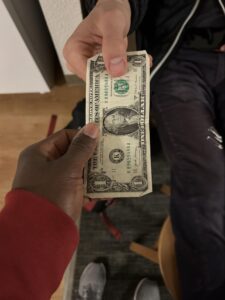
- I recruited my teammate Miles because I knew he was naturally a competitive person (he is a division 1 athlete) and I know he prides himself on how little screen time he has on his phone. I wanted to challenge him to see if he’d be willing to risk a small amount of money for the experiment and to see if he’d follow through and actually pay me if I could beat him. Luckily I did and below is an image of him handing me the dollar bill we bet for the lowest screentime competition we had
Person 3: (Recruited by Anjali)
- I recruited a person studying Earth Systems who is passionate about politics to see if their passion for politics could yield monetary consequences. Furthermore, this person uses their phone a lot watching youtube and netflix and are committed to finding a more sustainable routine to minimize technology overuse.
- For the experiment, I challenged him to not use his phone for a full 30 minutes and do work next to me instead – if he got distracted and pulled out his phone instead of doing work, then he would have to pay me a dollar. Otherwise, I would pay him a dollar. He pulled out his phone in 30 minutes and therefore he paid me a dollar. This showed that people were willing to risk small amounts of money to try and stay focused for short periods of time.
Assumption 2: Emotional Consequences
Person 1 (Recruited by Dorien):
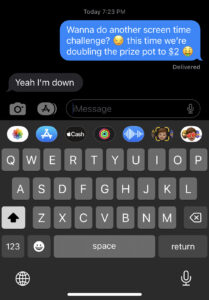
- I chose the same participant from my first study because they lost and had to give me a dollar. He was willing to participate in the screentime challenge again and we were able to duke it out. This time sadly… I lost. Here is a picture below though of the screenshot I took of him responding to my text willing to retry the screentime challenge
Person 2: (Recruited by Anjali)
- I recruited the same participant from the first assumption test and he was willing to try again. This time he was able to stay focused for 40 minutes in order to win the dollar back from me.
Person 3: (Recruited by Ellington)
- I recruited a software engineer who is working at Google Deep mind. He was slightly out of our demographic range but is a recent Stanford grad and so he was still able to help us test our experiment. This user was given slightly modified test conditions to validate the hypothesis. To simulate study time, instead I asked the user a question. I mentioned that every time he answered a question wrong, I would donate $5 to Donald Trump. I also mentioned that he could stop at any time. I would pretend to donate the money after each wrong answer.
- The user answered 3 questions correctly before providing an incorrect answer, which I then pretended to donate money. Afterward, the user wanted to continue playing, which validates our hypothesis that users would be motivated to continue using our app due to the emotional consequences of helping their least favorite political party.
Assumption 3: Political Party Distribution
Person 1: (Recruited by Ji Hong)
- I recruited a senior at Stanford studying CSRE (Comparative Studies in Race and Ethnicity). She fits our demographics as a college student but also provides a unique point of view as a graduating senior also looking for jobs after college. This provides us with insight as to how students who are nearing the end of their college journey manage and distribute their time and retain focus and concentration.
- For this experiment, it was pretty straightforward as we were only tasked with asking how many friends they have with a different political affiliation of their own. This student only managed to list two friends that they have with different political affiliations from themselves. Which works with our metric and also our metric evaluating criteria of having 2 or more friends. Therefore, this student passes this assumption test.
Person 2: (Recruited by Karson)
- I recruited a graduate student at Stanford pursuing a masters in computer science. This user fits our criteria because they fall into the category of someone who frequently uses their phone and also cares about politics. They are in their last year of their masters program and so we will be able to see what types of friends they have and how their political parties differ.
- For this test, there wasn’t much to it besides asking the user how many friends they have with differing political beliefs. This particular person has no friends at school with differing political beliefs but the majority of their friends back home are with the opposing party. In total, they had 3 friends that are of the opposing party.
Person 3: (Recruited by Anjali)
- I recruited a senior who is about to graduate and leads a political organization on campus, which demonstrates his heavy involvement in politics. The fact that they are a senior contributes to the idea that they are likely to have made a solid group of friends over the course of their college years. This user also frequently uses their phone and is trying to establish a healthy relationship with digital technology.
- For the test, the user indicated that they had multiple friends who were affiliated with three political parties that they themselves were not affiliated with. Therefore, they passed the test.
Final Synthesis:
Test #1:
We believed that a person will be willing to risk donating money to an opposing political party.
We observed that over 50% of participants agree to our bet.
From that we learned that people are willing to risk donating money to an opposing political party.
Therefore, we will continue formulating an app that donates money to an opposing political party if the user gets distracted.
Test #2:
We believed that a person would keep working on their screen time even if they lost and had to donate money to the opposing party.
We observed that most participants were willing to play again.
From that we learned that people would keep working on their screen time even if they lost money once to the opposing party in an attempt to get better.
Therefore, we know people will continue using the app even if they end up losing money to the opposing party by getting distracted.
Test #3:
We believed that people have friends who don’t share the same political interests.
We observed that most people have 2 or more friends from opposing political parties.
From that we learned that people are willing to share results with friends and “compete” in a friendly manner with their friends to improve upon staying focused.
Therefore, we know people will be able to share their results with friends with different opinions and compete with people they are close to.



