
Solution: We decided to create an app that focuses on competition against others with screen time and putting political donations at stake. Users are able to sign up in groups or individually, and compete against another team or individual to see who can get the lowest screen time. By the end of the competition, the losing team loses a small amount of money that gets donated to the opposite political party (e.g. $0.50 to the opposite party for losing).
Solution Ideation: In class, we came up with a couple of different potential solutions. One of the ideas our team had was to have a hologram sort of display that displays a flower, tree, or other object. The less time the user spends on their screen, the more their object will evolve and grow. We liked this idea because it gives the user something to look forward to and strive for. Most users would be interested in seeing how their object can evolve and comparing it to others. Because of the fact that it was a hologram, we decided to not go with the idea. We had another similar idea where the phone uses a baby in a womb hologram to incentivize people to not pick up their phone. A branch off of that idea was to use a hologram of a zombie. A different idea we had was a dating app that rewards users with matches based on their screen time. The idea is that if the user is on their phone too much, they won’t receive their matches so it gives them a reason to reduce their screen time. Ultimately, we decided to go with the idea mentioned above which was the political donation app. We made this decision because we liked the feasibility of it as well as the strong motivating factor. We think that most people who are politically leaning towards one side will not want to donate any of their money to the other side and so this is a huge motivating factor for reducing screen time. Additionally, the competition aspect of it will engage users to perform well (low screen time) because they want to earn money for their political party. There are some assumptions that will need to be tested with our idea, but we thought that the driving factors are strong and further exploring the idea would be in our best interest.


Assumption Mapping:
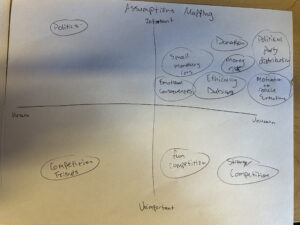
The most crucial assumptions that we will need to test to make sure our app can work is that users are willing to risk money, they are willing to face potential emotional consequences, and that there is a relatively even political party distribution. We highlighted these three assumptions as most important because all of them are assumptions we need to be true for this idea to be feasible. If the user isn’t willing to risk any bit of their money, even a small amount, then there will be no way to successfully motivate them to compete against others and reduce screen time. The outcome of the competition on this app can possibly create emotional distress if the user has to donate to a political party that they are heavily opposed to. We need to test that users are willing to face the potential emotional consequences that can occur from losing a competition. Additionally, it will be important to ensure that even if they are willing to face these consequences, that it is still ethical to execute this idea. Finally, we are assuming that the user base on this app would have a relatively even political party distribution. Ifthis assumption doesn’t hold true, then there might not be enough users on both sides that are willing to compete in order to create competition.
All of the key assumptions that we came up with in our 2×2 can be seen below. There are a lot of unknown important assumptions that we are making but as mentioned above, we chose
risking money, emotional consequences, and political party distribution as the three most important assumptions that need to hold true in order for this app idea to be feasible.
Assumption Tests:
- Risk Money
- Making a $1 bet with someone to hit a target screen time or they have to pay me a dollar and I’ll donate it to the opposite political party
- Step 1: Hypothesis
- We believe that a person will be willing to risk donating money to an opposing political party
- Step 2: Test
- To verify that, we will ask participants to bet a $1 to hit a target screentime goal or we will donate that dollar to the opposing party
- Step 3: Metric
- And measure the amount of participants who are willing to take us on that bet
- Step 4: Criteria
- We are right if we have over 50% of participants agree to our bet
- Emotional Consequences
- Using a participant who lost from the first test and see if they would be interested in playing again
- Step 1: Hypothesis
- We believe that a person would keep working on their screen time even if they lost and had to donate money to the opposing party
- Step 2: Test
- To verify that, we will ask the losing participants from the previous game and ask them if they want to do another bet
- Step 3: Metric
- And measure how many participants are willing to play again
- Step 4: Criteria
- We are right if most if not all are willing to play again
- Political Party Distribution
- Asking participants to list the number of friends they have that don’t share similar political party
- Step 1: Hypothesis
- We believe that people have friends who don’t share the same political interests
- Step 2: Test
- To verify that, we will ask participants to list the friends they have that don’t have the same political affiliation
- Step 3: Metric
- And measure how many friends these participants have that are from a different political party
- Step 4: Criteria
- We are right if they have 2 or more friends from opposing parties



