
Persona:
| Drawing | Name | Samantha |
 |
Activated Role | CS student in senior year of university, planning to go into Software Engineering position |
| Goal | I want to fix my posture | |
| Motivation | I spend a lot of my day sitting (which will continue once I graduate) and I have frequently experience back and neck pain | |
| Conflict | I always try to fix my posture but I end up forgetting, running out of energy, or not caring each time. | |
| Attempts to Solve | I’ve never consciously made a long-term effort that’s lasted. Whenever I remember or see a photo of myself, I end up straightening my back. But these changes go away when I forget or am uncomfortable for a few minutes. | |
| Setting/ Environment | I primarily care about my posture when I’m in a social setting or somewhere where I know people are watching me, like during a meeting or presentation. I try to fix it myself at my desk, but it’s harder to remember and care when I’m by myself. | |
| Tools | I primarily use my chair to help me when I do remember, but other than that, I have no tools. | |
| Skills | I like to workout regularly at least 3 times a week. I also like to stretch and do yoga. | |
| More | Weekday Routines:
Habits: activities that can be done unconsciously
|
When doing our interviews, since our target audience consists of university students who plan to go into sedentary jobs, I saw multiple interviews focus on this type of student: someone who sits and works a lot during the day, but also works out and has a regular routine. One other common trend I noticed is that a lot of people really only fix their posture in public and care whether it’s good in those situations. Otherwise, even when they are in pain, they will ignore it for the sake of work or because they don’t care unless they are really uncomfortable. All of this is to say that people don’t really care too much about their posture – they care more about consequences of their posture (how they are perceived and how much pain they are in). I wanted to highlight all of this in a stereotypical student that has these key traits. I have also highlighted some traits that I think are really key in creating this persona.
Journey Map:
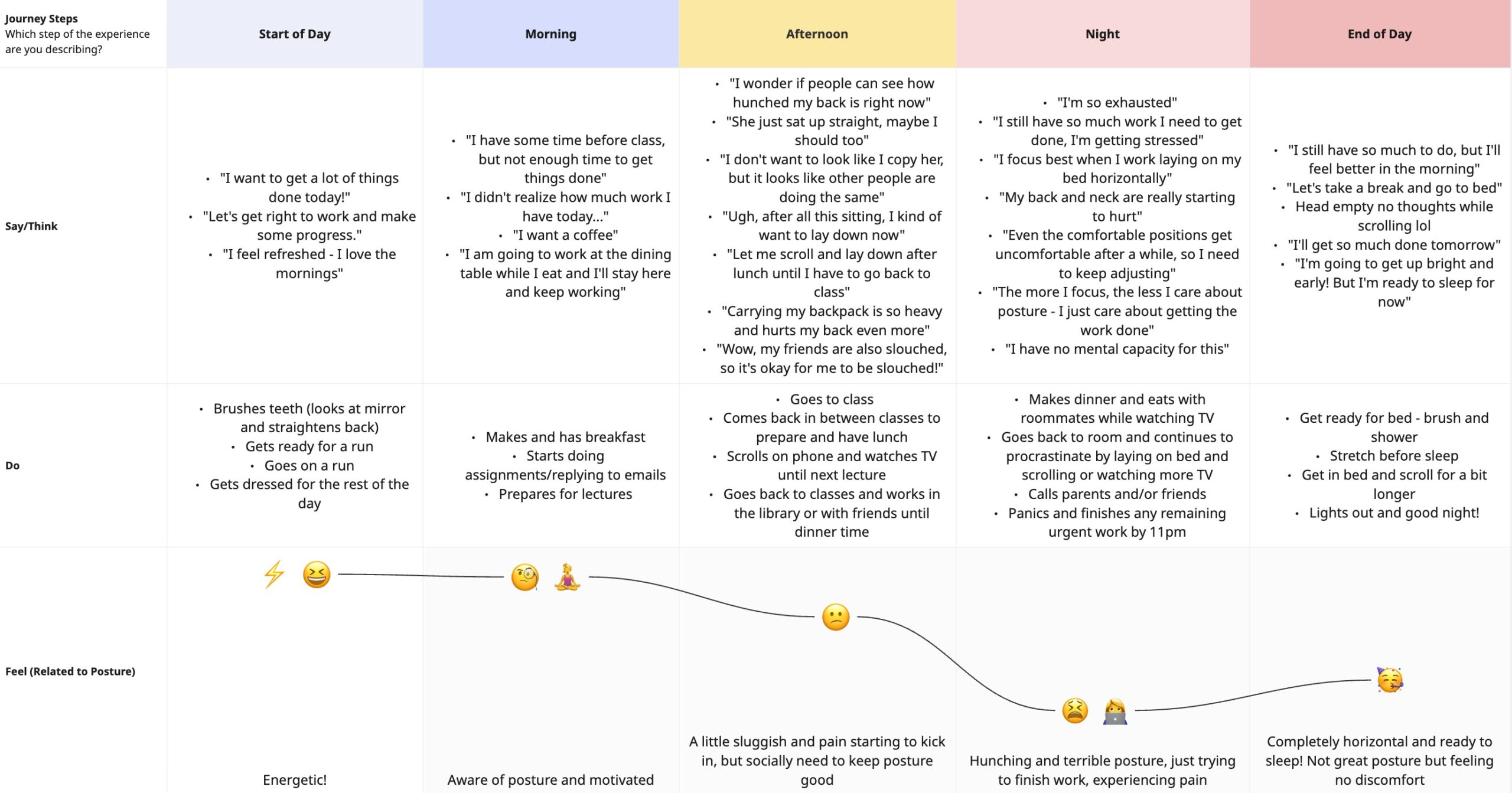
From this journey map, we’re able to see some trends. Samantha is most capable of maintaining good posture in the mornings. It seems that her posture is most connected to her energy level, and since she’s a morning person, we seem to see it most when she is refreshed in the mornings. Although she may not have great posture, this is the time when she’s most motivated to do something about it. Other than this, we also have social situations and when she’s aware of it because of others, but this is when it comes most naturally and effortlessly for her. Going off of this point, it seems like Samantha mostly relies on external motivators as opposed to internal ones when it comes to specifically her posture. Additionally, Samantha seems to be a regular part of her routine and a trigger to remind her to adjust her posture. Overall, this goes to show us that Samantha’s posture correction is associated with reacting to things (like seeing people or feeling pain) as opposed to thinking about posture consistently for the sake of posture. She isn’t able to already go into social situations with good posture or avoid the pain. She cares the least when there are other more important things, which leads me to think it might be easiest to start building a habit at times when she has the headspace to think about it before trying to correct her posture when she doesn’t have the brainspace to think about it (or folding it in with some unsuspecting, random habit like drinking water so it becomes really low-effort to focus on posture).



