
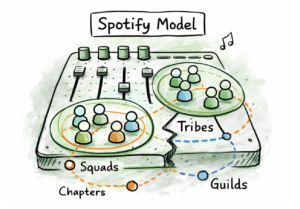
At Spotify, product managers are called product owners and they sit within squads of 6 to 12 people alongside designers and engineers that have end-to-end responsibility for a specific product area. The PO defines what the squad builds and in what
order, and while the squad decides for itself how it works, a tribe lead acts as general manager so PM authority is real but local.
Airbnb went the other way. Chesky moved from business units to a functional org with one roadmap for the whole company. He made designers equal to PMs and merged product management into product marketing. The CEO and design decide what ships, and the PM’s power lies in framing and telling the story rather than owning a backlog.
Zappos adopted holacracy and swapped teams for circles. Lead links assign people to roles but cannot tell the circle how to do its work. There is no PM since whoever holds the role decides.
I think the best model is Spotify. Early in my career, I want a scope small enough to own and outcomes that I can point to. A product owner in a squad sits next to the designers and engineers every day, and that closeness means that I would learn fast and see the direct result of my prioritization calls. On the other hand, Airbnb rewards craft and produces polished launches but gives PMs little leverage unless you are the CEO. With one company roadmap and Chesky reviewing the work himself, a junior PM mostly executes and tells the story of decisions made above them. Zappos provides a little too much freedom. When nobody holds a clear title and authority is spread across hundreds of circles, it becomes hard to know who owns a decision or how to get one made.



