UberCab (2008)
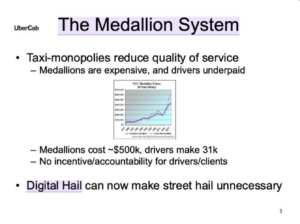
Problems: Slide 3 puts the fault on the medallion system: about $500k per medallion; drivers are underpaid, earning $31k; and a lack of incentive for both drivers and clients.
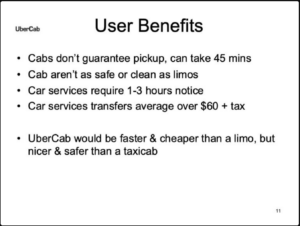
Evidence: Slide 11 depicts proof of the cab issues: cabs taking roughly 45 minutes, car services needing 1-3 hours’ notice, and the average cost over $60. These may be claims as there’s no actual surveys to back them, but the fact that 15 clients already signed up for the UberCab beta program suggests that they are more likely to be true than not.
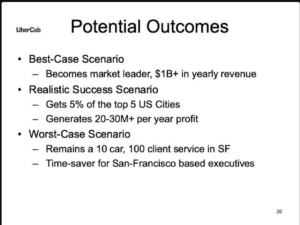
Market: The market is big and fragmented. Slide 17 shows that the top 4 players only hold 22% of revenue. Slide 20 lays out the best, realistic, and worst-case scenarios. It’s amazing to see that in 2026, 18 years later, Uber turned out to be a multi-billion-dollar company instead of a 10-car service in SF.
What an investor would ask:
- What does a ride cost, and what profit do you make per trip?
- Who is eligible to drive, and why would they join UberCab?
- How does 5% of the top 5 cities grow into $ 20- 30 M in profit?
Ideas for Sanity Check:
- Start with the problem
- Include the best, realistic, and worst-case scenarios to back my predictions
- End with a list of current accomplishments.