
Testing Process
To test the assumptions our team created last week, we built a website prototype that we had real participants try out. We split into pairs to test the following assumptions:
- Young working professionals are willing to pay pre-made soup bags in bulk that they can conveniently heat up at home on their own schedule, rather than relying solely on ready-to-eat soup deliveries (Daphne and Evelyn).
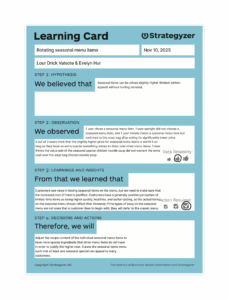
- Seasonal items can be priced slightly higher (limited-edition appeal) without hurting demand (Evelyn and Lour Drick.
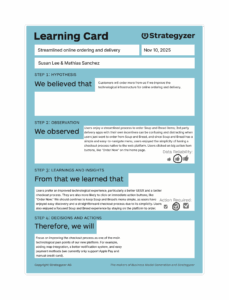
- Customers will order more from us if we improve the technological infrastructure for online ordering and delivery (Susan and Mathias).
A full breakdown of our testing process, findings, and interview transcripts can be found on this document.
Learning Cards

Team Discussion
From our first assumption, we observed that while there was some interest in the pre-made soup bags, users wanted to be able to select soup in smaller servings, which indicates that we were too optimistic in how willing potential customers would be to buying pre-made soup in bulk. Since users were not certain about how much soup they would want to consume in a given period, they wanted to be able to select smaller serving sizes, at least to begin with. Additionally, one user was unclear on the exact concept of the soup bags, which indicates that we need to spend some time clarifying how the soup bags work and what their intended use cases are. Thus, our hypothesis was partially validated by user interest in the soup bags, but it was also partially invalidated by a lack of interest in buying bulk sizes.
From our second assumption, we observed that there was not as much direct interest in the seasonal menu items as anticipated. While two of our three users added a seasonal item to their cart, one of them switched to the pre-made soup bag after comparing costs. Additionally, one user outright did not want a seasonal menu item because neither of the options appealed to them. For the one user that did complete the task flow with the seasonal item in their cart, the increased price compared to classic menu items was not a major point of friction, which validates our hypothesis to an extent. However, another user opted for a pre-made soup bag when comparing costs because the seasonal item did not appear to offer much more value compared to the pre-made soup bag.
From our third assumption, we observed that having a dedicated online platform for ordering did streamline the buying process for customers. Users noted that the simple and straightforward flow to order items contributed to higher conversion to orders, for both online and delivery ordering. These findings did validate our hypothesis.
Next Steps
Regarding our first assumption, we will add further customization to our website to allow for ordering pre-made soup bags in smaller serving sizes. This will better accommodate our users as it is useful for customers who are unsure how much soup they would consume at home. Allowing for smaller serving sizes still lets users buy pre-made soup bags without having to commit to larger order sizes, at least to begin with.
Regarding our second assumption, we will need to take a step back and curate a better rotation of seasonal menu items that differentiates itself from the classic menu in terms of the variety of the food, while also providing additional value to justify the higher costs over the pre-made soup bags. This will require us to consider new ingredients, combinations with bread, etc. that will entice users to order from the seasonal menu.
Regarding our third assumption, we will continue to improve the online ordering platform. One major point of feedback from users was to have an integrated map on the website, which would allow users to determine which store is closest to their location, allowing them to select the correct store for delivery or pickup. Additionally, to support our findings from our first assumption as well, we plan to include options for further customization of more menu items, which will allow users to buy the exact things they want to eat exactly how they want to eat them.



