
Team Soup & Bread split up into 3 teams to test 3 assumptions. For a higher resolution view of our test cards, see this document. (I couldn’t get it to upload any clearer than this, sorry)
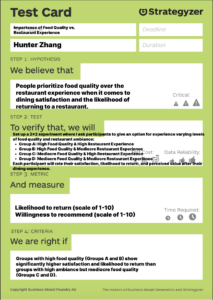
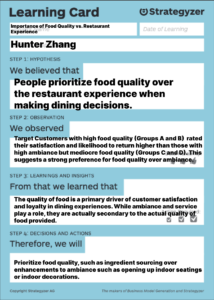
#1 – Food quality vs restaurant experience, conducted by Hunter Zhang
Notes:
“The process of experiment:
I conducted an experiment with my friends who are Bay Area students and professionals—our target demographic. I asked them to list real restaurants they felt matched each group’s characteristics, avoiding repetition to encourage diverse choices.
Then, they rated each restaurant on satisfaction, likelihood to return, recommendation likelihood, and specific ratings for food quality and ambiance.
Finally, participants chose their favorite restaurant and explained why. This process allowed me to compare preferences and identify whether food quality or ambiance had a stronger influence on their dining satisfaction and loyalty.”
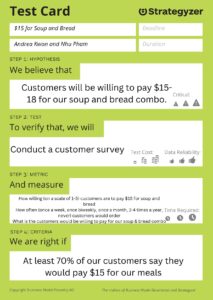
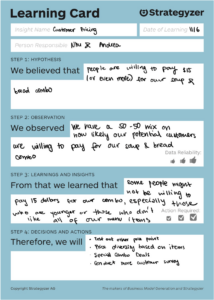
#2 – People are willing to pay $15 for a soup and bread combo, conducted by Andrea Kwon & Nhu Pham
Notes:
“We conducted a customer survey to test our assumption that people are willing to pay $15 (or even more) for our soup & bread combo. We briefed them on what their meal combo would look like, and if they were willing to pay $15 for it on a scale of 1-5. We then asked them what is the most they’re willing to pay, and how often they’d be willing to pay for it. We surveyed a total of 20 people, and from our survey, we found that around 10 people reported that they would be hesitant or not interested in paying $15, and around 10 people were on the side of being more willing to pay the 15 dollars price tag. When asked how much they would be willing to pay for a soup and bread combo, price options ranging from $14 to $16 received slightly higher interest, while there were also mentions of lower price points ranging from $8-$13 came a close second, as well as higher ranges like $18, received less support. The results also brought us some insights based on our customer feedback, such as the fact that they would be more willing to pay for some items rather than others (crab bisque versus chicken noodle soup), or that they would rather pay $11 at Panera for the same combo. From our results, we learned that our results are very 50-50, with some customers willing to pay $15-18, while some are hesitant to. Moving forward, with what we learned from the assumption testing, we plan to refine our pricing strategy to better align with customer expectations and preferences. Specifically, we will explore a tiered pricing model that offers options at different price points based on the type of soup and bread offered. For example, premium soups like crab bisque could be priced higher ($15-$18), while simpler options like chicken noodle soup could be offered at a more competitive price ($11-$14).”
#3 – Customers are attracted to seasonal and limited-edition offerings, conducted by Evy Shen and Winnie Chen

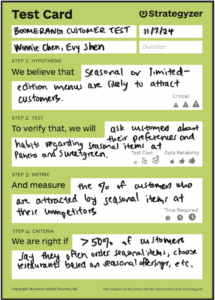
Notes:
“We did the Boomerang experiment where we conducted a customer test on competitors, Panera and Sweetgreen. We measured the interest of customers in seasonal items at Panera and Sweetgreen, asking them if they usually ordered seasonal items there, whether seasonal offerings influenced their decision to dine at those restaurants, what kind of seasonal offerings they enjoy, and how they perceive the value of those seasonal offerings. We found that the majority of customers do not really value or choose seasonal items.”



