
Team Members: Anjali, Dorien, Ellington, Ji Hong, Karson
2-3 Proto Personas:
Dylan (Anjali)
- Deleting social media and now getting distracted by Youtube/Netflix
| Name of persona:
Dylan |
Project | Team name/individual name |
 |
Role: | Senior Undergraduate Student, studying Earth Systems |
| Goal: | Stop watching youtube/netflix so much, avoiding using the phone to procrastinate doing work | |
| Motivation | Get work done faster, spend more time with friends, setting a healthier sleep schedule | |
| Conflict | Feeling anxious about doing work and then watching videos/picking up phone to avoid work | |
| Attempts to Solve | Going on a walk to destress/cope with anxiety and avoid scrolling endlessly/watching youtube | |
| Setting/ Environment | Study room in Columbae/studying outside | |
| Tools | iPhone, friends, walking, biking | |
| Skills | Walking, determination, focused work | |
| Routines | Going to the gym, going on walks, journaling | |
| Habits | Watching netflix/youtube videos |
Karson’s Person A (Pro Golfer)
- Distracted device usage doing an activity that doesn’t involve using an electronic device at all
| Person A | Project:
Distractions from Phones |
Kento |
|
Role: | Professional Golfer |
| Goal | Wants to continue to improve golfing skills – having more time would lead to better performance | |
| Motivation | To perform better in tournaments | |
| Conflict | Trying to continue to get better and be seen by golf associations | |
| Attempts to Solve | Creating a schedule and sticking to it to allocate time efficiently. Trying to quit cold turkey to free up time. | |
| Setting/ Environment | Back home in San Diego area | |
| Tools | Iphone screen time can be reduced, but also used to keep a tight schedule | |
| Skills | Strong discipline when it feels important to him | |
| Routines | Going to the golf course, lifting, playing a round of golf, then practicing on the driving range or putting holes. | |
| Habits | Go on youtube and instagram between and throughout golf practice |
April (Ji Hong)
- Mood contributes to distracted device usage and sleep
| Name of persona: | Project | Code Name: April |
|
Role: | College student, Senior studying engineering |
| Goal | April wants to not take naps during the day and also talking with friends on social media | |
| Motivation | Get more work done during the day and not be distracted by zoning out and her room and resulting in more work for the next day. | |
| Conflict | Sometimes mental health and mood come into play and she needs to take that time to recharge. April has been trying to not let these distractions deter her but sometimes energy levels make it difficult | |
| Attempts to Solve | Doing other things to distract themselves from sleeping or social media but that doesn’t necessarily mean doing the work either. For example, violin, clubs, etc. | |
| Setting/ Environment | Dorm room | |
| Tools | iPhone, friends, other hobbies | |
| Skills | Self-motivation, accountability, drawing, meditation, playing the violin | |
| Routines | Practicing the violin, doing capstone project, going to the gym, participating in clubs | |
| Habits | scrolling social media, listening to music |
Beverly – Ellington’s Persona
| Name of persona: | Project | Beverly |
|
Role: | Masters Student, Marriage & Family Therapy |
| Goal | To spend more time studying for exams and reaching her 3000 hours. | |
| Motivation | To graduate and get her therapy license | |
| Conflict | Gets distracted from Youtube & her animals | |
| Attempts to Solve | Goes to Starbucks to get away, spends more money than she’d like, feels bad about | |
| Setting/ Environment | Dorm room / Starbucks | |
| Tools | iPhone, computer, cat, | |
| Skills | Empathy, Compassion | |
| Routines | Therapy > Gym > Work > Youtube > Sleep | |
| Habits | Youtube |
Journey Maps:
- Dylan’s Map
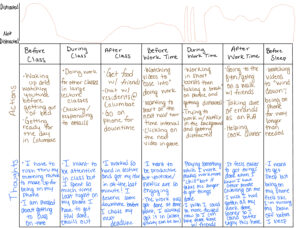
- Golfer’s Map

- April’s Map

Beverly’s Map:
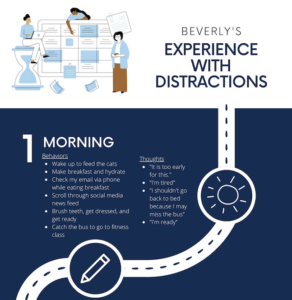
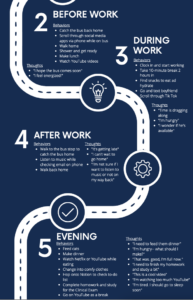
Synthesis Process:
2×2 of comparative research
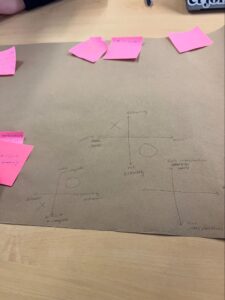
A part of our synthesis process was creating 2×2 charts comparing the tradeoffs of certain implementation methods for interventions with distractions. We discuss the dichotomy between something being a good balance between social/isolating and helpful/distracting. We also looked at ways that’s easy to integrate into people’s lives.
When creating these charts it allows you to think of ideas that are in the sweet spot. We marked that region on our charts with a large “O”. These are ideas that are easy to integrate and aren’t an added distractor to people’s lives. Or are ideas that are social, but not distracting. We marked regions where we didn’t want any ideas to fall with an “X”. These are ideas that are distracting and hard to integrate or aren’t social.
Chunking
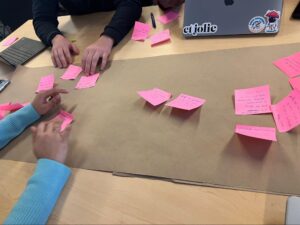
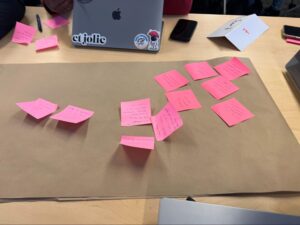
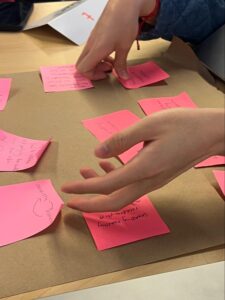

Another way we wanted to chunk our data was by grouping them into different groups. Splitting our data into Primary Research and Secondary Research. This allows us to be able to compare our findings between the different types of research so we can start coming up with patterns with distracting behavior.
Below are a couple examples of things on our sticky notes:
- lots of negative emotionality associated with getting distracted, leads to a negative feedback loop where people are likely to get more distracted
- Screen time isn’t always a good predictor of how distracted people are getting, sometimes people are on their phones for productive reasons (listening to music while working out, notes app, clock app)
- It’s not the screen time itself but distracted screen time we want to target (excessive scrolling, watching video after video)
Mapping To Frameworks

Another great way to synthesize data is to map key insights and quotes to different frameworks of thinking.
We made sure to utilize this technique when we were analyzing our data from our baseline study. The mapping allows us to see patterns in user behavior and sentiments and allows us to better brainstorm interventions that can combat any common themes we found in our study.
Connection Circle
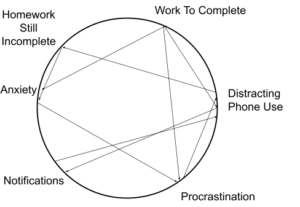
When digging deeper into the data from our participants, we were able to notice a key pattern that we could identify in a connection circle. This pattern of having work to complete and being anxious about it or having a readily available device at their disposal leads to not completing their homework. We saw that our participants procrastinated on their work either because they thought they would be able to still complete their work in time, and/or they were anxious about it and might’ve just not wanted to work on it. This model helped us understand the process that our participants undertake as they aim to complete work throughout the day.
Intervention Study:
Opportunities to introduce interventions:
- Getting started
- Encourage people to start working for 10 minutes
- Nudge people to work for 10 minutes before picking up their phone
- Halfway through
- Get up and stretch, take a walk outside instead of picking up your phone
- Nudge people to
To combat distractions, our team will intervene at the moment when people are starting to do work for something. This is because we often see that people will say they want to start doing work but end up scrolling social media or getting distracted before they actually begin their tasks. We plan to make users start doing work when they say they want to do work. We hypothesize that people who start working right away for about 10 minutes will want to continue to work or stay focused now that they are in a concentrated state.
We made this decision by carefully observing the nuanced behaviors of our users. Many times, our data would report people would be distracted by social media, friends, or other external source but many of the applications we’ve researched in the literature review covers the standard pomodoro or complete distraction blocker. So we wanted to see where a new intervention could pop up and that was when we noticed that people who want to study take a long time to ramp up or have a slow start.
However, this wasn’t the first thing we noticed. As we collected our data, we thought a lot about positive reinforcement or the manipulation-benevolence chart. We had an idea of an instant boot off an app after a user used it for some set time they’ve allotted themselves to be on it. That would be super effective in having a hard stop on the distractor but the difficulty in this is that studying won’t be of the user’s own volition and integrating this on other social applications might have some legal boundaries that might be difficult.
Moving on, we drew inspiration from the Forest, as they use manipulation to convince their users to keep studying. The premise is to grow trees and if you leave the app during the Pomodoro session, the tree will wither and die. You collect different trees to be a part of your forest and thus, the dead tree will be added if you leave the app. This uses manipulation in a good way and it pinpoints the user’s morality and pathos where you either do something and something grows or the opposite and they die. The only con we noticed is that if there’s an emergency that forces you to use your phone, you’ll end up with a withered tree out of your control. Our idea was something similar but more like some wild hypothetical where it’s about elephants rather than trees. Every time you successfully focus and complete tasks, you get elephants onto your farm but failure to do so brings more extreme measures where the ivory tusk gets removed. While this suggestion was more to poke fun at the extremes people can use to force themselves to work, it brings up ethical questions and also how far is too far? So this implementation was trying to have some ethical issue be the crutch of why someone should focus.
Our final idea came in by drawing synthesis from the first two. We realized that humans are more likely to care about something if it affects their social perception or ranking. Therefore, the idea came in a form where your length of focus is dependent on other people in your social circles–almost making it into a competition of sorts. This idea works because you now consider others when it comes to focusing and you’re competing with other groups to see which individual/team can do it for the longest. The cons are if everyone who uses this idea doesn’t really care about competition, it’s hard to make somebody care if that’s the case.
In our intervention study, we will be seeing how strong people’s willpower is. We will remind them at the beginning of the day for one block of time they are studying, try to start studying immediately for ten or fifteen minutes as a way to go straight into a focused zone rather than saying you’re going to study and then wasting time by scrolling TikTok. At the end of the night, we will check in and see if they continued to work after the 10-15 minutes; they stopped after the 10-15 minutes; they didn’t go straight into work and got distracted nonetheless from some external factor. It would be even better if people are studying with each other and they compete and see who goes for a longer time. This way we can see if competition does boost the duration of focus. Ultimately we are looking at two things: one, whether starting right away and working for 10-15 is enough to bring people into the zone when working. And two, if competition with others is enough of an incentive as well.




Comments
Comments are closed.