
Synthesis, Proto-Personas, Journey Maps, and Intervention Idea!
Problem Statement
We are hoping to encourage young adults (particularly college students and new grads) to wear sunscreen more often.
We interviewed 10 college students and new grads about their sunscreen habits and experiences. People have heard that they should put sunscreen on but the word “lazy” is thrown around a lot.
Wearing sunscreen is extremely important for preventing skin cancer and other skin damage from UV exposure. There is a gap between educating people and action taken to actually do skincare prevention.
Synthesis
Affinity Mapping
We first wrote down all of our insights onto post-it notes and grouped them by theme.

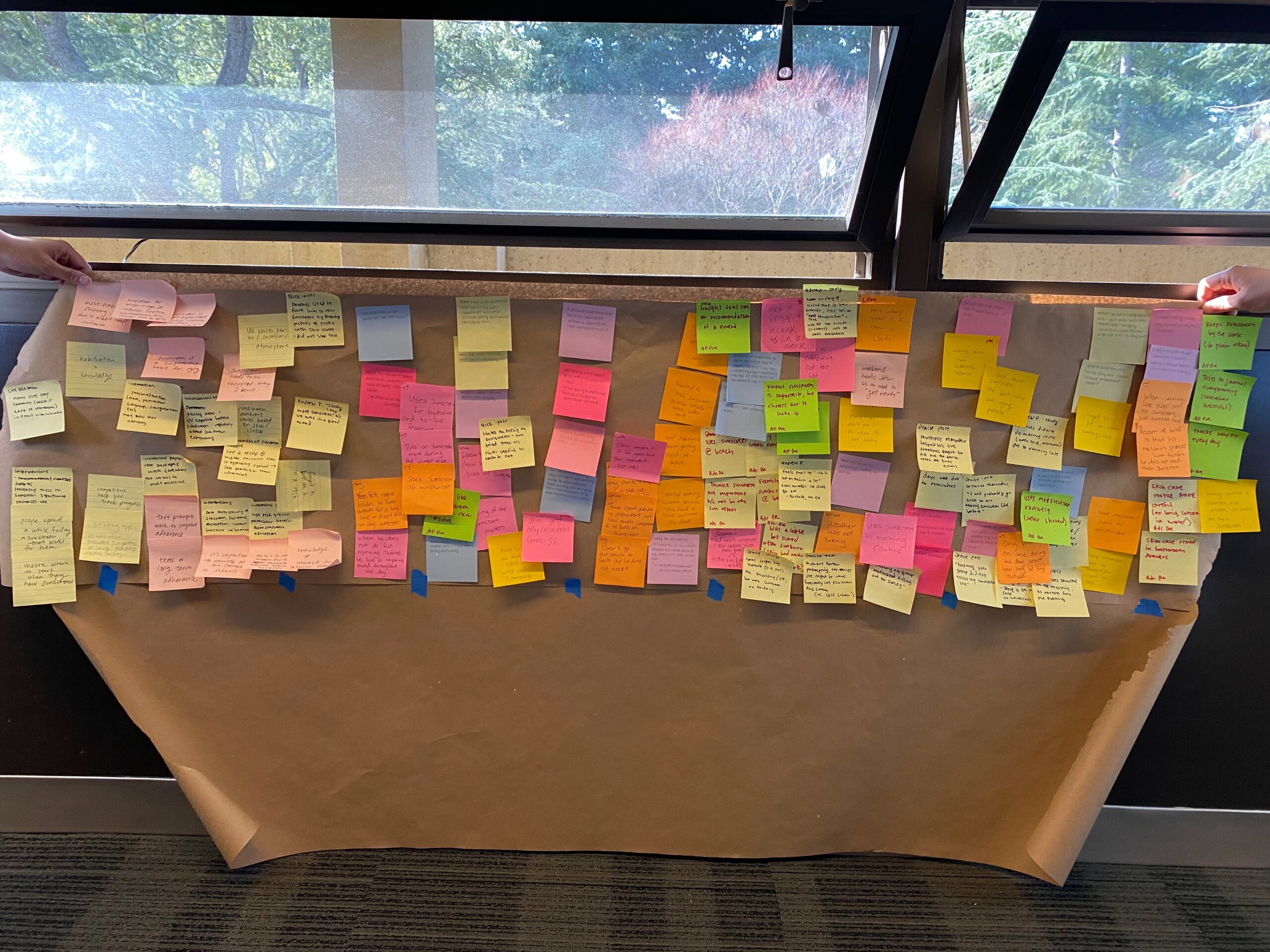
Several themes emerged from the affinity mapping:
- Barriers to entry:
- Sunscreen not part of the morning routine, people were forgetful, or had to rush to get out of the house in the morning
- Peer pressure from people around you
- Family did not make a big deal of sunburn
- Would wear sunscreen if saw friends wearing it
- Integrating sunscreen into things already in morning skincare routine
- The only person who wore sunscreen regularly wore it as a tinted moisturizer
- Weather was a big factor
- Many people felt that if it wasn’t hot outside, there was no need to wear sunscreen
- Negative experience with the sun (i.e. sunburns), led to increased motivation to wear sunscreen)
- Negative skin feel of sunscreen was huge barrier
Frequency Mapping

We then reorganized our insights by frequency.
We see that bad skin feel of sunscreen and weather were the most frequent barriers to wearing sunscreen, but we also saw sizable chunks for how running late affected sunscreen usage, and how social pressure affected sunscreen usage. While it may be hard for us to address the feeling of sunscreen on the skin (this is a problem with the sunscreen itself), there were many opportunities present in addressing environment, social pressure, or lateness as barriers.
2×2 Matrix

We also utilized a 2×2 matrix to sort through our insights. We utilized knowledge-feelings on the horizontal axis, and high effort-low effort on the vertical axis. One insight gained through this was that the decision to wear sunscreen or not was often a very intuitive process for users. Rather than making judgements based on their knowledge of skin care or skin damage, many users made decisions based on the weather that day or at the urging of the people around them (e.g. their friends might suggest a sunscreen to use or tell them that they don’t need to wear sunscreen). We saw that there was a huge gap in low-effort knowledge based actions– this might suggest that education of sunscreen benefits might not be the most effective intervention. This was also backed up by our literature review, which found that knowledge of skin cancer risk factors did not necessarily lead to risk-lowering behaviors.
In our baseline study, we asked participants about their actions before/after putting on sunscreen, daily actions, and anything else that contributed to their sunscreen wearing for the day. We found that the most often reported activities impacting activities were the following (also reflected visually in the connection circle diagram):
- Liked the look and feel
- Disliked look and feel
- Have it next to moisturizer
- Part of their morning routine
- Sunny outside
- Cloudy outside
- Wanting to look more presentable
- Getting reminder
- Pressure from others
- Hearing anecdotal reasons
- Put sunscreen on

From this connection circle we noticed some of the big categories were: weather, being around people, timing, and routine. Overall, weather could decide different actions later down the road, but there were also roadblocks that would completely halt any chance of putting on sunscreen. Some of these were the fact that people didn’t have sunscreen, couldn’t locate their sunscreen, or just didn’t have the time. We decided that it’s harder to change these behaviors that are more out of our control, and we could instead have more impact on building up habits. Our intervention idea decides to lean on the social aspect and create positive behavior change by increasing seeing sunscreen wearing in one’s environment, and tying that into their routine. By choosing to focus on increasing social pressure and habit chaining, sunscreen wearing becomes more integrated and less of a one-off/solo experience.
Another way that we tried to investigate the results from our baseline study was through a fishtail model broken down into four main categories: environment, materials, timing, and routine.

We decided to focus on why people were NOT wearing sunscreen to try and find areas that we could intervene. One big takeaway was that the “materials” category played a foundational role for someone’s sunscreen behavior. If people didn’t like the product or had a negative reaction, this overshadowed motivations to take action. Another big takeaway was that some people’s routines varied based on their day and included some things that could get dropped in a time crunch. This showed that sunscreen or another morning habit are not as valued as they say it is, so somehow the stakes need to be raised.
Proto-Personas
Throughout our baseline interview studies, we identified 3 different proto-personas when it comes to users and their sunscreen-wearing habits. The 3 different proto-personas are outlined below.
Persona 1: The Busy Bee

This group would like to wear sunscreen more, but they have trouble finding time in their day to establish such a habit.
- Role: College students who have packed schedules
- Goal: The Busy Bees want to find a seamless way to incorporate sunscreen into their routine
- Motivation: They know sun protection is important and want to prevent skin damage
- Conflict: They are often in a rush to get out the door in the mornings, and thus struggle to find time to put it on
- Attempts to Solve:
-
- They will sometimes put on sunscreen if they know they’ll be out for a long time
- Keeps their sunscreen by the door, but often forgets to put it on before leaving
- Setting/Environment: The dorms, lecture halls, and outside on campus
- Tools: Phone and other devices on hand that can serve as reminders. They also often have backpacks and notebooks + other school supples. They also often have planners / agendas with them.
- Skills: The ability to dedicate a few days to grow a habit
- Routines:
- They have a skincare routine that they do in the morning, but may skip it depending on if they are running late
- Will walk / bike to class every day
- Habits: They brush their teeth every morning, without fail
- Why We Prioritized This Group: This group is the most accessible to us in terms of finding test participants, and is also the most promising group in terms of wanting to work sunscreen into their daily routine.
 Persona 2: The Reluctant Rhino
They know they should wear sunscreen, but they are reluctant to because they don’t see the importance of wearing sunscreen on a daily basis, especially because it’s hard to see an immediate effect.
- Role: College students who are results-driven
- Goal: The Reluctant Rhino wants to become more educated about why sunscreen is important
- Motivation: They know sun protection is important and want to prevent skin damage
- Conflict:
-
- Doesn’t feel a need to wear sunscreen daily since its an extra step and weather doesn’t seem warm enough to warrant it
- Doesn’t like the look (pasty) and feel (greasy) of sunscreen on the face
- Attempts to Solve:
-
- Friends have attempted to recommend them sunscreens to use before
- Will wear sunscreen for outdoor activities but only if they see other people wearing it (especially if other people have a white cast or greasy face)
- Wears sunscreen at the beach because they see an immediate effect if they don’t (i.e. sunburns)
- Keeps sunscreen by the rest of their skincare in the bathroom
- Setting/Environment: The dorms, lecture halls, and outside on campus
- Tools: Phone and other devices on hand that can serve as reminders; they also often have backpacks and notebooks + other school supples. They also often have planners / agendas with them.
- Routines:
-
- Does their skincare routine after showering
- Will often go to the gym in the mornings on weekdays
- Will bike / walk to class every day
- Habits: They brush their teeth every morning, without fail
- Why We Prioritized This Group: We could have a high impact on this group’s skin health by convincing them to start wearing sunscreen even a little more than what they already do. This group also has the highest barrier to convincing them.
Persona 3: The Working Walrus
This group focuses on young adults in corporate jobs. They are often just going between home and office, but are more out and about on weekends.
- Role: New grad working a corporate job
- Goal: The Working Walruses want to be educated more on why they should wear sunscreen daily even with their low sun exposures.
- Motivation: They know that sunscreen is protective and that they should be wearing it
- Conflict: They are often in a rush to get out the door in the mornings, and most of their weekdays are spent indoors anyways. Some Working Walruses wonder if there is a point to wearing sunscreen when they aren’t outdoors much
- Attempts to Solve:
-
- Some Working Walruses have tried moisturizers with SPF, but still prefer their tried and true moisturizers without SPF
- Will wear sunscreen when outdoors for long periods of time, like when hiking or at the beach
- Setting/Environment: House, office, and outdoors in the city on weekends
- Tools: Phone and other devices on hand that can serve as reminders. They also often have backpacks and notebooks + other school supples. They also often have planners / agendas with them.
- Skills: Sociable, reliable – can be kept accountable
- Routine: Routinely plays sports (like tennis) on the weekends
- Habits: Have a morning routine that is more minimal and a night routine for when they’re getting ready for bed
- Why We Prioritized This Group: This is also an impactful group. New grads will be working years in jobs and different industries, so it’s important for them to develop good habits early. Their routines were also quite different from those of students, so we thought it was important to recognize those differences in a separate persona.
Journey Maps (Full images here)

Some insights we discovered about Barry are that these people are somewhat similar to Wally the working walrus. Meaning when they are both busy they tend to not prioritize things over others. For Barry for instance once he noticed he was running late he prioritized getting a banana to eat which was important to him. However, putting on sunscreen did not serve the same level of importance. There has been a huge theme of sunscreen not holding the same level of importance as other tasks for people, especially busy people.

Some insight that we discovered with the personas who have a reluctant archetype is that they are reluctant when it comes to putting on sunscreen but when it comes to other things like going to the gym they are pretty consistent with that. Another interesting key insight is that even though they have this reluctant attitude they still keep up with checking on the weather outside and make an informed decision whether to put on sunscreen or not based on that. Lastly, feeling like putting on sunscreen as an extra step is evident throughout their decision process because for Riley he felt that it was not needed and didn’t even consider it because it was not sunny outside.

Some insights that were very interesting about Wally is that Wally tends to make excuses for not putting on sunscreen because of work. Being a young adult in the corporate world makes work the number one priority for Wally. A key insight that we discovered is that a lot of times the reason sunscreen was not applied was because they were running late for work. Running late for work meant that sunscreen was not a priority but ensuring they had everything for work and they had their coffee was the main priority.
After reviewing the key insights from our three persons journey maps it helped us understand what is the best way to intercept their routine and encourage them to wear sunscreen. All of the decisions about whether or not they were going to put on sunscreen happened during the morning. This gave us a really great idea of ensuring that our intervention must start in the morning. Also seeing how personas who are busier tend to prioritize different things. This was a very insightful thing to recognize because it allows us to think of ideas to relate the things a person prioritizes to the action we are trying to get them to do which is to wear sunscreen. Our future steps involve tapping into a person’s morning routine and pushing the intervention there to get them to start using sunscreen and seeing the priority in that.
Ideation and Intervention Idea (from 5A)
We brainstormed several ideas based on our past analysis– first, we generated ideas separately. We then discussed as a group which ideas we wanted to move forward with.
Our Top 3 Ideas
- Direct personalized reminder
-
- Send text reminder at a self-reported time where participants are most likely to be getting ready for the day (ideally right after brushing their teeth or showering)
- Supporting data: Firstly, we found in our literature review that text reminders containing information about the weather and then a prompt for the receiver to apply sunscreen was an effective way to improve adherence to sunscreen use. Research from our lit review also showed that personalizations in text messaging, such as using participant’s name and tailoring it to their context can further promote sunscreen use
- Pros:
-
-
- Habit chaining: Our plan was to send this text right after participants wake up and include a personalized prompt to wear sunscreen by leveraging habit chaining. For most participants, the messaging will be tied to brushing teeth, since this is a habit done without fail by all of our participants. For some, especially those who irregularly wear sunscreen after morning gym, the messaging will be tied to shower (so that they are reminded to wear sunscreen after brushing or after shower respectively).
-
-
- Cons (why we decided to not pursue this):
-
-
- User engagement: People may find the daily text reminders to be annoying, leading them to ignore the messages after some days
- High friction: Users need to tell us their daily wake up times which may vary. This opt-in user information causes high friction. Since our participants already have low motivation for daily sunscreen use, this level of effort from them is unlikely
-
- Narrative-based reminders
-
- Each day a user applies sunscreen and shares that information with us (either via text or photos), we send them a part of a story.
- Supporting data: Our Reluctant Rhinos noted intrinsic demotivators with sunscreen, such as with its look (pasty) and feel (greasy). To offset this, we planned on adding an extrinsic motivation in the form of storytelling.
- Pros:
-
-
- User retention: Users may feel the need to see where the story goes
- Positive association: Stories are likely to be memorable and have stronger emotional response and thus users may form a positive association with the stories and sunscreen use.
-
-
- Cons (why we decided to not pursue this):
-
-
- If the user does not empathize with the characters in the story or find it boring, they will quickly abandon this
- Not everyone will like the same story and it will be difficult to find custom stories for different people
- If the snippet is short, there might not be enough incentive to continue another day. If is long, then they might not read it.
-
- Accountability group chat
-
- Create a moderated group chat where we ask group members to post a photo of them wearing sunscreen every morning. It could be their photo or just one with the sunscreen bottle.
- Supporting data: Most participants indicated that the visibility of sunscreen was positively correlated with use. Infrequent users also noted that they applied sunscreen when they saw it in their environment like bedroom/restroom and that it was out of mind when it was out of sight. So this idea is motivated to increase awareness of sunscreen location so that it is salient in their minds. Participants also noted that they sometimes wore sunscreen out of social pressure. In addition, we found that users made decisions about whether or not to wear sunscreen in the morning before heading out for their day, making early morning the best time to remind users.
- Pros:
-
-
- Leverages social accountability when they see others’ uploading pictures
- Improves awareness of where sunscreen is located in their environment
-
-
- Cons:
-
-
- It can seem forced—especially if we fail to create a group where people do not care about each other and thus not feel socially accountable to each other (possible due to lack of an existing friend group to text)
- Potential discomfort with sharing private photos
- Social dynamics might be inaccurate if researchers are in the chat
-
We decided to move forward with the accountability group chat idea.
Of the three ideas, we liked this the most as it not only adds another layer of incentive (social pressure) to wear sunscreen, it also does so in a low-friction way that does not require much effort from the user. Both of these goals are important. Firstly, since Reluctant Rhinos indicated intrinsic demotivators with sunscreen’s look and feel, we needed to add an external motivation in the form of social accountability so that the behavior change is more desired. Being exposed to others who are also trying to improve their sunscreen use habits can give a sense of social support that can be beneficial. Moreover, the activity itself (taking a photo of the bottle or while wearing sunscreen) serves not only as a reminder but also increases spatial awareness of sunscreen location.
Overall, we felt that this idea was most comprehensively suited to address the themes that we found from our process so far. This approach leverages the social aspect to encourage positive behavior change by increasing the visibility of sunscreen usage in the surroundings and integrating it into daily routines. The focus is on enhancing social influence and establishing a habit, making sunscreen application more of a routine practice and less of an isolated event.
Updates to Ideation Based on Feedback:
In 5A, we received feedback that our top three ideas were a little too similar– they all focused on some sort of phone-based reminder. Since 5A, we have ideated a variety of new interventions based on new interviews. From those, we narrowed down to three. A number of insights guided our team’s ideation process. Though we diversified our approaches, we wanted all ideas to include an element of being aware of the user’s sunscreen behavior so that we can determine the effectiveness of our overall idea. We also wanted to ensure each of our ideas was based on different insights so that we could critically evaluate their pros and cons as we plan our future directions, which could leverage some elements of ideas that we abandoned.
For the top 3 ideas, the key insights we grounded them in were making users more educated about sunscreen, finding a way to incorporate sunscreen into busy schedules outside of the morning routine, and using social effects to promote sunscreen use.
Our Top 3 Ideas
-
- Sensor attached to sunscreen bottle cap + Educational nudge
- Create a small add-on for sunscreen bottle cap that sends a timestamp whenever the bottle cap is opened. This data collected by us will be used to nudge users whenever they fall behind (don’t open their sunscreen bottle for a while) by sending them emotionally engaging and entertaining educational content about sun protection. We, however, will not explicitly reminding them to wear sunscreen
- Supporting data: Our Reluctant Rhinos noted intrinsic demotivators with sunscreen, such as with its look (pasty) and feel (greasy). So we wanted to help increase their intrinsic motivation. To do so, we used the insight that they want to be more educated about why sunscreen is important before they are ready to commit to consistent use. In our newer interviews, we also got a feedback that emotion arousal from messaging unrelated to reminders (for example: “It is so nice and sunny today!”) can also promote sunscreen wear.
- Pros:
- Increasing user knowledge on sunscreen
- Might be helpful for those who find reminders annoying
- Knowing that the sensor will “tell on them” might nudge users to open the bottle every once in a while, by which point they might as well apply sunscreen
- Cons (why we decided to not pursue this):
- Given our small budget and the pace of this quarter, this project was not feasible
- Sunscreen bottles come in different forms and not all of them have caps, which necessitates custom design for each type of bottle
- The add-on needs to be recharged after a while, which creates a big friction
- Sunscreen dispenser by swiping Stanford ID card:
- Similar to hand sanitizer dispensers, this idea places sunscreen dispensers at different points on campus with high foot traffic like dining halls. The sunscreen dispenser is activated by swiping the Stanford ID, which is also to keep track of sunscreen application that will be then used by us to automatically generate weekly sunscreen reports sent to their inboxes. Consistent use for 7 days will be rewarded with $7 dollars added to Meal Plan Dollars. This will be a collaboration with R&DE.
- Supporting data: A lot of the Working Walruses we interviewed this week mentioned morning rush as prime reason for not wearing sunscreen. Some of them mentioned that they apply it in the morning but then do not reapply it throughout the day due to not going back to their residences. This group did not show enough incentive to carry a sunscreen in their backpacks so this idea was developed to reduce friction and make sunscreen more salient in the place everyone goes to during lunch: dining hall.
- Pros:
- Reduction of friction: No need to own or carry sunscreen
- Ease of access: It can be accessed while swiping in dining hall
- Always salient: It will be hard to ignore it given it will be on the way
- Meal plan dollar can be a good incentive for Stanford college students to do it consistently
- Cons (why we decided to abandon it):
- R&DE partnership is too lengthy, and this was not feasible to be executed in this quarter
- People, especially those who wear makeup, might not want to apply sunscreen inside a dining hall
- Refilling this will be added workload on dining hall employees
- Sensor attached to sunscreen bottle cap + Educational nudge
- Accountability group chat
-
- Create a moderated group chat where we ask group members to post a photo of them wearing sunscreen every morning. It could be their photo or just one with the sunscreen bottle.
- Supporting data: For Working Walruses and Reluctant Rhinos, sunscreen use ranks low on their daily priority list. So this idea is motivated to increase awareness of sunscreen location so that it is salient in their minds, thereby increasing it in their priority list, which is based on both motivation and effort. We wanted to target motivation as that was underdeveloped in both Working Walruses and Reluctant Rhinos. We saw a room to increase their motivation by providing more sunscreen-related cues in their days than they currently do. As we executed this last week, we got further validation for the social element where people who were not planning to wear sunscreen that day decided to do so because they saw somebody else do it. Initially most participants indicated that the visibility of sunscreen was positively correlated with use. Infrequent users also noted that they applied sunscreen when they saw it in their environment like bedroom/restroom and that it was out of mind when it was out of sight. So this idea is motivated to increase awareness of sunscreen location so that it is salient in their minds. Participants also noted that they sometimes wore sunscreen out of social pressure. In addition, we found that users made decisions about whether or not to wear sunscreen in the morning before heading out for their day, making early morning the best time to remind users.
- Pros:
- Leverages social accountability when they see others’ uploading pictures
- Improves awareness of where sunscreen is located in their environment
- Positive emotional arousal on seeing other people’s photos and messages can also act as a nudge
- Cons:
- Conversations can feel forced—especially if we fail to create a group where people do not care about each other and thus not feel socially accountable to each other (possible due to lack of an existing friend group to text)
- Potential discomfort with sharing private photos
- Social dynamics might be inaccurate if researchers are in the chat
We decided to move forward with the Accountability group chat idea
- Why we decided to pursue this idea:
- Of the three ideas, we initially liked this the most as it not only adds another layer of incentive (social pressure) to wear sunscreen, it also does so in a low-friction way that does not require much effort from the user. Both of these goals are important. Firstly, since Reluctant Rhinos indicated intrinsic demotivators with sunscreen’s look and feel, we needed to add an external motivation in the form of social accountability so that the behavior change is more desired. Being exposed to others who are also trying to improve their sunscreen use habits can give a sense of social support that can be beneficial. Moreover, the activity itself (taking a photo of the bottle or while wearing sunscreen) serves not only as a reminder but also increases spatial awareness of sunscreen location.
- Overall, we felt that this idea was most comprehensively suited to address the themes that we found from our process so far. This approach leverages the social aspect to encourage positive behavior change by increasing the visibility of sunscreen usage in the surroundings and integrating it into daily routines. The focus is on enhancing social influence and establishing a habit, making sunscreen application more of a routine practice and less of an isolated event. Also, this was the most feasible solution given time and cost. When we executed this, we found generally positive results, which further increased our confidence in this.
Intervention Study
For our intervention, we’ve chosen to create a social accountability system through utilizing group chats. Each day, we will ask members of the group chat to send proof of them wearing sunscreen to the group. All participants consented to being part of the group chat ahead of time.
We recruited young adults who are interested in increasing their sunscreen use. 2 of the participants came from our baseline study (the rest were filtered out as being not the right fit or did not want to continue) and 8 of the participants are new. Of these 10 participants, 8 are students and 2 are recent college graduates.
The Plan
In order to simulate the social accountability factor, we plan on adding each participant to a group chat with 2-3 other participants and 2 members of our research team. One member of our team will be the prompter (Wizard of Oz for the “app/computer” itself), and the other member will act as a participant.
We will prompt the participants to introduce themselves to each other on the first day in order to increase familiarity with each other. We hope that this will help increase social accountability. The rest of the study will follow as so:
- Each morning, the prompter in each group chat will send a message around 8:15 AM, saying something like: “This is your reminder to wear sunscreen today! Send a picture of your sunscreen!”
- The other team member in the group will send a photo of them applying sunscreen to further prompt the other participants to act. This also serves as a second reminder.
- We then plan on collecting the information at the end of each day from each participant using this Google form. The form collects questions such as:
- Day of the study
- If the participant wore sunscreen today (Yes/No)
-
- If yes, further context: (when, what prompted you, etc.)
- If no, further explanation: (why not?)
- Morning routine
- When did you go outside
- How did the group chat make you feel
- Any changes to motivation
After the 5-day study is over, we will conduct post-study interviews to further flesh out responses.



