
Our team’s behavior change topic is improving morning routine by reducing phone distractions.
Part 1
Sticky Notes (Simple Ideas)

From our initial brainstorming, we generate 13 ideas that can be categorized into 5 groups: smart devices, social media platforms, extreme barriers to phone usage, reasonable barriers to phone usage, and nudge-based implementations.
Notecards (4 selected ideas)
Smart devices, while can be very effective, are a little out of the scope of the course given the time and resources needed to build them. Social accountability can often be promising in being consistent with good habits. Thus we picked one of the ideas on social media platforms. Extreme barriers can be very undesirable and thus were immediately discarded. A lot of our intervention study users mentioned the distraction created by notifications, so we picked notification manager as another idea to further elaborate. Prior literature showed that tiny barriers often keep people from getting distracted unconsciously. Therefore, we picked the idea of making users wait as well. Finally, we picked another nudge-based idea since nudges are always great tools to build habits.

Paper Concept Sketches
Upon further discussion, we realized that social accountability is an extreme external motivator that is unlikely to perform in the long term. We also noticed that the other three ideas are small enough to be regarded as individual tasks in a larger app. Thus we combined the three ideas to build a design for our final solution.

Part 2
Using the ideas we generated from our sticky notes, notecards, and paper concept sketches, we formulated assumptions about our potential users. We first constructed a venn diagram to classify our ideas by feasibility, desirability, and viability. Then, we created a 2×2 map of our assumptions, labeled by importance and how known these assumptions already are. Our most notable assumptions are important, unknown ones, because they include novel ideas that can generate high value for users.
Venn Diagram (Ideas Mapping)

2×2 Matrix (Assumptions Mapping)

Part 3
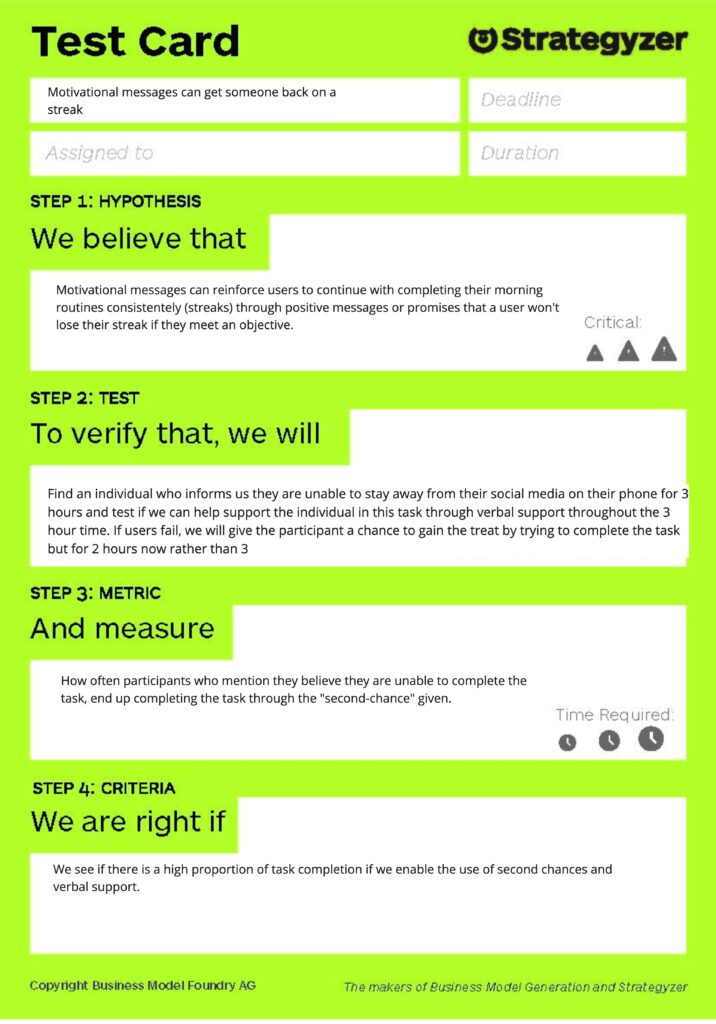
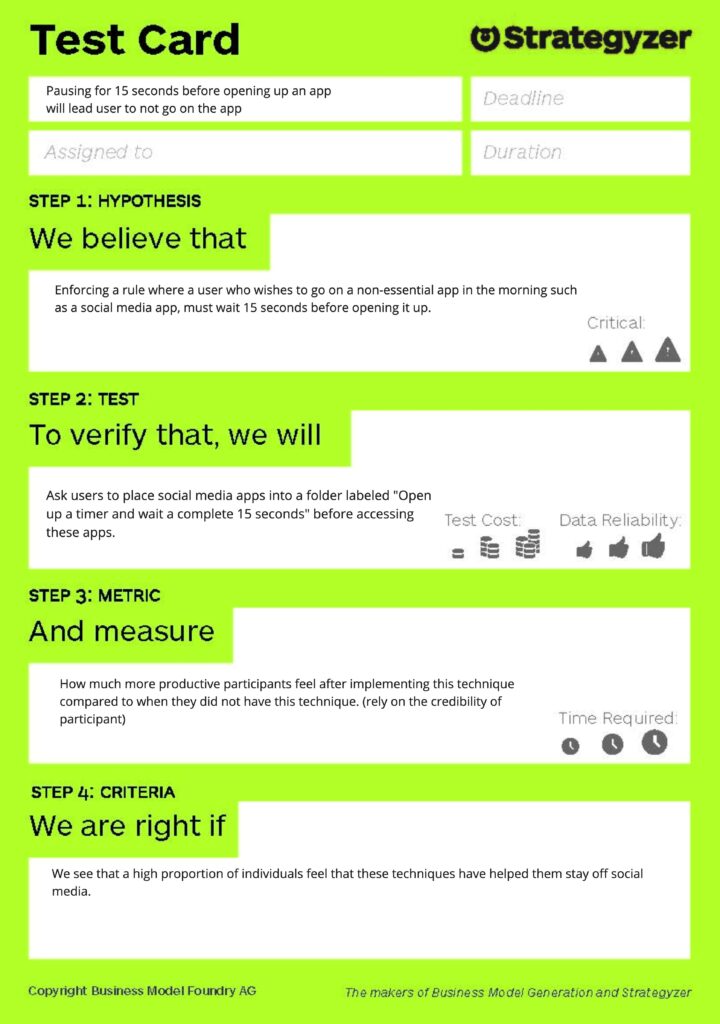
We picked two of the assumptions that fall in the important and unknown quadrant to create assumption tests for – motivational message can encourage someone to get back on track with a streak, and pausing for 15 seconds before going on an app will lead user to not go on the app.




Comments
Comments are closed.