Comparative Research and Analysis
Competitors Overview

*click on image to view clearly*
Helps plans visits outdoors
- AllTrails
- Relive
- The Dog Spot Beach Guide
- OuterSpatial
These competitors encourage people to spend time outdoors by acting as a guide to the outdoors. They help people do outdoor activities by providing information about ideal locations to do said activities.
Strengths
These apps are successful at getting people to spend time outdoors by:
- Lowering the barrier to outdoor activities for newbies by providing a wealth of information provided by local experts
- Utilizing encouraging, enticing language when talking about spending time outdoors which helps create a positive association
Weaknesses
These apps could do better by:
- Reducing the barrier to access the application by removing requirements such as location tracking, notifications, and/or creating an account
More general app for selfcare
- Finch: Self Care Widget Pet
Although this app is more general and broad than the other apps in our comparative review, we felt it was pertinent to include it to explore how apps go about encouraging general habit building. Finch is a self-care virtual companion app that grows every time you accomplish one of your goals.
Strengths
- The virtual companion aspect of the app provides an additional incentive for the user to accomplish their goals and thus, increases motivation.
- The user may develop an attachment to the virtual companion which will encourage repeat usage.
Weaknesses
- The user may feel discouraged from using the app because they may feel shame or guilt for not completing their goals and have to look at their stunted virtual pet.
Primary focus encourage time outside with specific metrics
- 1000HoursOutside
- Fitbit
- NatureDose
Some people are encouraged to build habits by looking at their progress and their experiences as bite-sized, digestible quantified data.
Strengths
- Appeals to users who are into tracking their habits and quantifying their life such as one of our participants.
- Clear, numerical goals can help entice users into spending more time outdoors because they have a solid goal post they can shoot to achieve and rest after.
Weaknesses
- Some users are perfectionists and may stop using the app if they break their usage streak.
- Some users may be turned off by their low numbers and become discouraged.
Gamifies time outside
- The Gruffalo Spotter
- Ingress
- Pokemon Go
The following apps encourage users to spend time outside in nature. They get users to walk around by placing goals at different locations that users have to physically go to in order to gain the rewards. This gamification of the outdoors has become increasingly popular and often utilizes augmented reality (AR) technology.
Strengths
- Gamification helps provide people motivation to spend time outdoors by setting clear goals and rewards.
- Some of the most successful apps in the world are Ingress and Pokemon Go. Apps using this model have proven to be popular and have a loyal following that continue to return to the app.
- Our research shows that people often become bored after just 32 minutes of unstructured, outdoor play time. These applications provide a way to stay engaged and encourage people to use their imagination and get creative with the way they engage with the outdoors.
Weaknesses
- Gamification can be seen as a form of manipulation and a less effective way to help users create a habit because the motivation will always be extrinsic (from the application) instead of intrinsic (from formulating a connection with being outdoors).
- These applications heavily rely on GPS tracking which places a huge drain on users’ smartphones and causes them to delete the application.
- Gameplay can become repetitive quickly and users could become bored.
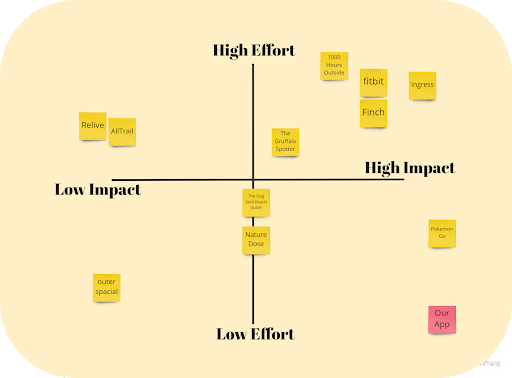
To get some additional sense of the direction we want to head in, we mapped a number of other apps designed to get people outside. The first graph is the breadth of the app’s target audience by how reusable it is, and the second graphs the amount of effort needed on the user’s end to how impactful it is. We found that apps like FitBit, Finch, and Pokemon Go reach a wide audience, are heavily reusable, and are highly impactful towards our end goals. The only issue with these apps is that a number of them require a large amount of effort to get the desired effects. Our goal is for our app to be positioned similarly to Pokemon Go, in the top right of the first graph, and bottom right of the second. Ideally, we would be able to reach an even wider audience and be even more reusable.

Our Product
There are very few established apps whose primary goal is to help users spend more time outside. Apps like Pokemon Go and Ingress are fun games that happen to get users to spend time outside. Apps like FitBit are designed to help users stay fit. And apps like the Dog Spot Beach Guide and AllTrails help users who already go outside to find better locations. 1000HoursOutside is the closest, but it is designed specifically around kids. We want our app to hit the issue much closer to home – giving users more control over their habit formation by allowing them to choose their activities, locations, goals, and even their nudges, anchors, and celebrations.
In terms of the above 2×2’s, our ideal app would be in the top right of the first graph, and the bottom right of the second graph. That would mean the app reaches a wide audience, is reusable and high impact, and requires not a lot of effort. The effort piece is one of the most important yet difficult parts of that equation, since we anticipate a lot of our users being busy and unable to add a high effort habit to their routine. To get around this obstacle, we are hoping to tie usage of our app to other, already in use behaviors, such as calendar management. If our app can be integrated into a user’s existing calendar habits, we can provide that high level of impact and reusability without adding too much additional effort.
Comparator deep dives
AllTrails
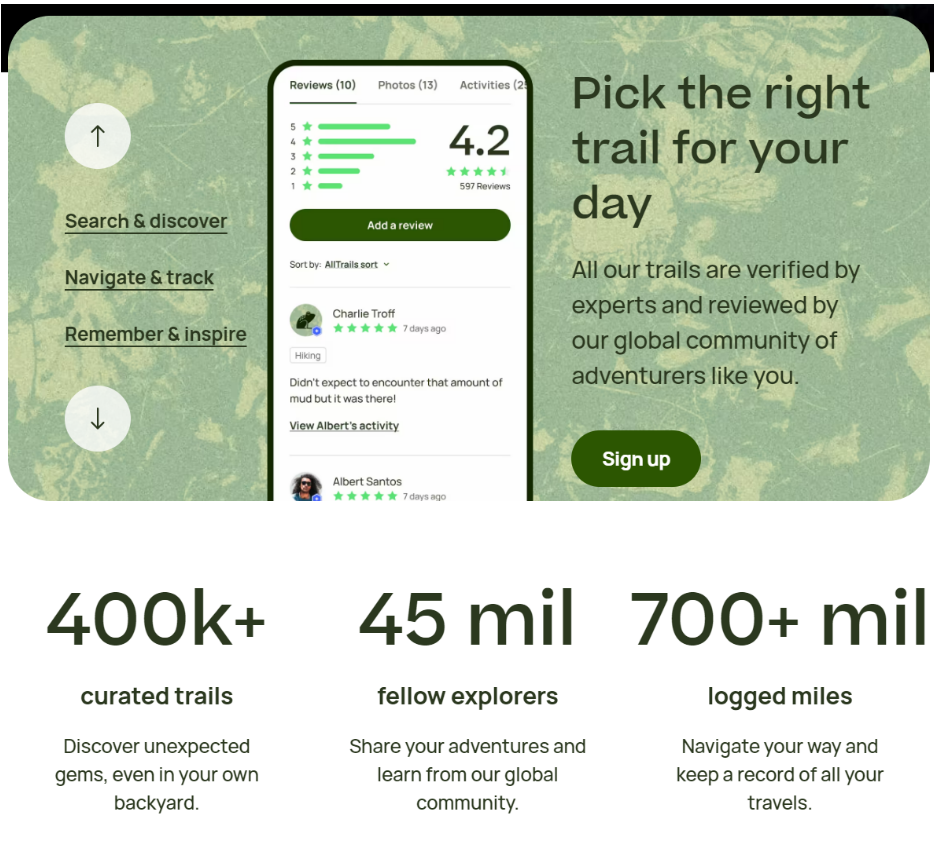
Product description: AllTrails is an online outdoor travel database meant to be used to provide community curated trail maps. Users are able to scan detailed, hand-curated maps, trail reviews and photos from their local community members. Users can explore the outdoors in a guided format and share the experience with their family and friends.
Target Audience: beginning and advanced hikers as well as trail walkers. This encompassess almost all age groups, income labels, ethnicities, and genders
Problem Overview: Inexperienced hikers and trail walkers struggle to find safe trails at their level to explore. The trails could be out of their skill range, no longer in commission, require special equipment, or only available during limited time frames.
Their Solution: With AllTrails, people can view trail maps submitted and up-kept by community members. Users can check trail conditions, read thousands of reviews, view crowd-sourced images and more, enabling more users to have easy access to the outdoors.
Source: alltrails.com
Relive
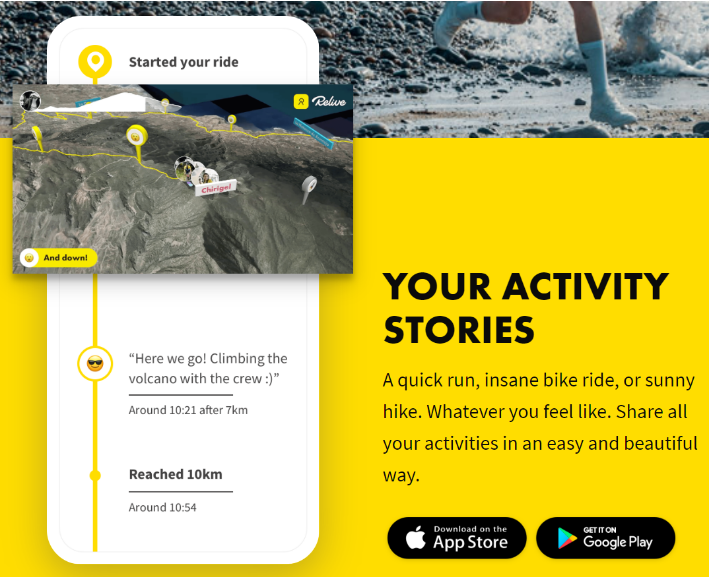
Product description: Relive is a social media-esque app for tracking outdoor recreational activities. Its primary feature that makes it stand out from our activity tracking applications is that it has a “stories” feature where users can attach photos and videos to their outdoor experiences.
Target Audience: Users who want to capture their outdoor memories and share them.
Problem Overview: Users wanted a way to capture memories and share their stories with friends and family after a rewarding, beautiful experience outdoors.
Their Solution: Relive is an app whose main two features are to track your outdoor activities and to share those activities as “stories.” Stories are composed of photos and videos you took during that session.
Source: relive.cc
Finch: Self Care Widget Pet
Product description: Finch is a virtual pet application that grows when you accomplish your self-care goals.
Target Audience: Individuals who struggle with completing self-care goals due to poor mental health.
Problem Overview: Finch was started by two friends who personally struggled with anxiety, depression and self care.
Their Solution: Finch is meant to make self-care fun and accessible in order to help people take care of themselves and build good, positive habits. The user is a “finch guardian” and takes care of a pet finch by completing their goals.

Source: finchcare.com
NatureDose
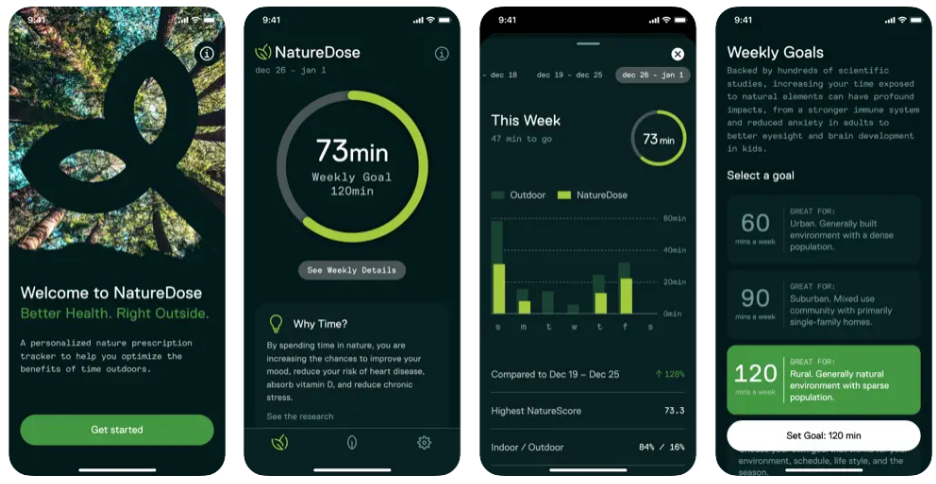
Product description: monitors time people spend inside and outside; allows people to compare time spent inside versus outside, compare daily and weekly statistics; allows people to set weekly targets
Target Audience: People who want to spend more time outside whether they are living in an urban, rural or a suburban area
Problem Overview: Screen addiction is extremely prevalent in our current society, leading people to spend less time outside
Their Solution: Providing people with a tool to set goals regarding going outside and giving them an insight into their habits will encourage them to spend more time outside
Source: NatureDose app
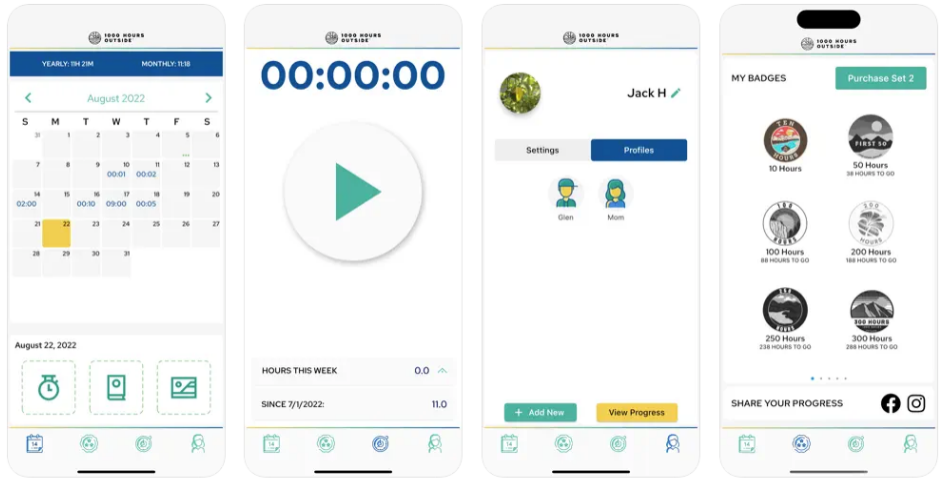
1000 Hours Outside
Product description: keeps a record of how many hours you spend outside
Target Audience: people who want to track time spent outside
Problem Overview: people spend too much time indoors
Their Solution: users can track the time spent outdoors, share their results with their family and earn rewards. This in theory will encourage people to spend more time outdoors
Source: 1000hoursoutside.com
OuterSpatial: Get Outside
Product description: Ensures that people have up to date information about their favorite outdoor places. You can discover new places to camp, hike, off-road, fish, walk your dog, or hang with your family!
Target audience: is people who enjoy public recreational spaces and go there often. Families as well.
Their Solution: to provide any updates necessary and help them find any events they might want to go.

Source: outerspatial.com
Fitbit
Product description: Wearable watch technology that will send you reminders to move, keep track of your steps, and track your exercise
Target Audience: Active people, older people trying to be more active who might be less tech-savvy
Their Solution: Technology that reminds people to move and helps them track how much movement they make throughout the day

Source: fitbit.com
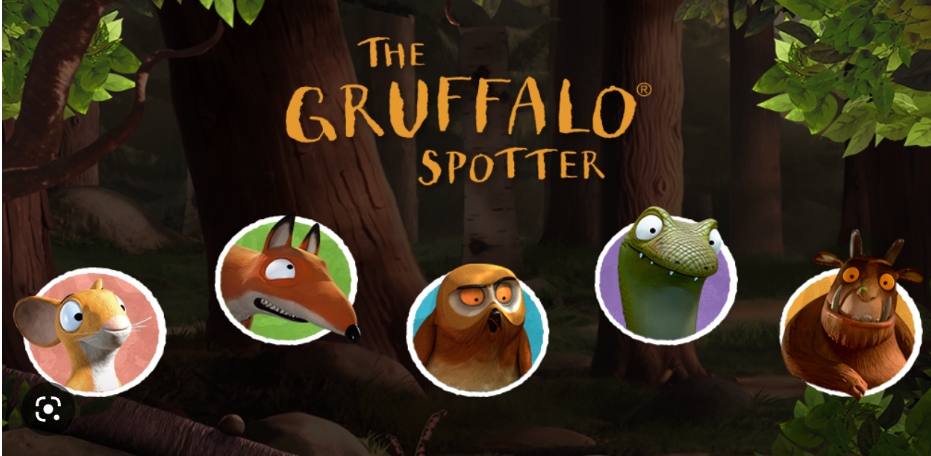
The Gruffalo Spotter
Description: Throughout 26 forested sites in the UK, The Gruffalo Spotter app leads children on a game following clues (such as tracking augmented reality footprints). The augmented reality app gets children and their families excited to spend more time outdoors in the forest!
Target Audience: Children and their families
Problem Overview: National forests have been seeing a decline in visitors and in the digital world families find it increasingly stressful to find ways to enjoy nature together.
Their Solution: make a way for children to get more excited about going to the forests!
Source: Magic Light Pictures
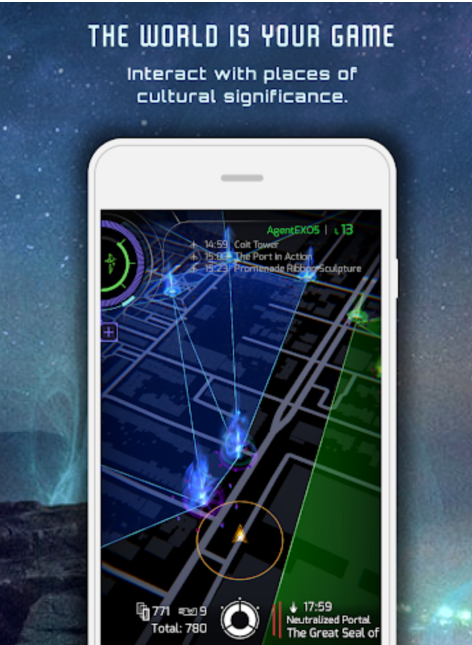
Ingress
Product description: From the company that brought you Pokemon Go (well technically Ingress came first), Ingress is an augmented reality science fiction game that sends users on walks around their neighborhoods to local landmarks. Users either play as the Enlightened or the Resistance, and collect powerups for their factions as they play.
Target Audience: Gamers and science fiction enthusiasts who want to spend more time outside or make more out of the time they spend outside.
Problem Overview: Video games cause people to spend a lot of time inside.
Their Solution: Create a video game designed to be played outside!
Source: ingress.com
The Dog Spot Beach Guide
Product description: Designed to help plan visits to the beach with your dog! It can help with weather, and show certain restrictions at certain beaches. Unfortunately, it only works in the UK.
Target Audience: Dog Owners
Problem Overview: It can be hard to tell which beaches allow dogs, and which don’t
Their Solution: Create a database for beaches that allow dogs, and which beaches enforce which restrictions!

Source: The Dog Spot Beach Guide app